



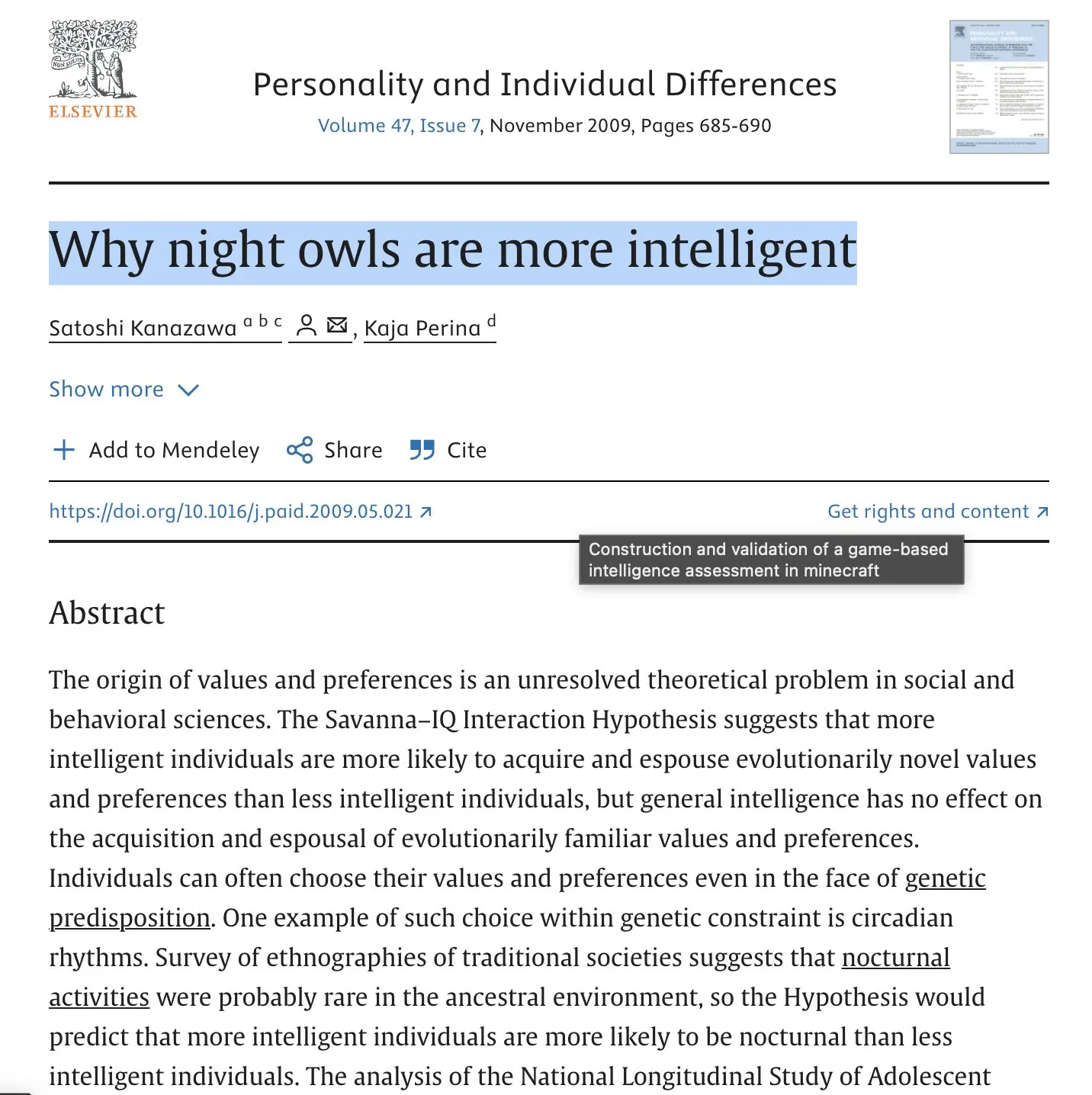
It is an appealing claim, and a comforting one for anyone who stays up by choice. It rests on work attributed to researchers at the London School of Economics, who analysed data from several thousand people to link circadian rhythms to cognitive ability. I wanted to look at what those figures establish, what they only suggest, and what they do not say.
- Researchers at the London School of Economics link a higher IQ to a later bedtime.
- According to the data cited, bedtime is around 11:41 pm for an IQ below 75 and around 1:44 am for an IQ above 125.
- The proposed explanation comes from evolutionary psychology: staying up late would be a recent preference for the human species.
- This is a correlation, which does not prove that going to bed late makes you more intelligent.
- Chronotype also depends on biology, age and imposed schedules.
What the data say
According to the data presented, people with a higher intelligence quotient are significantly more likely to be “night owls”. The gap shows up directly in average bedtime:
- Very low IQ (below 75): bedtime around 11:41 pm
- Average IQ (between 90 and 110): bedtime around 12:10 am
- Very high IQ (above 125): bedtime around 1:44 am, with weekend mornings stretching past 11 am
Between the two extremes, the gap exceeds two hours. It is a little over an hour and a half between the average group and the highest group. The gradient is regular: the higher the IQ, the later the bedtime.
A methodological reminder is useful. IQ is a standardised measure, designed to capture certain aptitudes in reasoning, memory or language. It covers neither creativity, nor judgment, nor social skills. Calling someone “brighter” in a headline is a shortcut I will avoid here.
The evolutionary psychology hypothesis
Why such a link? The authors put forward an explanation drawn from evolutionary psychology, a field that seeks to understand some present-day behaviours in light of the living conditions of our distant ancestors.
The reasoning goes like this. For the vast majority of human history, night was made for sleeping. With no artificial light, there was little to gain from staying awake after dusk, and real risks, notably predators. Staying up late to pursue complex thinking, carry out a project or solve a problem would therefore be an “evolutionarily novel preference”, without precedent in our history as a species.
The argument continues: people with higher general intelligence would be better equipped to depart from ancestral instincts. They would move away more easily from the traditional routine of rising and going to bed with the sun, and adapt more readily to a world that now runs twenty-four hours a day. In this reading, a late bedtime is not a lack of discipline but a sign of greater flexibility in the face of a changed environment.
The hypothesis is elegant. At this stage, it remains an interpretation: the data observe schedules and scores, not mechanisms.
The limits of a correlation
This is where caution is needed, and where I would avoid any hasty conclusion.
Correlation is not causation. Nothing in these figures shows that going to bed late makes you more intelligent. Nor that being more intelligent mechanically pushes you to stay up. A third factor can affect both at once: level of education, type of activity, autonomy in organising one’s time. A person who works on personal projects in the evening does not keep the same rhythm as someone bound by early-morning schedules.
Chronotype is not a pure choice. The preference for morning or evening depends partly on biological factors, including genetics, and it changes with age. Teenagers generally go to bed later than children, and the rhythm then settles back in adulthood. Depending on the population studied and the stage of life at which it is measured, the picture can change.
The size of the effect matters. An average difference in bedtime between groups says nothing about any one individual. Many people with a high IQ get up early, and many night owls have an ordinary IQ. A statistical tendency does not become a personal rule.
The evolutionary explanation is itself debated. This field produces hypotheses that are sometimes hard to test, and its readings of present-day behaviour are regularly challenged by other specialists, who favour social or cultural explanations. I therefore present the argument as a lead, not as established fact.
What other research suggests
The link between chronotype and cognition has been the subject of other studies, with more nuanced conclusions. Several studies associate an evening preference with better results on certain reasoning tests. Others find that morning types often achieve better school results, an effect frequently attributed to schedule regularity and greater conscientiousness. It seems to me that these findings do not contradict each other: they measure different things, cognitive aptitude on one side, success in a system paced by early-morning schedules on the other. I have no recent figures to offer here, and they will need to be checked before going further.
On health, the literature is more consistent on one point: the mismatch between the body clock and social constraints, sometimes called “social jet lag”, is associated with poorer sleep quality and long-term health risks. In other words, the problem may not be going to bed late in itself, but having to get up early when you go to bed late.
Why this matters
Beyond curiosity, this question has practical stakes. It touches on the organisation of work first: as remote work and flexible hours spread, the room given to individual rhythms becomes a management issue. It concerns schools next, where debates about start times, particularly for teenagers, come back regularly. It concerns public health finally, because insufficient sleep has documented effects on attention and well-being, whatever the level of intelligence.
It also questions how we judge behaviour. The saying “the early bird catches the worm” has long praised the discipline of rising early. The data presented turn the proverb on its head with a smile: the night owl, it would seem, gets the highest IQ score. I find the line amusing, but it should not be used to rank ways of life.
A question that remains open
Should we conclude that staying up late makes you more intelligent? No, and the data do not claim it. They describe an association, which the evolutionary hypothesis tries to explain, without a demonstration being available at this stage. The real question, in my view, lies elsewhere: to what extent do our societies let everyone live according to their natural rhythm, and at what cost to each? It is on that ground, more than on the question of IQ, that the subject deserves to be followed.
FAQ
Does going to bed late make you more intelligent?
No. The data show a statistical association between a late bedtime and a higher IQ, not a cause-and-effect link.
What does “night owl” mean?
It is a person whose natural rhythm leads them to go to bed and get up late, as opposed to an “early bird”.
Why is evolutionary psychology invoked?
Because staying up late would be a recent practice on the scale of human history. According to this hypothesis, people with a higher IQ would adapt more easily to this new way of life.
Should I push back my bedtime to get ahead?
Nothing in these data justifies it. Sufficient, regular sleep remains the priority, whatever the schedule.