

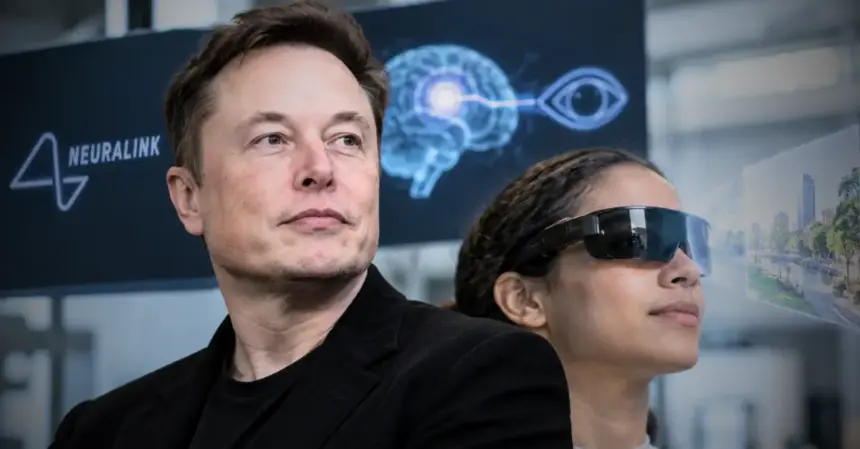
Even someone blind from birth could “see” thanks to signals written directly into the visual cortex. Later, he adds, would come ultra-HD resolution and the ability to perceive infrared, ultraviolet and radar.
To restore sight to people who have never had it would be one of the great medical advances of the century. That is precisely why I think the promise deserves a careful reading: what is established, what remains to be demonstrated, and what the timeline already tells us.
A quote that circulates as news
The first point to clarify is the chronology. These remarks are not recent. They come from an interview Musk gave to Y Combinator in June 2025, in which he said Neuralink would carry out its first vision implants “in the next six to 12 months,” citing a monkey that had worn the device for three years. Several media outlets and accounts recirculated the clip this summer as if it were a fresh announcement.
That nuance changes the reading. The deadline set in June 2025 has now largely passed. To my knowledge, no patient had been implanted as of August 2026, and Neuralink still listed the trial as “upcoming” on its website. Benzinga reported at the time that the first human trial would take place in the United Arab Emirates in 2026, which I have not seen confirmed.
A pitch we have heard before
This is not the first time Musk has promised sight to people blind from birth. In December 2022, at a Neuralink presentation, he already asserted that even someone who had never seen could regain vision, and he set human trials six months out. The first human implant came only in January 2024, more than a year later. In March 2025, he was talking about a first vision implant before the end of the year.
I do not raise this to discredit the project. Delays are common in medicine, where safety takes precedence over speed. But it does invite us to treat Musk’s deadlines as ambitions rather than commitments.
👓 𝗘𝗹𝗼𝗻 𝗠𝘂𝘀𝗸 𝘃𝗲𝘂𝘁 𝗿𝗲𝗻𝗱𝗿𝗲 𝗹𝗮 𝘃𝘂𝗲 𝗮𝘂𝘅 𝗮𝘃𝗲𝘂𝗴𝗹𝗲𝘀, 𝗺𝗲̂𝗺𝗲 𝗱𝗲 𝗻𝗮𝗶𝘀𝘀𝗮𝗻𝗰𝗲 #elonmusk #Neuralink
👉 https://t.co/Rn5iMAEk9l
Une déclaration d’Elon Musk disant que dans les 6 à 12 mois, Neuralink implantera ses premiers dispositifs de vision. pic.twitter.com/SXtHnNGk87— Silicon Valley (@SiliconValleyMa) September 30, 2026
How to restore sight without going through the eyes
The principle is simple to state and formidable to carry out. A camera captures the image and sends it wirelessly to an implant. That implant, an array of microelectrodes placed on the visual cortex by a surgical robot, stimulates groups of neurons. The brain is then supposed to interpret those stimulations as perceptions of light.
The difference from retinal prostheses is that the device bypasses the eye and the optic nerve. That is what makes the approach conceivable for people who have lost both eyes, provided, as Musk himself specifies, that the visual cortex is intact.
What the patient gets is not an image but phosphenes, small points of light. Stimulation of the visual cortex has been studied since the late 1960s. The real challenge is turning it into a stable, useful signal for everyday life.
Key milestones in the Neuralink Blindsight story
Here are the public milestones of Neuralink Blindsight, the project’s name.
- December 2022: Musk first mentions restoring sight, including to people blind from birth.
- September 2024: the US FDA grants Blindsight “breakthrough device” designation.
- March 2025: in Wisconsin, Musk announces a first human implant before the end of 2025.
- June 2025: at Y Combinator, he pushes the deadline to six to twelve months.
- August 2026: no human implant confirmed; the trial is listed as upcoming on the company’s website.
A “breakthrough” designation is neither a marketing authorization nor proof of efficacy. It signals the regulator’s interest in a serious condition without a satisfactory treatment, and it eases communication with the agency. What the public knows about the monkey trials rests, to my knowledge, mostly on statements by the company and its founder.
Voices more cautious than Musk’s
Musk himself tempered his message at the outset: the vision would initially be very low resolution, comparable, in his words, to Atari-era video game graphics. Specialists agree. In late 2024, IEEE Spectrum reported that, measured against the founder’s claims, Blindsight would almost certainly disappoint. Ione Fine, a computational neuroscientist at the University of Washington, judged that Neuralink would build the best cortical implant possible with current technology, producing nothing like normal vision, but with real potential to transform the lives of blind people.
For someone who has never perceived anything, distinguishing a door, a curb or a moving shape would already be a considerable advance. Talking about “ultra-HD,” on the other hand, is speculation.
Restoring sight to people blind from birth, the open question
This is the most delicate point of the promise. The visual cortex of a person blind from birth has not developed like that of someone who has seen: it may have been repurposed for other functions. Nothing establishes, at this stage, that it will respond to stimulation as the cortex of an adult who became blind would, or that the brain will be able to make sense of these signals without ever having learned to see.
How well such learning works is unknown, and it likely requires long rehabilitation. Only rigorous clinical trials, with patients followed over time and results published, can settle the matter. That is why the phrase “you’re going to see” strikes me today as a hypothesis, not a finding.
A field where Neuralink is not alone
Neuralink has real assets: a surgical robot already in use, industrial capacity, and the experience of its first product, Telepathy, implanted since January 2024 in paralyzed patients, including two in Canada in 2025. But vision is a problem of a different order from moving a cursor, given how much information must be conveyed.
The field is also crowded. According to IEEE Spectrum, the Orion project, which came out of Second Sight and was taken over with Cortigent, had already entered a clinical trial by late 2024, while the Prima system, a retinal prosthesis, now belongs to Science, a company led by Max Hodak, a former Neuralink co-founder. At that point, no company had commercialized a cortical visual prosthesis. The story of a lone breakthrough is therefore misleading.
Infrared, ultraviolet, radar, the dream part
That leaves the most spectacular promise. Technically, capturing infrared or ultraviolet is within reach of off-the-shelf sensors, and a radar signal can be converted into an image. The problem is not capture but transmission: the data must be encoded in a language the brain can learn to interpret, with a limited number of stimulation points.
I see three stakes behind this prospect. The first is medical: regulators approve a device to treat a condition, not to “enhance” a healthy person. The second is social: who would have access to such a technology, and at what cost? The third is strategic, since augmented vision would interest defense, navigation and industry, and raises the question of protecting connected neural data.
What I take away
Restoring sight through the cortex rests on a credible scientific bet and an immense need: millions of people live with blindness that nothing cures. The FDA designation shows the regulator takes the subject seriously. But between that recognition and a patient who “sees,” there remain a first implant, published results, an assessment of long-term safety, and then larger trials.
I will therefore keep treating the superpower promises with distance, while closely following any announcement of a first patient. That announcement, not the quote making the rounds, will tell us whether we are witnessing a medical turning point or one more episode of Musk’s optimistic timelines.
FAQ
Can Elon Musk really restore sight to the blind?
Not at this stage. The Blindsight implant is experimental and, to my knowledge, has not yet been placed in a human. Early results would be very low resolution.
Will people blind from birth be able to see?
Musk says so, provided the visual cortex is intact. No public data demonstrates it, and the cortex of someone who has never seen may respond differently.
What is Neuralink Blindsight?
An experimental implant that stimulates the visual cortex to produce perceptions of light, bypassing the eye and optic nerve. The FDA granted it “breakthrough” designation in September 2024.
Will people really see in infrared or radar?
That is a very long-term ambition voiced by Musk and not scientifically validated. Early versions would first aim for very low-resolution vision.