

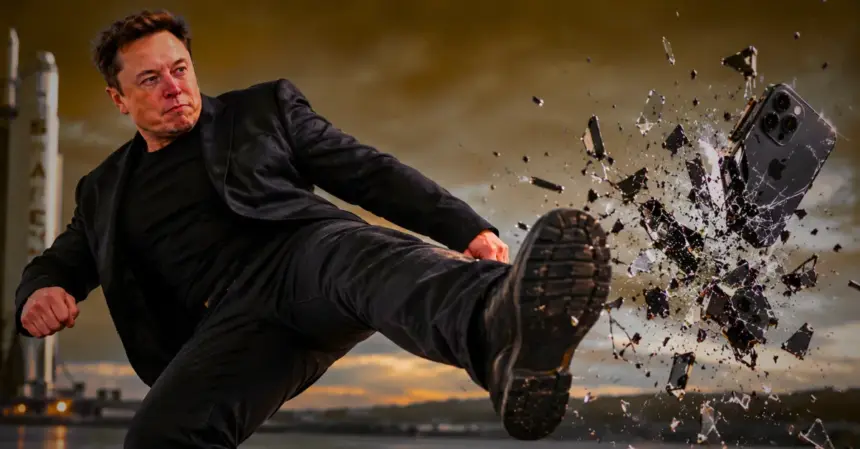
Recently, the head of Tesla, SpaceX and xAI claimed that the phone as we know it, along with apps and operating systems, is bound to disappear within five to six years. I read it with the caution I apply to all of his forecasts, but also with the attention they deserve: behind the punchy line lies a coherent vision of the future of personal computing, and it raises real questions.
Key takeaways
- ✓Elon Musk predicts the traditional phone will disappear within five to six years.
- ✓According to him, there will be no more operating systems or apps.
- ✓The device would only serve as a screen and speaker for AI-generated content.
- ✓This timeline remains a personal estimate, facing technical and regulatory limits.
- ✓The real question is what we will agree to delegate to AI.
What Elon Musk actually said
Let’s go back to his remarks as they were reported, without embellishing them. According to Elon Musk, “we won’t have a phone in the traditional sense,” and what we call a phone today will become “an edge node for AI inference, for AI video inference.”
He adds that in the future there will be no operating systems and no apps: the device will be there only for the screen and the audio. Everything will go through artificial intelligence, which will show the user, again according to him, “anything you can think of,” and even what it can anticipate you might want to see.
The reasoning boils down to one central idea: the phone would stop being a tool you operate and become a surface that receives. In this logic, it “will only display the pixels” and produce only the sounds it anticipates its owner will find most desirable.
The phone as a simple AI terminal
To understand this vision, we need to pause on the expression “edge node.” In computing vocabulary, an edge node is a device located at the end of the chain, close to the user, that performs part of the computation instead of sending everything to remote servers. Inference, for its part, refers to the moment when an already trained AI model produces a response: a text, an image, a video.
In concrete terms, Elon Musk describes a phone whose primary function would no longer be to run programs, but to stream content created by an AI in real time, partly locally and partly in the cloud. The classic interface, with its icons, menus and app stores, would become superfluous. You would no longer open a music, messaging or video app: you would express an intention, or the AI would guess it, and the content would appear.
I find this shift interesting because it does not say the screen disappears. It says that software as we have built it for thirty years, that is, a set of siloed apps, would cease to be the main layer between humans and machines.
📵 Le téléphone n’existera plus selon Elon Musk d’ici quelques années #elonmusk @elonmusk #telephone
👉 https://t.co/nPi5e7QgDc
Il y a des phrases qui, venant d’un dirigeant ordinaire, passeraient pour une provocation de séminaire mais pas venant d’Elon Musk… #AI #smartphone https://t.co/gjpeuSSnTB— Silicon Valley (@SiliconValleyMa) October 6, 2026
A world of AI-generated content
The second part of the statement is perhaps the most structural. Elon Musk believes that most of what people will consume in five or six years, “maybe sooner,” will be AI-generated content: music, videos, and probably much more.
To support his claim, he cites creations made with Grok Imagine, the image and video generation tool developed by xAI, his artificial intelligence company. Some users, he says, have produced videos lasting ten or fifteen minutes that remain “quite coherent.” The argument is worth noting, but I weigh it carefully: the coherence of a video a few minutes long is real progress, yet it does not prove on its own that cinema, series or music videos will be replaced by entirely synthetic streams.
We should also note the commercial dimension. Elon Musk runs a company that sells precisely these technologies. That does not make his forecast wrong, but it invites us to read it as the thesis of a player engaged in the race, not as the observation of a neutral observer.
The key points of Musk’s vision
To keep track, here is the vision summarized as he expressed it:
- the traditional phone disappears in favor of a terminal dedicated to AI;
- operating systems and apps become useless;
- the screen and audio remain the only roles of the device;
- the AI anticipates the user’s wishes and presents content to them;
- most consumption, including music and video, becomes AI-generated content;
- the stated horizon is five to six years, or even less.
Why this announcement matters for the industry
If we take this vision seriously, its economic consequences are considerable. Today’s mobile ecosystem rests on two major operating systems, on app stores that take a commission, and on millions of developers who make a living from this model. A world without apps would upset this balance: who would then control the relationship with the user? Probably whoever owns the AI assistant, not whoever makes the hardware or runs the store.
This is where, in my view, the strategic stake lies. The sector’s major players, from smartphone makers to software giants, are already investing heavily in assistants capable of acting on the user’s behalf instead of simply answering questions. Elon Musk’s statement fits into this trend: that of a battle to become the single interface, the one that would replace all the others.
There is also an advertising and cultural dimension. If an AI decides what appears on your screen based on what it anticipates, the questions of content diversity, dependence on recommendations and transparency of criteria become central. I come back to this point below, because it is the one I find most underestimated.
Reasons to stay cautious
I won’t hide my skepticism about the timeline. Elon Musk is known for technology forecasts whose deadlines have often slipped, notably in autonomous driving. That doesn’t mean the direction is wrong, but that the five-to-six-year horizon should be read as an ambition, not a commitment.
Several concrete obstacles exist. First, computing power and battery life: generating video continuously demands resources that current batteries and chips cannot provide without massive reliance on remote servers, which requires robust networks and abundant energy. Second, usage: most people use their phone for precise, reliable tasks, such as paying, navigating, identifying themselves or communicating. Entrusting these actions to an AI that “anticipates” requires a level of trust that the technology has not yet demonstrated.
The recent history of devices designed as alternatives to the smartphone, those small gadgets equipped with an AI assistant launched in recent years, also reminds us that the public does not easily give up an object it has mastered. The smartphone caught on because it replaced several devices at once, and because its app ecosystem met a very wide range of needs.
Finally, the question of regulation cannot be avoided. A device that constantly generates and selects content raises issues of data protection, copyright and liability in case of error or misleading content, subjects on which authorities, in Europe in particular, remain vigilant.
What this changes for us, the users
Even if the announced deadline seems optimistic, I think the underlying trend deserves to be taken seriously. We already see it: conversational assistants are gradually replacing certain searches and certain apps. We ask an AI for a route, a recommendation or a summary instead of opening several services.
The real question, in my view, is therefore not whether the phone will disappear in 2031, but what we will agree to delegate. A device that displays only what it thinks you would like to receive is, by design, a device that reduces your share of initiative. That can be very comfortable. It can also lock everyone into a bubble of tailor-made content, where surprise, contradiction and discovery become rarer.
For media outlets, creators and website publishers, the challenge will be to stay visible in a universe where users no longer choose their own sources. This is a reflection we must begin now, without waiting for the technology to mature.
An open conclusion
What I take from this statement is less a prophecy than an invitation to look at where personal computing is heading. Elon Musk sketches a future in which the device fades away and AI becomes the sole interface, and he does so with the self-assurance that characterizes him. Between this vision and the reality of usage lies the test of time, networks, batteries, regulation and, above all, user trust.
The question that seems decisive to me is this: when the machine knows better than we do what we want to see, will we still want to choose?
FAQ
Is Elon Musk saying that screens will disappear?
No. According to his remarks, the device would remain there for the screen and audio. It is apps and operating systems that, in his view, would become useless.
What does “edge node for AI inference” mean?
It refers to a device located close to the user that runs, at least in part, the computations that allow an AI to produce text, sound or video.
What timeframe has been announced for this change?
Elon Musk mentions five to six years, or even less. This is a personal estimate that remains to be confirmed.
What is Grok Imagine?
It is the AI image and video generation tool associated with xAI, Elon Musk’s artificial intelligence company, which he cited to illustrate the coherence of some generated videos.