


What retailers still see poorly is the moment before the purchase: what caught the eye, what was ignored, what made a customer hesitate. One company, Auki, claims it can close that blind spot without adding a single piece of equipment. I wanted to understand what that promise covers, and what it raises.
A digital twin built with phones
Auki presents itself as a player in the “real world web”, a software layer meant to make physical space readable by machines. In its public updates from September 2026, the company describes a chain that is simple in principle.
It starts by mapping the venue with smartphones to produce a digital twin: a live virtual representation of the store, with its shelves, products and walkways. According to Auki, this map already serves staff through augmented reality and robots that use it to find their way.
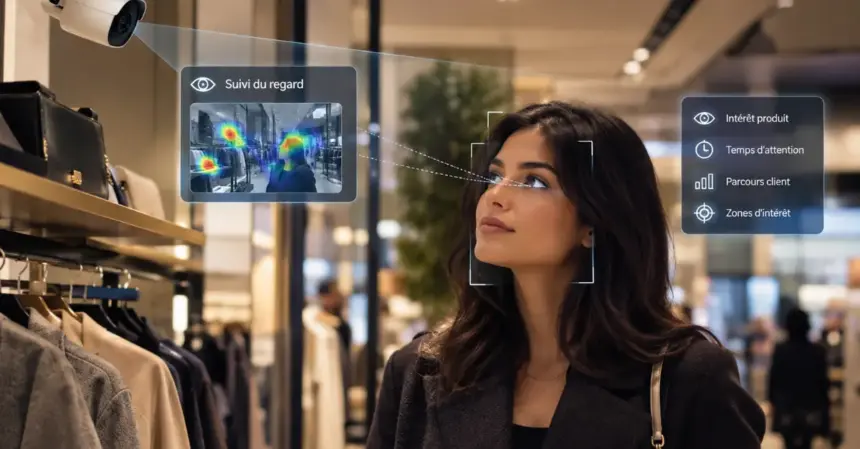
Then comes the step that matters here. The cameras already fixed to the ceiling, whether for security or people counting, are linked to this map. Their images are used to estimate where people stand, which way their heads are turned and therefore where they are looking.
From security camera to attention map
The output is a heatmap: red where eyes linger, blue where they slide past. According to Auki, the map can be viewed by hour, day or month, and tied to the product catalogue so that attention paid to an item can be compared with its sales.
The idea is not new in itself. Computer vision researchers have worked on gaze estimation in commercial settings for years, and eye-tracking tools, whether glasses or webcams, are already used to test packaging or shelf layouts on volunteer panels. What changes is the deployment: no more recruiting participants, but continuously exploiting the feed of infrastructure that already exists.
That is the shift, and it hinges on very little. The physical world had remained more opaque than the web, where every click and reading time has long been measurable. Online, attention is a routine data point. In stores, it may become one too.
📷 𝗟𝗲 𝗺𝗮𝗴𝗮𝘀𝗶𝗻 𝘃𝗶𝗲𝗻𝘁 𝗱’𝗮𝗽𝗽𝗿𝗲𝗻𝗱𝗿𝗲 𝗮̀ 𝘃𝗼𝗶𝗿 𝗼𝘂̀ 𝘀𝗲 𝗽𝗼𝘀𝗲𝗻𝘁 𝗹𝗲𝘀 𝘆𝗲𝘂𝘅 👀
Perchées au plafond, devenues presque invisibles à force de faire partie du décor.#AI #ArtificialIntelligence #ComputerVision #RetailTech #Retail #DigitalTwin pic.twitter.com/7W8Yg4xkrl— Silicon Valley (@SiliconValleyMa) October 2, 2026
Aggregated data, but on what terms
Auki puts one argument at the centre: the system does not say who looked, only what was looked at, in aggregate. Its founder compares the approach to counting cars on a bridge without noting the plates. According to the company, the person never enters the record.
The argument is serious, but it calls for two caveats.
The first concerns when anonymisation happens. To estimate posture and gaze, the system must first analyse an image of a person. That the final result is aggregated does not erase this intermediate processing. In the usual reading of lawyers, data protection law looks at the whole chain, not only at what is stored at the end. The guarantee therefore rests on architecture: where images are processed, for how long, what comes out, and who can verify it.
The second concerns purpose. A camera installed to protect property and people was not put up to measure commercial attention. Redirecting its feed to another use raises the question of purpose limitation, a cardinal principle of European law. Auki acknowledges as much: in its 25 September update, it says the demonstration drew mixed reactions and that legislation and retail inertia weigh more than the appeal of a demo.
What research says about accuracy
A more prosaic question remains: does it work, and how finely? Academic work argues for caution. A 2022 study on gaze estimation in stores, which introduced a dedicated dataset, reports an angular error of about 15 degrees for its best model. At a few metres, a gap like that is enough to confuse two neighbouring products on a shelf.
That study is four years old, and models have improved since. To my knowledge, Auki has not published detailed accuracy figures for its demonstration. Two levels need to be distinguished. To say that an entire display attracts more attention than another, a rough estimate averaged over thousands of passers-by may be enough. To arbitrate between two adjacent items, caution is warranted until the method has been documented and independently evaluated.
The legal framework, first judge of the model
In Europe, the question is especially acute. The GDPR applies as soon as a person can be identified, directly or not, and an image of a person is in principle personal data. Informing customers, assessing proportionality, setting retention periods and honouring the right to object then become concrete matters, which a simple CCTV pictogram does not necessarily cover.
The EU AI Act adds a layer of transparency and bans certain practices, such as inferring emotions in the workplace or in education. In my reading, estimating the direction of a gaze does not fall into those categories, but the line between gaze analysis and interest or emotion analysis is thin, and specialist lawyers will watch it closely.
In Morocco, law 09-08 on the protection of individuals with regard to the processing of personal data, overseen by the CNDP, also governs video surveillance and its secondary uses. No retailer should commit without checking that its installation is compliant.
What retailers can expect
For a retailer, the appeal is twofold: avoiding a new fleet of sensors, and gaining continuous measurement instead of a one-off audit. Auki states that its paid pilots already cover more than 6,500 retail locations, a figure that remains to be documented chain by chain, and a pilot is not a full rollout.
Here are the points that, in my view, will determine adoption:
- the real accuracy of gaze estimation, independently measured
- where images are processed, on site or in the cloud, and how long they are kept
- transparency toward customers and the possibility to object
- compatibility with the existing camera fleet and the product catalogue
- a demonstrated commercial gain, meaning the ability to link attention to sales
A space that learns to respond
If this technology delivers, the store stops being merely a place of sale. It becomes a space that records the attention paid to it, and that could one day adjust a display, move a product or guide an employee accordingly. The line between measurement and nudging is then a fine one.
The debate now opening is not only technical. It is about what customers accept being inferred about them, even without being identified, when they did not ask for it. The answer will depend less on the quality of the algorithms than on the guarantees retailers are willing to make verifiable. Attention, a data point online, will settle in stores only if trust follows.
FAQ
Do stores need to install new cameras to use Auki’s system?
No, according to the company: it relies on cameras already in place, linked to a digital twin of the store built with smartphones.
Does the system identify customers?
Auki says it does not: only the attention paid to products is kept, in aggregate, with no link to a person. That guarantee depends on the technical architecture, which retailers and regulators must verify.
Is it legal in Europe?
It depends on the setup. The GDPR applies to the processing of images of people, with requirements on purpose, information and proportionality. Each deployment must therefore be assessed case by case.
Is gaze tracking accurate?
Academic research reports errors of several degrees in store conditions. The tool is more reliable for aggregated trends than for telling two neighbouring products apart.