
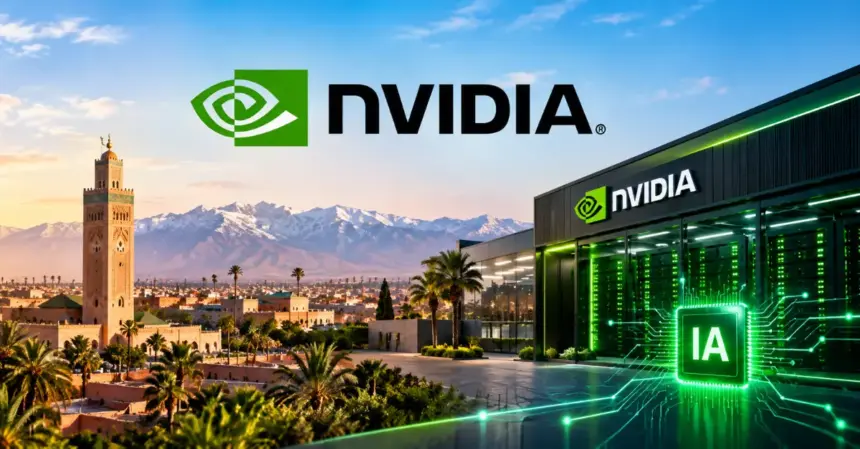
In a blog post published on September 21, Nvidia confirmed two AI infrastructure projects on Moroccan soil. The more prominent of the two, the Nexus AI Factory, is set to rise near Casablanca with an initial investment of $1.2 billion and a target capacity of 500 megawatts. The second project is part of the continental rollout by Cassava Technologies, Nvidia’s first cloud partner in Africa.
These announcements did not come out of nowhere. They confirm and build on commitments made in April at GITEX Africa in Marrakech, where several consortiums had already outlined plans to give the Kingdom sovereign computing capacity. What the Nvidia post changes is the official validation, by the chipmaker itself, of the role it intends to play in both ventures.
Cassava Technologies expands its African data center network
The first project is led by Cassava Technologies, a pan-African technology group described by Nvidia as its first cloud partner on the continent. Having already deployed Nvidia-accelerated computing capacity in South Africa, Cassava plans to extend its network to four additional markets: Morocco, Egypt, Kenya and Nigeria.
The total budget announced for this pan-African program could reach $720 million. Nvidia, however, discloses neither the exact location of the future Moroccan site, nor its power capacity, nor a timeline for its launch. That reticence contrasts sharply with the much more detailed communication around the Nexus AI Factory, suggesting the Moroccan leg of the Cassava program is still at an early, preparatory stage.
The stated goal of these facilities remains consistent across markets: to let local businesses and developers train and run AI models on servers based on the continent, rather than relying on computing capacity hosted in Europe, the United States or the Gulf.
The Nexus AI Factory, a 500-megawatt project near Casablanca
The second project, further along in its public presentation, is the Nexus AI Factory. Announced in April at GITEX Africa in Marrakech, it is to be built in Nouaceur, on the outskirts of Casablanca, in partnership with Morocco’s Ministry of Digital Transition and Administration Reform, its Ministry of Investment, Convergence and Evaluation of Public Policies, and the Moroccan Agency for Investment and Export Development (AMDIE).
The project is led by a consortium bringing together US infrastructure operator Nexus Core Systems, South Korea’s Naver Cloud, expected to operate the platform, and investment firm Lloyd Capital. Nvidia’s role is that of technology supplier, providing its Blackwell-generation processors.
Here are the key figures disclosed for the site:
- Initial investment: $1.2 billion
- Target capacity: 500 megawatts, deployed in phases through 2027
- Technology: Nvidia Blackwell (GB200) processors
- Power supply: renewable energy provided by TAQA Morocco
- Location: Nouaceur, on the outskirts of Casablanca
One methodological point deserves emphasis, as it is often a source of confusion in coverage of this type of announcement: the $1.2 billion figure is not a direct Nvidia investment in Moroccan soil. It corresponds to the initial budget of the Nexus AI Factory project as a whole, to which the American group is supplying its technology without being the project’s primary investor. The distinction matters for accurately gauging the nature of Nvidia’s commitment, which remains, first and foremost, that of a chip and software platform supplier rather than an infrastructure operator.
The choice of Nouaceur is not incidental. The area offers proximity to Europe and direct access to several submarine fiber-optic cables, an advantage for the connectivity and low latency that data center operators look for. The Casablanca-Settat regional council had previously approved the allocation of several hundred hectares to host major industrial projects, including this site.
Why these announcements matter for Morocco
Both projects are part of a broader race among African countries to attract AI-related computing infrastructure. According to several accounts of the April announcement, Morocco was reportedly preferred over South Africa and other candidates on the continent, with investors citing the Kingdom’s political stability, strategic geographic position and existing infrastructure.
The stakes go beyond economic attractiveness alone. Having sovereign computing capacity on national territory is increasingly presented, by governments and industry players alike, as a condition for strategic autonomy at a time when artificial intelligence is spreading across entire sectors of the economy, from healthcare to defense to financial services. For Morocco, which has set an ambition to make AI a pillar of its economy by 2030, these two projects represent a concrete step, even if their full realization will unfold over several years.
That said, the immediate scale of these announcements deserves some nuance. The figures disclosed correspond to initial investments and eventual target capacities, not facilities that are already operational. The Nexus AI Factory rollout is itself planned in stages through 2027, and the Moroccan leg of the Cassava program has, at this stage, no disclosed timeline or size. Direct job creation, often highlighted in this kind of communication, also tends to remain limited in the early phases of such projects, since data centers are capital-intensive infrastructure rather than major employers.
What these announcements suggest going forward
Both projects confirm an underlying trend: major American players in the sector, whether chipmakers or cloud operators, are now seeking African footholds for their AI infrastructure rather than confining themselves to already-saturated markets in Europe and North America. With these two converging announcements backed by Nvidia, Morocco is positioning itself as one of the preferred entry points for this dynamic on the continent.
What remains to be seen is whether these initial commitments will translate, within the announced timelines, into facilities actually going live. The recent history of major digital infrastructure projects, in Africa and elsewhere, shows that the gap between announcement and delivery can be significant. Nvidia’s confirmation is a strong signal, but the real test will play out over the coming years, as the first phases of these sites come online.
FAQ
Is Nvidia directly investing $1.2 billion in Morocco?
No. That figure corresponds to the initial budget of the Nexus AI Factory project as a whole. Nvidia’s role is that of technology supplier, notably its Blackwell processors, not the project’s primary investor.
Where will the Nexus AI Factory be built?
The site is planned for Nouaceur, on the outskirts of Casablanca, an area chosen for its proximity to Europe and access to submarine fiber-optic cables.
What is the difference between the two projects Nvidia announced?
The Nexus AI Factory is a dedicated data center project led by a consortium of Nexus Core Systems, Naver Cloud, Lloyd Capital and Nvidia. The second project is part of the pan-African rollout by Cassava Technologies, Nvidia’s first cloud partner on the continent, which plans computing capacity in Morocco, Egypt, Kenya and Nigeria.
When will these facilities become operational?
The disclosed timeline for the Nexus AI Factory calls for phased deployment through 2027. No timeline has been disclosed for the Moroccan leg of the Cassava Technologies program.