

I read the message from Fahd Laamoumi, the company’s co-founder and managing director, with the interest and caution owed to any industrial announcement not yet confirmed by an independent source. The substance is still worth examining, because it touches on the most discussed weakness of modern guided systems: their dependence on satellite signals.
What BDS is announcing
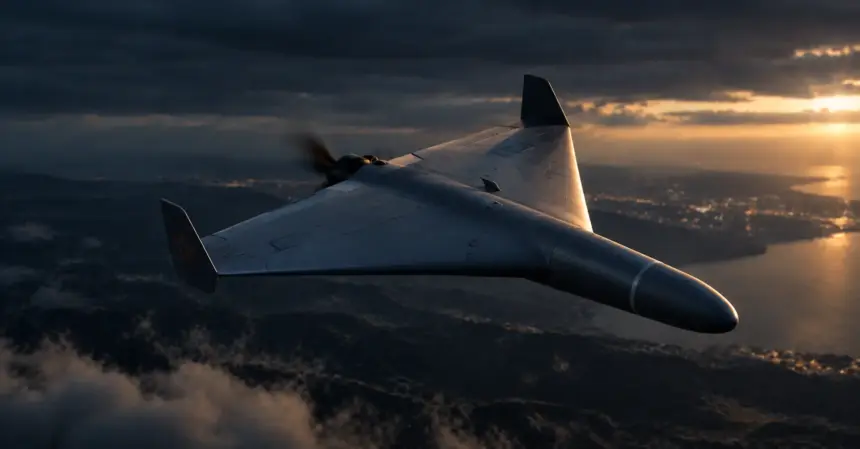
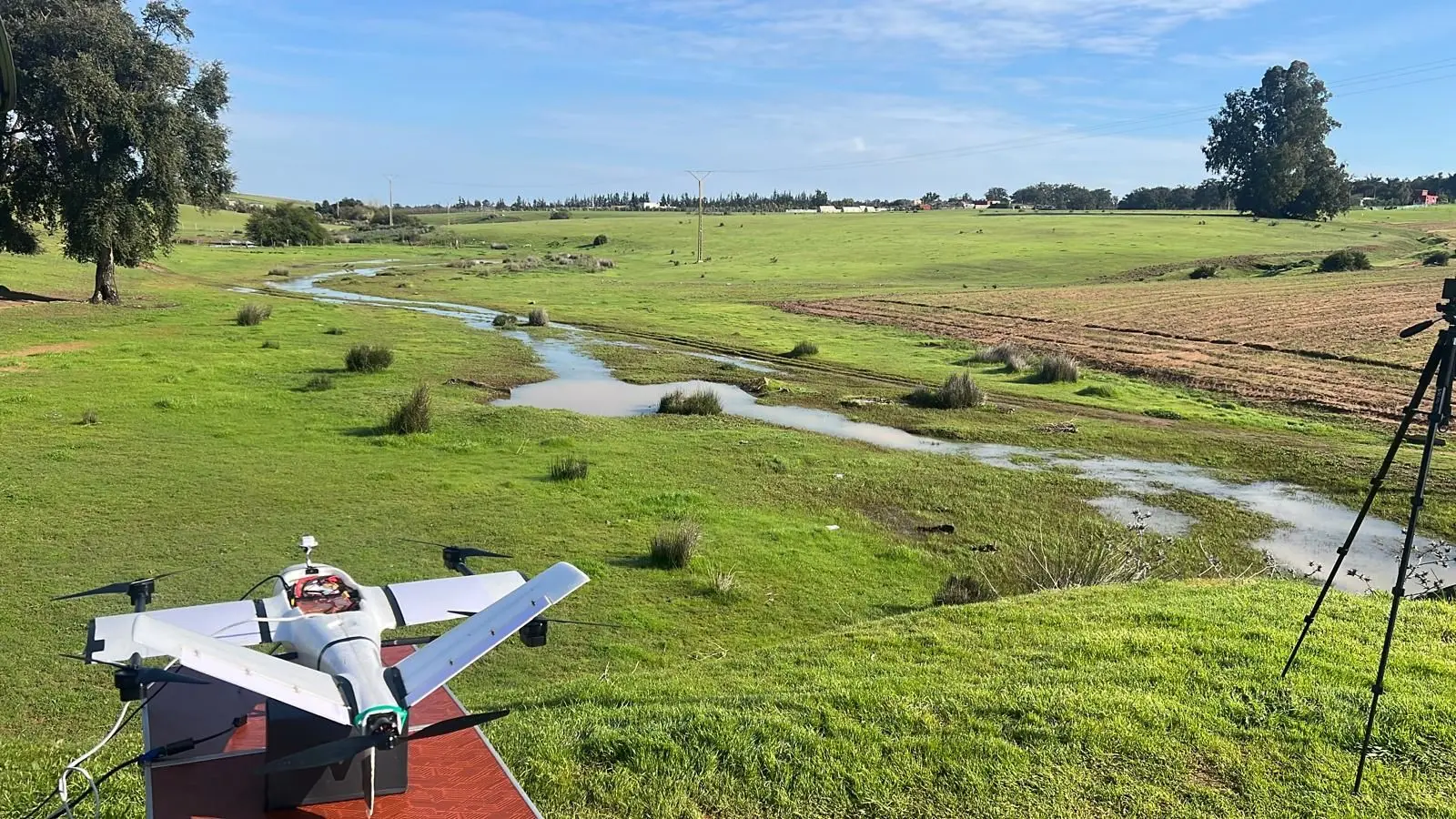
On September 28, 2026, BDS published the first version of its autonomous drone prototype, along with a demonstration video. According to the post, the field trials were successful. A decoy reproducing a launcher of the Russian S-400 air defense system, presented as the “Decoy”, reportedly served to test target recognition and guide the aircraft to its objective. The claimed range reaches 2,000 km.
I want to be clear that these elements come from the company itself. To my knowledge, no Moroccan institution or independent expert has corroborated them at this stage. The Royal Armed Forces have not, for now, made any public comment.
The real subject, a drone that flies without GPS
What strikes me is less the distance than the design philosophy. In its message, BDS explains that it set out to solve a critical weakness: the jamming and spoofing of GPS signals, now common in several theaters of conflict, notably Ukraine and the Middle East. A drone that loses its satellite signal loses its sense of direction and, often, its mission.
The company describes navigation based on reading the terrain. The drone compares what it perceives of the ground with a free worldwide elevation map, much like a pilot who recognizes valleys and ridgelines. All the computing is reportedly done onboard, on a computer “the size of a hand”, with off-the-shelf sensors.
The principle is not new: terrain-correlation navigation has existed for decades, notably on certain cruise missiles. What is newer is its miniaturization and cost. The question I would put to BDS is how the system behaves over flat desert, over the sea, or in poor visibility, where the terrain offers few landmarks. The video alone cannot answer that.
Three AI agents for one mission
BDS describes a three-stage architecture. A first module handles navigation. As the drone approaches the target area, a second artificial intelligence agent searches for the target. A third takes over for the final, high-precision phase. According to the company, the drone “perceives, decides and acts on its own”.
This is the formulation that calls for the most reservations, and not only technical ones. A system that identifies and attacks without supervision raises legal and ethical questions the international community has not settled, in the debate over lethal autonomous weapons systems. I note that BDS does not specify what degree of human control remains in the decision chain. That is a point that needs clarifying.
Figures to handle with caution
Here are the data BDS puts forward in its message, which I report as stated, without validating them:
- prototype developed in under 18 months;
- budget of less than $1.15 million;
- navigation performance presented as comparable to that of far more expensive systems;
- design, code, manufacturing and testing carried out in Morocco, with no outsourcing;
- announced next steps: a live demonstration in real conditions, a new generation of airframe, and a larger team.
The cost-to-performance ratio is the central argument, and also the hardest to verify. A prototype is not a product. Between a demonstrator that passes a filmed test and a reliable system, mass-produced and integrated into a chain of command, there are often several years and budgets of a different order of magnitude.
Why BDS did not come out of nowhere
The company, based in Rabat, is led by Fahd Laamoumi, a Belgian-Moroccan aerospace engineer who studied at ISAE-SUPAERO. In an interview with Yabiladi in November 2024, he already spoke of his ambition to develop autonomous flying robots for defense. At the same time, social media posts mentioned a P1 drone shown at MAS Airshow 2024, with range and precision figures well above those of yesterday’s prototype. Those numbers circulated without official validation, and I cite them as such.
The industrial context is better documented. In recent years Morocco has made a visible effort to build a national defense base. Moroccan and Spanish media report the installation in Benslimane, between Rabat and Casablanca, of the Israeli company BlueBird Aero Systems, with a line of SpyX loitering munitions, and of the Turkish company Baykar. Le360 mentioned in April 2026 ten authorized defense industrial projects, representing about $260 million in investment and more than 2,500 announced direct jobs. The 2026 military budget reached, according to Bladi, a record 14.5 billion dirhams.
In this landscape, BDS occupies a singular niche: a local private player claiming to master its own technology, whereas the major programs rely on foreign technology transfers.
An S-400 decoy, technical message or political signal
The choice of an S-400 launcher decoy as a test target does not strike me as trivial. Technically, it is a recognizable object with a precise visual signature, useful for testing target recognition. Politically, the S-400 is a symbol: according to several open sources, Algeria acquired it, even though Algiers has never publicly detailed its systems. BDS names no country, and I refuse to go further than what the company says.
It is nonetheless worth keeping in mind the regional rivalry and the race for capabilities that has taken hold between Rabat and Algiers. Any announcement of this kind is read through that lens, whatever its authors’ intentions.
What it would change for the FAR, and what remains uncertain
If the announced performance is confirmed, the interest for the Royal Armed Forces would be threefold. First, a long-range, low-cost strike capability that is hard to jam. Second, greater sovereignty, since the data and intellectual property would remain in Morocco. Finally, a knock-on effect on an ecosystem of local engineers and subcontractors.
Skeptics will point to several limits. A test is not an operational campaign. The reliability of AI software in degraded environments remains to be demonstrated. Modern air defenses also know how to detect and shoot down slow, low-radar-signature drones. And nothing indicates, at this stage, that the Moroccan army has placed an order. On that last point, I found no public information.
There is also an export dimension. The company has previously mentioned Morocco’s potential in that area, thanks to its diplomacy. Such a market would however require certifications, licenses and compliance guarantees that the prototype stage does not yet allow us to assess.
An open conclusion
What I take from this announcement is a clear ambition and a real technical subject, satellite-free navigation, which concerns every army. I also take away that the promised demonstration “in real conditions” will be the true test. Until then, caution is in order: the claimed 2,000 km and precision await independent validation. The question now is whether BDS can move from prototype to a reliable system, and whether Morocco will give it the means to do so.
FAQ
What is BDS?
Ballistic Defense System is a defense company based in Rabat, led by Belgian-Moroccan engineer Fahd Laamoumi, specializing in autonomous drones.
Is the drone already in service with the Moroccan army?
Nothing suggests so. BDS speaks of a first-version prototype, and to my knowledge no official order has been made public.
How can a drone fly without GPS?
According to BDS, it compares the terrain it flies over with an onboard elevation map. The method has existed for a long time, but its performance varies depending on the terrain.
Is the 2,000 km range confirmed?
No. It is a statement by the company, with no independent validation to date.