

Morocco is among the thirty partner nations covered by this agreement, alongside European, Asian and Gulf allies. The contract, still modest compared with the several-hundred-million-dollar deals signed in recent months for this same program, is nonetheless worth examining: it illustrates the mechanism, often opaque from the outside, through which Moroccan military capabilities are woven into an industrial and logistical ecosystem largely managed out of Tucson, Arizona.
A contract modification, not a new order
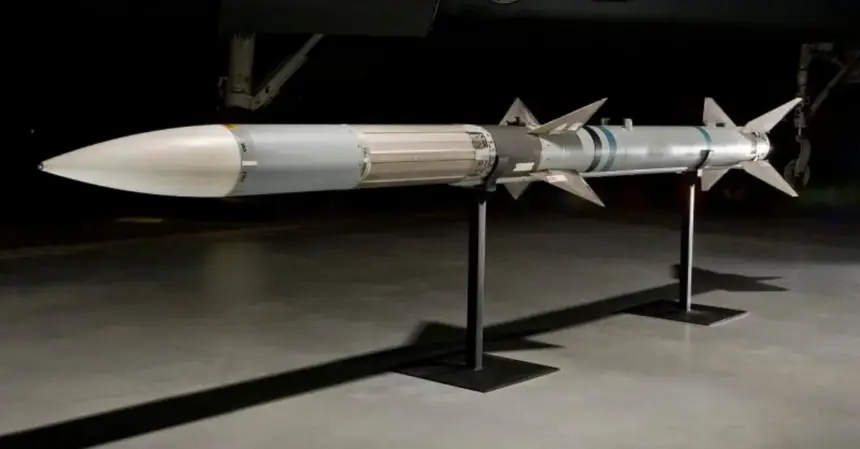
It is worth clarifying the nature of the award first. This is not a new contract in the strict sense, but a firm-fixed-price modification to a previously awarded agreement, covering specifically the purchase of parts for the Advanced Medium-Range Air-to-Air Missile, better known by its acronym AMRAAM. Work will be carried out at Raytheon’s Tucson facilities, with completion expected by August 31, 2027.
The contracting activity falls under the Air Force Lifecycle Management Center, based at Robins Air Force Base, Georgia — the organization responsible for overseeing the lifecycle of Air Force weapons systems, from design through retirement. This is the body that manages, among other things, the pooled AMRAAM production orders intended for both U.S. forces and foreign clients through the Foreign Military Sales, or FMS, program.
Funding for this tranche is split across three distinct sources: $61.5 million from fiscal year 2025 Air Force missile procurement funds, $8.3 million from FY2025 Navy weapons procurement funds, and $35.6 million from pooled FMS funds shared among the partner nations. This breakdown reflects a group-purchase mechanism in which American and foreign orders are merged into a single production lot, allowing unit costs to be reduced for all parties involved.
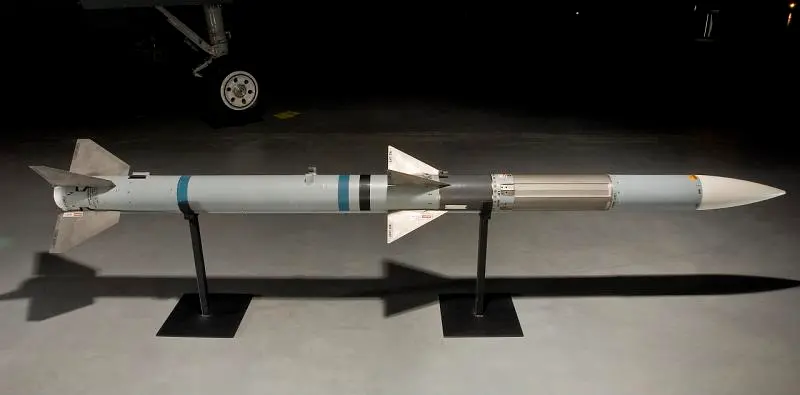
Morocco among thirty FMS clients
The list of countries benefiting from this contract modification is long and heterogeneous, reflecting the scale of the international network built around AMRAAM since it entered service in the late 1980s. The FMS nations covered by this agreement are as follows:
- Argentina, Australia, Belgium, Bulgaria, Canada, Czechia, Denmark, Finland, Germany, Hungary, Israel, Italy, Japan, Kuwait, Lithuania, Morocco, Netherlands, Norway, Poland, South Korea, Saudi Arabia, Singapore, Spain, Sweden, Switzerland, Taiwan, Turkey, United Arab Emirates and United Kingdom
Morocco’s presence on this list is nothing new. The kingdom has long been an AMRAAM user, with variants of the missile equipping the Royal Moroccan Air Force’s F-16 Fighting Falcon fleet. This type of pooled production contract generally does not represent the announcement of a new arms sale in the diplomatic sense — those are subject to separate notifications to the U.S. Congress — but rather the industrial translation of earlier purchase commitments, folded into a continuous production cycle.
One link in a broader chain of contracts
This $105.6 million contract fits into a much larger sequence of announcements concerning the AMRAAM program over the past year. Last June, the Department of War had already awarded Raytheon a $398.7 million contract for design work on the next-generation missile variant, designated D4/C9, an agreement that also included Morocco among the roughly thirty FMS partners involved. Other tranches, ranging from several hundred million to several billion dollars, have punctuated the year to fund production, software modernization, or the extended-range AMRAAM-ER variant.
This accumulation of successive contracts, often of very different sizes, corresponds to the usual operating pattern of major U.S. weapons programs: rather than signing a single multi-year agreement, the Pentagon proceeds through successive batches, adjusted according to annual budget needs and cumulative demand from FMS clients. For a country like Morocco, this means its name resurfaces regularly in Department of War announcements without this necessarily reflecting an intensification of its purchases — most often, it is simply the continuation of commitments made years earlier.
Why this kind of deal matters for Morocco
The value of tracking these announcements, seemingly technical and repetitive as they are, lies in what they reveal about Morocco’s place within North Africa’s air defense architecture. The kingdom has made fighter fleet modernization a consistent pillar of its defense policy since the early 2010s, through the acquisition and subsequent upgrading of its F-16s, the platform for which AMRAAM serves as the reference air-to-air armament.
Maintaining a steady flow of munitions, spare parts and software updates directly conditions the operational readiness of that fleet. In a regional context marked by an arms race with Algeria, which has diversified its suppliers between Russia and China, the reliability of the American supply chain remains a strategic parameter for Rabat. These modification contracts, even when they involve relatively modest sums by the scale of the U.S. defense budget, guarantee the continuity of this supplier-client relationship over the long term.
That said, the scope of the information should be qualified: the Department of War’s announcement specifies neither the volume of missiles or components allocated specifically to Morocco, nor the exact share of funding it receives within the shared $35.6 million FMS envelope. This opacity is standard for this type of announcement, which favors a consolidated reading of the contract over a country-by-country breakdown.
Outlook
As the August 2027 deadline approaches, it will be worth watching whether further contractual tranches are added, as has happened repeatedly since 2023 for the AMRAAM program. The ramp-up of the D4/C9 variant, whose design work began this year, could also translate into production orders in the coming years, with Moroccan participation likely to continue given the longevity of its relationship with the program. Whether this continuity will eventually be accompanied by a more visible diversification of Moroccan air-to-air capabilities remains an open question, at a time when several regional powers are investing heavily in their air defense systems.
FAQ
Does this contract represent a new arms sale to Morocco?
No. It is a modification to a pooled production contract between the U.S. Air Force and its FMS clients, not a separate sale notification to Congress.
What is the exact amount allocated to Morocco under this contract?
The official announcement does not break down funding by country; only the overall $35.6 million FMS envelope, shared among the thirty foreign clients, is disclosed.
Which Moroccan aircraft use the AMRAAM missile?
The Royal Moroccan Air Force’s F-16 Fighting Falcon fleet is the main Moroccan platform equipped with this air-to-air missile.
Is this contract linked to the $398.7 million deal announced in June?
It is a separate agreement, but both fall under the same AMRAAM program and include Morocco among their FMS beneficiaries.