

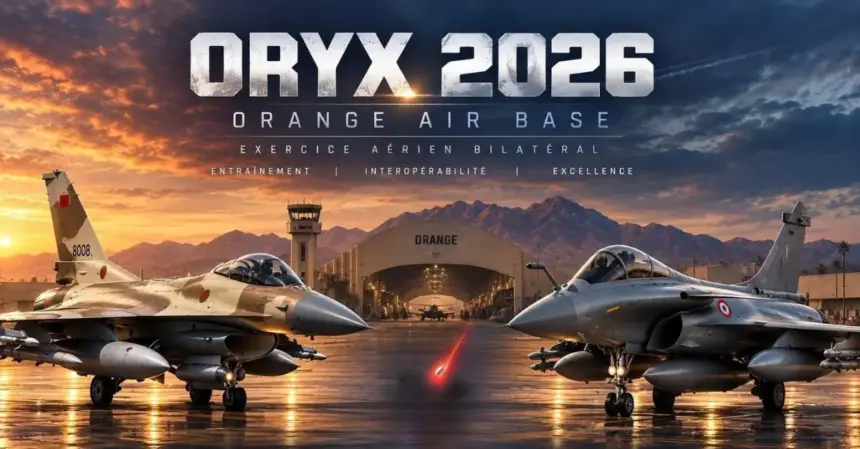
This Sunday afternoon, local time, four F-16 fighter jets from the Royal Moroccan Air Force (RMAF) were expected to land at Orange-Caritat Air Base 115, in the Vaucluse department, accompanied by a C-130H transport aircraft. According to specialized Moroccan military sources, notably relayed by the FAR-Maroc forum and several accounts closely following Royal Armed Forces news, this would mark the first time Moroccan F-16s have set foot on French soil for a joint exercise since the Kingdom acquired them. The information has not yet been officially confirmed by either the French Ministry of the Armed Forces or the Moroccan general staff, but it fits into a pattern of military rapprochement that has already been widely documented between the two countries.
An exercise that reverses the direction of the last air rapprochement
The arrival of these aircraft at Orange is not an isolated gesture. In June 2025, an exercise named Marathon 25 already brought together, this time on Moroccan soil, eight RMAF F-16s and five French Rafale B fighters from the 4th Fighter Wing, accompanied by an A330 MRTT Phénix refueling aircraft and Puma helicopters assigned to transport and medical evacuation missions. That exercise had been presented by the French Air and Space Force as a meeting centered on knowledge-sharing and building crew proficiency.
ORYX26 is, in a sense, the mirror image of that earlier encounter. This time it is Moroccan pilots crossing the Mediterranean to train against the Rafale jets of Fighter Squadron 1/5 Vendée, a unit permanently based at Orange. For the Moroccan fighter force, whose engagement doctrine and training habits remain largely structured around the F-16, going up against a more advanced aircraft like the Rafale, in a real training environment on the operator’s own territory, represents a rare comparative exercise much sought after by military planners.
Orange, a training ground accustomed to international cooperation
Orange-Caritat Air Base 115 was not chosen at random. Equipped with a single runway of more than 2,400 meters, it permanently hosts Fighter Squadron 1/5 Vendée, flying the Rafale, as well as Fighter Squadron 2/5 Île-de-France on Mirage 2000B. Its location in southeastern France, close to extensive air training zones over Provence and the Alps, makes it one of the French Air and Space Force’s preferred platforms for hosting foreign detachments and conducting bilateral air combat exercises.
This logistical choice also confirms an underlying trend observed for several months: the growing frequency of Franco-Moroccan bilateral exercises, which are no longer limited to one-off encounters but are settling into a regular calendar, alternating host locations between the two shores of the Mediterranean.
What is known about the deployed force
The information available at this stage, coming mainly from specialized military sources tracking Royal Moroccan Air Force news, outlines the following elements of the exercise:
- Four Moroccan F-16 fighters and one C-130H transport aircraft were expected to arrive at Orange base on Sunday afternoon
- The exercise pairs these aircraft with the Rafale jets of Fighter Squadron 1/5 Vendée, permanently based there
- It follows on from exercise Marathon 25, conducted in June 2025 in Morocco in the opposite direction
- Neither the precise schedule of the exercise’s phases nor its total duration has been officially disclosed to date
These details should be treated with caution until confirmed through an official statement from the French Ministry of the Armed Forces or the Moroccan Royal Armed Forces general staff, which typically publish a summary once an exercise concludes, as was the case with Marathon 25.
A military partnership accelerating on multiple fronts
ORYX26 does not occur in a diplomatic vacuum. It comes as Morocco has been taking part, since February 8, in Orion 26, one of the largest joint-force exercises held in Europe in recent years. Led by France and involving more than 12,000 troops from twenty-four partner nations, several of them NATO members, this exercise notably saw the Moroccan frigate Mohammed VI join the French carrier strike group built around the aircraft carrier Charles de Gaulle, taking part in high-intensity maneuvers in the Mediterranean alongside coalition vessels.
This sequence of successive air and naval exercises reflects a tangible intensification of defense cooperation between Rabat and Paris, after several years marked by recurring diplomatic tensions. On the Moroccan side, it comes alongside a large-scale modernization effort of the fighter fleet. Washington approved as early as 2019 the sale of 25 new F-16 Block 72 “Viper” jets, along with the upgrade to F-16V standard of the 23 aircraft already in service, for a combined amount of several billion dollars. According to available information, the first new aircraft destined for the Royal Moroccan Air Force has already rolled off the production line and is undergoing ground testing, with first test flights expected between the end of the third quarter and the start of the fourth quarter of 2026, and deliveries set to continue through the end of the year.
Strategic stakes and outlook
For Morocco, the growing number of these air engagements with France responds to several overlapping logics. The first is operational: exposing its pilots to demanding Western training standards at a time when its F-16 fleet is in the midst of transitioning to a technologically more advanced configuration. The second is diplomatic, forming part of the consolidation of a Franco-Moroccan defense partnership relaunched in recent months, following a period of cooling bilateral relations linked in particular to the Western Sahara issue.
For France, these exercises fit into a broader strategy of projecting influence across the Maghreb and Africa, where the military partnership with Morocco constitutes one of the historic pillars, alongside shared economic and security interests in the Sahel region. Hosting Moroccan aircraft at a French air base, rather than solely projecting French assets toward Morocco, also sends a signal of reciprocity in a bilateral relationship where symbolic balance matters as much as the operational content of the exercises.
It remains to be seen whether ORYX26 will become a recurring fixture, following the pattern built over the years by other European air partnerships, or whether it will remain a one-off milestone in a cooperation calendar still under construction. Official confirmation of the exercise’s details, expected in the coming days, should allow for a more precise assessment of its scope.
FAQ
What is exercise ORYX26?
It is a bilateral air exercise between the Royal Moroccan Air Force and the French Air and Space Force, held at Orange air base and pairing Moroccan F-16s with the Rafale jets of Fighter Squadron 1/5 Vendée.
Why is this exercise being described as a first?
According to specialized Moroccan military sources, it would be the first deployment of Royal Moroccan Air Force F-16s on French soil for a joint exercise since their acquisition, following on from exercise Marathon 25 conducted in the opposite direction in Morocco in June 2025.
How does it relate to exercise Orion 26?
ORYX26 comes as Morocco is already taking part, since February, in Orion 26, a large joint-force exercise led by France and involving twenty-four nations, illustrating the broader intensification of defense cooperation between the two countries throughout 2026.
Has this information been officially confirmed?
No, at this stage the details of the exercise come from specialized Moroccan military sources and have not yet been confirmed through an official statement from the French Ministry of the Armed Forces or the Moroccan general staff.