
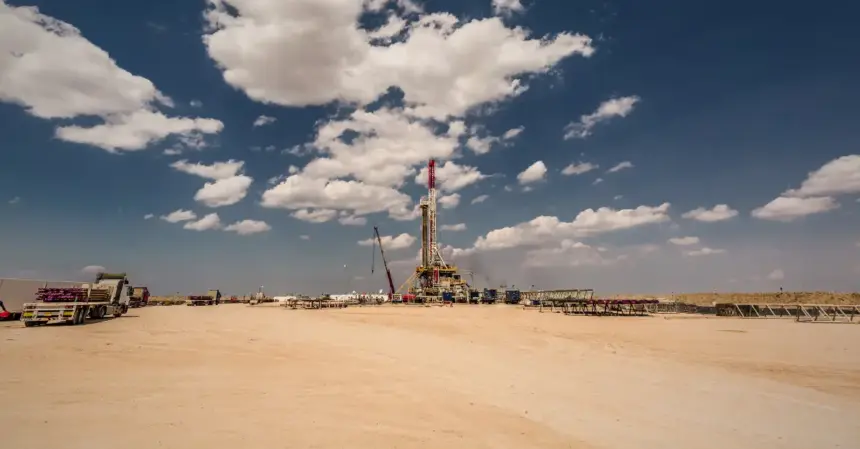
In a regulatory announcement published on September 21 in London, the company laid out the timeline for this campaign. The full operation is expected to run for roughly twenty days, with the drilling itself requiring between twelve and fourteen days, the remainder devoted to logging and other work carried out once the target depth is reached.
Learning from a difficult earlier attempt
MOU-6 is not Guercif’s first attempt. In 2023, the MOU-3 well had already cut through several gas-bearing formations, confirming the presence of gas at multiple levels. But that campaign ran into a technical problem: damage to the formations during drilling made it impossible to properly assess their production capacity. In other words, the gas was there, but no one could say with confidence at what rate it could actually be extracted.
That is the difficulty Predator says it set out to correct with MOU-6. The well is designed to intersect the TGB-6 and A-Sand reservoirs, but with a different approach than the one used previously. The company says it adapted its drilling fluids and pressure management with the aim of better preserving fine, fragile sands that are particularly vulnerable to mechanical damage during drilling. This more cautious approach stems directly from lessons drawn from earlier drilling at the site.
Significant resource volumes, still unconfirmed
The independent technical report on MOU-6 gives a sense of what is at stake. Under the median case, the well’s two primary targets represent roughly 123 billion cubic feet of recoverable contingent resources, close to 3.5 billion cubic meters.
The same report also outlines a more ambitious scenario: a much larger gas trap spanning 81 km². Its median potential is estimated at 664.5 billion cubic feet recoverable, nearly 19 billion cubic meters. This figure, however, falls under unrisked prospective resources, a category meaning that both the presence and the continuity of this gas still need to be demonstrated through drilling. That distinction, often lost in the communication around projects like this, is worth restating: between an identified resource and an exploitable reserve lies the test of actual drilling results.
Flow rate as the real test
The start of drilling guarantees nothing about future exploitation, a point Predator itself does not try to obscure in its communication. The decisive outcome will come from future flow tests, which must show that gas can move reliably from the reservoirs to the wellbore, and in commercially viable quantities. This is precisely what MOU-3 failed to establish in 2023, having not preserved the integrity of the formations it passed through.
This flow test therefore represents the pivotal stage of the project. An abundant resource is worth nothing commercially if it cannot be extracted at a sufficient and consistent rate. It is this parameter, more than the raw volume of gas in place, that will determine whether Guercif moves toward exploitation or remains, for now, a geological promise.
A modest first outlet before heavy infrastructure
If the tests prove successful, Predator is considering a deliberately limited first commercial phase. The gas could be sold directly to Moroccan industrial users as compressed natural gas, transported by truck. The model under study anticipates production of up to 20 million cubic feet per day, a level that would allow commercialization to begin without waiting for heavy transport infrastructure to be built.
This incremental approach carries clear strategic value for a project still surrounded by technical uncertainty: it limits upfront investment while the resource continues to be characterized. A larger production volume could later justify a connection to the Maghreb-Europe pipeline, which runs less than ten kilometers from Predator’s wells at Guercif. That proximity gives the company a meaningful option should volumes eventually exceed what truck transport can handle.
Timeline and key figures
- Drilling start date: September 19, 2026
- Estimated total duration: approximately 20 days, including 12 to 14 days of drilling
- MOU-6 target depth: approximately 925 meters
- Recoverable contingent resources (median case, primary targets): 123 billion cubic feet (~3.5 billion m³)
- Unrisked prospective potential (81 km² extended trap): 664.5 billion cubic feet (~19 billion m³)
- Initial commercial outlet under consideration: up to 20 million cubic feet per day, sold as CNG to Moroccan industrial users
What Guercif represents in Morocco’s gas strategy
Morocco imports most of the natural gas it consumes, a dependency that weighs on its energy bill and its industrial planning. Against that backdrop, any exploration project with the potential to lead to local production, even a modest one at the outset, takes on particular significance. Guercif is not, based on current geological knowledge, poised to single-handedly reshape the country’s energy equation. But a local supply of compressed natural gas, even limited to a handful of industrial users in the Oriental region, would represent a welcome diversification away from imports exposed to the volatility of international markets.
The proximity of the Maghreb-Europe pipeline adds another dimension to the story. Should extracted volumes grow beyond what truck transport can reasonably handle, this existing infrastructure would offer a connection option without requiring a new long-distance transport network to be built. That argument, however, remains contingent on drilling and test results that have not yet been obtained.
One step among several, not a conclusion
Predator describes MOU-6 as the well capable of turning the resources already identified at Guercif into genuinely exploitable reserves. The wording is cautious, and it should be: the company has already experienced, with MOU-3, a drilling campaign that revealed gas without allowing its production potential to be properly assessed. If drilling and flow testing confirm expectations this time, Predator says it intends to move toward an exploitation concession and finalize financing for a first gas project at the site.
That path nonetheless remains a long one. Between a well reaching its target depth and actual commercial production, several regulatory and financial steps still need to be cleared. The coming weeks, with flow test results, will show whether Guercif changes status, from a promising zone to a field under development, or remains, as it did after MOU-3, a file awaiting technical clarification.
FAQ
What is the MOU-6 well meant to prove?
It must establish whether the gas identified at Guercif can be extracted at a rate sufficient for commercial exploitation, something the previous well, MOU-3, failed to confirm due to damage sustained by the formations during drilling.
When will the drilling results be known?
Drilling began on September 19, and the full operation, including logging, is expected to last around twenty days. Flow tests, which will determine the actual commercial potential, will follow this phase.
What would be the first commercial outlet for the gas if the project succeeds?
Predator is considering selling it to Moroccan industrial users as compressed natural gas, transported by truck, with production of up to 20 million cubic feet per day.
Could the Maghreb-Europe pipeline be used?
It runs less than ten kilometers from Predator’s wells at Guercif, making it a viable option for a future connection should production volumes eventually exceed what truck transport can handle.