

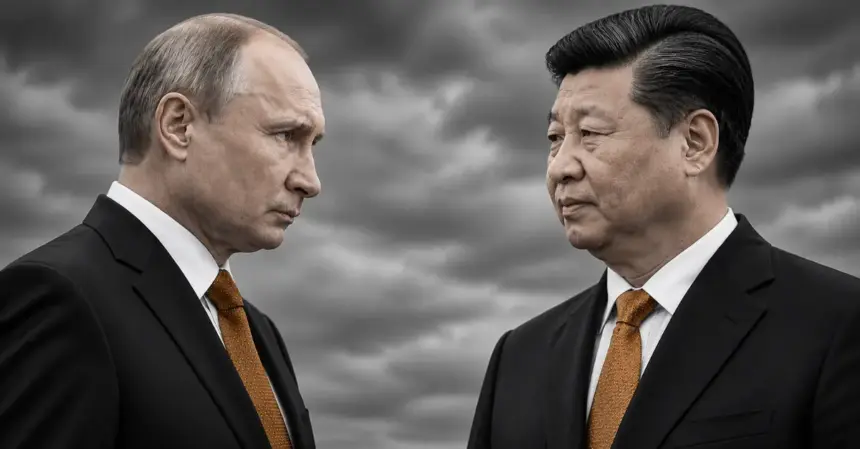
The timing was no accident: a few days later, Russian troops crossed the Ukrainian border. The announcement was clearly meant to send a deterrence signal to the West. Five years on, with a trilateral Xi-Putin-Trump summit having just been held in Shenzhen in November 2026 and a “peace declaration” published, it is time to take stock. The partnership exists and it is real, but it has never been the alliance some imagined. It is an asymmetric, pragmatic relationship punctuated by friction, in which Beijing clearly plays the role of senior partner.
A legacy of mistrust and unequal treaties
To understand the current limits, we have to go back further than 2022. For centuries, the two civilizations largely ignored each other, separated by the vastness of Siberia and the Mongolian steppes. The first significant direct contacts date from the 18th century. Then came China’s “century of humiliation”: unequal treaties, the Opium Wars, territorial losses. Russia profited too, seizing Port Arthur and territories in Manchuria and Central Asia. These episodes remain in Chinese memory, even though the official narrative puts more emphasis on the British and the Americans.
The Chinese civil war, Mao’s victory in 1949 and the initial alliance with Stalin temporarily sealed a communist bloc. But Stalin’s death, Khrushchev’s de-Stalinization and Mao’s Cultural Revolution quickly widened the rift. In 1969, military clashes broke out along the border. Richard Nixon exploited this split in 1972 with his historic trip to China, in exchange notably for the one-China policy. Until the end of the USSR, the two communist nuclear powers remained rivals.
Putin’s pivot and the post-2022 acceleration
The arrival of Vladimir Putin changed the dynamic. The 2001 Treaty of Good-Neighborliness, the settlement of the last border disputes around 2008, and then the major Power of Siberia gas contract after the annexation of Crimea in 2014 marked a rapprochement. The logic is simple and recurring: when relations with the West deteriorate, the Sino-Russian link becomes a priority. The invasion of Ukraine in 2022 pushed this logic to its maximum. Isolated and sanctioned, Russia made China its main outlet.
The figures speak for themselves. According to Chinese customs data, bilateral trade rose from about $108 billion in 2020 to a peak of nearly $245 billion in 2024, before falling to $228 billion in 2025, the first decline since 2020, driven notably by the drop in energy prices and a decrease in Chinese car exports to Russia. In 2026, the rebound is clear: more than $214 billion over the first nine months, up about 30%, pointing to a possible new annual record. China has been Russia’s top trading partner for years (roughly a quarter to a third of Russian trade, depending on the year). The reverse is not true: Russia accounts for barely 3 to 4% of Chinese trade.
Key figures on the asymmetry
- Population: about 1.4 billion people in China versus 140-146 million in Russia.
- Trade: China = Russia’s no. 1 partner; Russia = a minor partner for China.
- Structure: Russian exports dominated by energy and raw materials; Chinese exports = manufactured goods, cars, electronics, dual-use items.
- Chinese investment in Russia: still modest (a few hundred million dollars a year according to several analyses).
Competitors as much as partners
This structural asymmetry explains why the cooperation has a ceiling. The two countries are competitors in many areas. In Africa, they covet the same resources and influence: Russia through security contracts and the Wagner group (or its successors), China through infrastructure and the Belt and Road. In Central Asia (Kazakhstan, Uzbekistan, Kyrgyzstan, etc.), Chinese influence has gradually supplanted the Soviet legacy. The countries of the region are not naive: they align with the dominant economy.
In armaments, the competition is direct. Both military-industrial complexes need to export to sustain their production lines and expertise. Every Chinese sale is a sale lost for Russia, and vice versa. Accusations of Chinese industrial espionage and reverse-engineering of Russian technology are recurrent, and Moscow has restricted certain transfers of advanced systems. Militarily, joint exercises exist, but there is no NATO-style integration and no automatic mutual defense commitment. Neither side wants to be dragged into the other’s conflict (Taiwan for China, escalation with NATO for Russia).
The energy example is particularly revealing. After losing the European market, Russia urgently needed outlets. Power of Siberia is operating and has reached its capacity. The Power of Siberia 2 project (sometimes renamed Power of Baikal or routed via Mongolia), with a planned capacity of 50 billion cubic meters per year, has been dragging on for years. A memorandum has been signed, but commercial negotiations regularly stall over price: Beijing demands very favorable terms, aware that Moscow has few alternatives. As of late 2026, the final contracts have still not been closed, and the International Energy Agency projects possible full capacity only around 2040.
Strategic stakes and outlook
Why does this matter? Because this partnership shapes the multipolarity that Beijing and Moscow say they promote. It allows Russia to continue its war in Ukraine while benefiting from an energy market and dual-use goods, while giving China discounted resources and diplomatic leverage. For Europe and the Mediterranean basin, the implications are concrete: redirected energy flows, competition for influence in North Africa and the Middle East, and the risk of sanctions circumvention via Chinese or third-country routes.
Western analysts stress the “asymmetric interdependence”: Russia needs China far more than the reverse, which gives Beijing growing bargaining power. Official statements insist on a relationship “at the highest level in history,” “back to back,” and stable in the face of turbulence. The facts show a relationship that is useful but bounded by conflicting interests, historical mistrust and an imbalance of power.
Five years after the “no limits” announcement, the partnership has held up in its broad economic and diplomatic outlines. It has not produced a Russian-Chinese bloc capable of overturning the Western order. China remains the senior partner, able to extract advantages while keeping its freedom of action. Russia, constrained, accepts this relative subordination because the alternative, Chinese hostility, would be worse. This mechanical reality, more than the speeches, will determine the future of the relationship.
FAQ
Is the Sino-Russian partnership a true military alliance?
No. It is a strategic coordination partnership, with no formal alliance treaty and no automatic mutual defense commitment. Military cooperation exists (exercises, some transfers), but it remains limited by mistrust and diverging interests.
Why did trade fall in 2025 before rebounding in 2026?
According to Chinese customs, the 2025 decline (~6-7%) is mainly explained by the drop in Russian oil and coal prices and a sharp fall in Chinese car exports to Russia. The 2026 rebound is driven by recovering volumes and energy prices, as well as Chinese manufactured goods.
Is the Power of Siberia 2 project permanently blocked?
No, but it is moving very slowly. A memorandum exists and talks continue, but the disagreement over price and commercial terms persists. No final construction decision had been made as of late 2026.
Does China openly support Russia’s war in Ukraine?
Beijing does not openly and officially supply lethal weapons, but it is Russia’s main energy customer and a major supplier of dual-use components. This stance lets China support Moscow economically while limiting the risk of Western secondary sanctions.