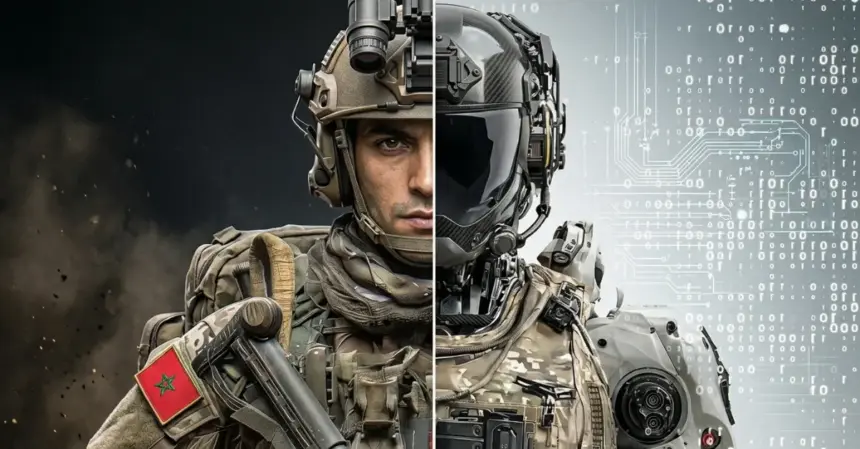
This is no longer a distant prospect. Recent conflicts in Ukraine, Gaza and other theaters have shown that AI is tangibly changing the speed of decision-making, detection capabilities and the conduct of strikes. For a country like Morocco, located at the crossroads of the Mediterranean, the Sahel and the Atlantic, investing in these technologies is a matter of sovereignty and modernization rather than a simple arms race.
Shortening the decision chain
One of the most visible effects of military AI concerns the “kill chain,” the sequence that runs from detecting a target to engaging it. According to analyses by the Center for Strategic and International Studies (CSIS) and Ukrainian field feedback, this process could take hours or dozens of minutes at the start of some conflicts. Decision-support systems based on computer vision and data fusion now sometimes reduce it to under two minutes, or even a few seconds in limited cases.

The American Project Maven, originally designed to analyze drone video feeds, illustrates this evolution. U.S. military officials have indicated that combining computer vision with large language models made it possible to go from a capacity of fewer than 100 targets per day to around 1,000, and potentially more with the integration of generative tools.
During the American campaign against Iran in 2026, the Maven Smart System was used to support strikes at a high tempo, according to statements by the Pentagon’s Chief Digital and AI Officer.
In Ukraine, battle management software such as Delta and AI kits embedded in FPV drones make it possible to maintain navigation and target identification even when radio or GPS links are jammed. CSIS analysts estimate that a still-minority share of drones already use AI to recognize and lock onto targets more autonomously. The mass effect nevertheless remains central: even 2% of the millions of drones produced each year represents a significant operational volume.
These developments do not mean that systems are fully autonomous in lethal engagement decisions. In most documented cases, a human operator remains in the loop. However, the compression of the time available for human deliberation raises questions about control and error.
From detection to coordination
Beyond individual drones, AI facilitates the coordination of multiple sensors and effectors. Concepts such as swarms or “kill webs” aim to link reconnaissance, electronic warfare and strikes without concentrating forces in the traditional way. Articles from the Modern War Institute and CSIS describe how agentic systems – capable of reasoning about tasks and coordinating actions within set parameters – could orchestrate heterogeneous formations of aerial, ground or naval platforms.
In parallel, algorithmic targeting systems have been used in Gaza. Investigations by +972 Magazine and Local Call described tools such as Lavender and The Gospel, used to generate target lists from surveillance data. These systems considerably increased the number of targets proposed, even though human verification formally remained required. Critics have pointed to the risk of errors stemming from the speed of reviews and the probabilistic nature of the algorithms.
These developments show a twofold dynamic: on the one hand, improved precision and speed for armies with solid data infrastructure; on the other, a relative democratization of low-cost strike capabilities through drones. States and non-state actors can now challenge conventional forces without costly crewed platforms.
Morocco’s choices in AI and defense
Morocco has been modernizing its forces and developing a defense industrial base for several years. According to statements by Abdellatif Loudiyi, Minister Delegate in charge of the Administration of National Defense, the national defense budget for 2026 stands at 73 billion dirhams, or about 4% of GDP, up from the previous year. Commitment appropriations for the acquisition and repair of equipment, as well as support for the defense industry, have also increased.
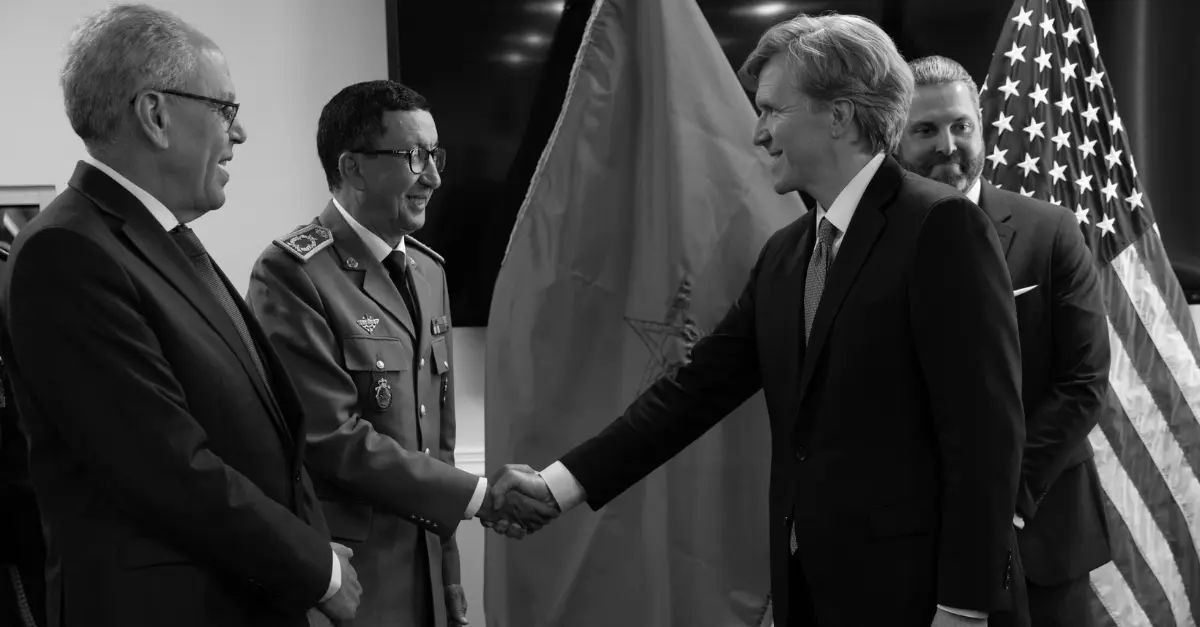
On the industrial front, ten projects have been authorized for a total investment of about $260 million, potentially creating 2,500 jobs. Among them are partnerships for the production of armored vehicles with Tata Advanced Systems, drones with Baykar (Turkey) and an assembly line for Spy-X loitering munitions with BlueBird Aero Systems (Israel). Industrial acceleration zones dedicated to defense are being set up, with an objective of becoming operational by the end of 2026.
The partnership most directly linked to AI involves Harmattan AI, a French company specializing in autonomous systems. In June 2026, a strategic agreement was concluded with the Royal Armed Forces. It provides for local production capabilities for autonomous air defense systems, a military AI research and development center in Rabat, and collaboration with Moroccan universities.
In October 2026, at the Marrakech Air Show, a letter of intent was signed for the development and production in Morocco of IRIFI, an autonomous deep-strike system with an announced range of 2,000 km, capable of operating even without satellite navigation.
At the same time, the “Morocco AI 2030” roadmap, presented in its operational phase in September 2026, aims to generate 100 billion dirhams in added value for GDP, create 50,000 direct and indirect jobs and train or certify 200,000 talents by 2030. It relies on the network of Jazari institutes and sovereign data infrastructure. Although primarily civilian, this strategy provides dual-use skills and infrastructure useful to the defense sector.
These orientations fit within a regional context marked by tensions with Algeria and by challenges of land and maritime border surveillance, counter-terrorism and a presence in the Sahel. Morocco favors partnerships that allow technology transfer and local production rather than the simple purchase of finished equipment.
Recent key figures on AI and defense
- Potential reduction of targeting time to under two minutes in some Ukrainian contexts (CSIS sources and operational feedback).
- U.S. targeting capacity raised to about 1,000 targets per day with Maven, according to reported official statements.
- Moroccan 2026 defense budget: 73 billion dirhams.
- Investments authorized in the Moroccan defense industry: about $260 to $333 million according to 2025-2026 announcements.
- Announced range of the IRIFI system: 2,000 km, with production of critical components planned in Morocco.
Strategic stakes and points of debate
Morocco’s investment in military AI offers several advantages. It strengthens a form of technological sovereignty by reducing total dependence on foreign suppliers for critical capabilities. It also makes it possible to develop local skills in dual-use fields (autonomous navigation, image processing, cybersecurity). Geopolitically, having more precise and faster surveillance and strike systems can contribute to deterrence in an unstable Mediterranean and Sahelian environment.
There are limits, however. Building a complete military AI chain (data, models, computing infrastructure, doctrine of use) requires time and sustained investment. Autonomous systems raise questions of responsibility in case of error and of compliance with international humanitarian law. Debates persist within Western armed forces and in UN forums over the acceptable degree of autonomy in weapons systems. Some experts stress that AI amplifies existing capabilities but does not replace doctrine, logistics or political control.
For Morocco, the challenge is to align these technologies with its security priorities without entering a purely quantitative arms race. Partnerships with European, Turkish and Israeli players offer diversification options, provided that know-how transfers are effective and that local production progresses beyond mere assembly.
In conclusion
AI does not change the nature of war, but it alters its tempo and lowers its entry costs. Armies that master data fusion, partial autonomy and the production of attritable systems gain a relative advantage. By combining a national civilian AI strategy with industrialized defense programs, Morocco is positioning itself to integrate these developments progressively.
Success will depend on the ability to train engineers, secure supply chains for critical components and define clear rules of use. These technical and political choices will continue to shape the balance of power in the Mediterranean basin over the next decade.
FAQ
Does AI already enable fully autonomous strikes without human intervention?
In most documented cases, a human remains in the decision loop. Drones can navigate or identify targets autonomously after losing their link, but lethal engagement generally remains supervised.
Why is Morocco investing in systems like IRIFI rather than settling for conventional purchases?
The stated goal is to develop local production of critical components and a military AI R&D center, in order to strengthen technological sovereignty and build national skills.
Are Moroccan investments in military AI comparable to those of other countries in the region?
Morocco relies more on technology-transfer partnerships and an emerging industrial base than on massive procurement volumes. Its defense budget remains lower than Algeria’s, but is oriented toward more modern capabilities.