When I went through the postdoctoral positions published on November 6, 2026 on EURAXESS by Mohammed VI Polytechnic University (UM6P) in Benguerir, two programs immediately caught my eye. One focuses on bio-inspired drones with wings that can change geometry in flight. The other aims at autonomous navigation systems built on artificial intelligence, digital twins and onboard computing.
These announcements are not isolated. They are part of a broader push in which Morocco is seeking to master dual-use technologies, useful both to industry (notably the OCP group) and to an ambition of technological sovereignty in the Mediterranean basin and beyond.

Wings that adapt like those of birds
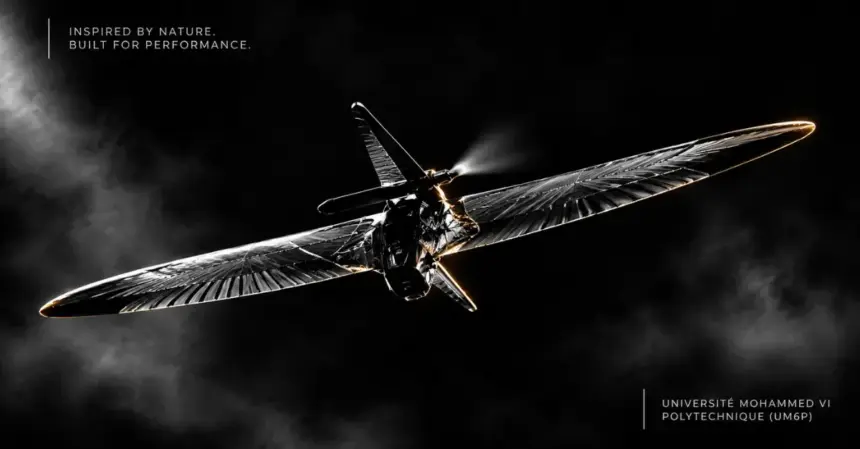
The first program, hosted by the UM6P’s GSMI/GEP entity, is recruiting a researcher to design, build and test drones inspired by the aerodynamics of birds and bats. The core idea is simple and age-old: a fixed wing is always a compromise. By changing its shape during flight – span, camber or sweep depending on the phase – it is possible to optimize lift, drag and energy consumption.
The researchers plan to get there using lightweight composite materials, computationally optimized structures, and parts produced by 3D printing (FDM/SLA). The prototypes will go through wind tunnel tests, vibration and fatigue tests, then flight campaigns.
The stated goal is a TRL 5 prototype (technology validated in a relevant environment), three publications in Q1-ranked journals, a contribution to a patent, and the setting up of a design workflow for morphing-wing drones at UM6P. It is a realistic milestone: global research on morphing wings has existed for years (work published in Science Robotics in 2020 already showed gains in agility and speed range), but operational prototypes remain rare, especially at a controlled cost.

Autonomous navigation and digital twins for industry
The second program, published the same day, targets autonomy. It plans the development of algorithms combining machine learning, computer vision and sensor fusion so that drones can analyze their environment and adapt their trajectories. The researchers will also work on digital twins fed by flight data, useful for monitoring equipment condition, analyzing performance and anticipating failures. Part of the computation will be done onboard (edge computing) to reduce latency. Experiments are planned at UM6P and OCP group sites.
How morphing improves the energy efficiency of a bio-inspired drone
This recent demonstration from EPFL shows the measurable gains (up to 11.5% energy savings) obtained by varying the shape of the wings and tail in real time. This is precisely the type of aerodynamic performance the Moroccan researchers are aiming for in their morphing-wing drone program.
This component targets a TRL 6 demonstrator (tested in an environment representative of industrial conditions) and a digital mission management platform. The link with OCP is no coincidence: the world’s leading phosphate producer has concrete needs for infrastructure monitoring, environmental monitoring and logistics across vast sites. More enduring and autonomous drones find an immediate application there, before any military projection.
Why this matters in the Mediterranean basin
These programs arrive as Morocco accelerates its defense industrialization. At the Marrakech Air Show in October 2026, Rabat signed agreements covering the co-development and local production of systems, including the IRIFI long-range strike drone (with the French company Harmattan AI, announced range of up to 2,000 km), guided munitions with the Emirati firm EDGE for its Bayraktars, and plans for defense industrial zones (675 hectares at Nouaceur and Sidi Yahya).

Local startups such as Ballistic Defense System presented the Matador, an autonomous attack drone able to navigate without GPS thanks to AI agents and terrain vision. Licenses have been granted to Turkish, Israeli and other manufacturers, while defense industrial acceleration zones are being developed.
In an environment where GPS can be jammed or spoofed – a reality observed in several recent conflicts – more efficient wings (and therefore more endurance or payload) and robust autonomous navigation become tactical advantages. For a country that still imports a large share of its advanced systems while seeking to move up the value chain (aeronautical components for Airbus and Boeing, local production of SpyX loitering munitions, etc.), this academic research provides a skills foundation. It also helps train engineers who can move on to the defense industry or export.
Challenges to watch
The targeted TRLs (5 and 6) indicate that we are still far from mature systems that can be deployed at scale. University research often remains distant from the cost, reliability and certification constraints of a military or industrial system. Recruitment is open (with a deadline in December 2026 for the first position), but the ability to retain talent against European or North American offers will be decisive.
Finally, the dual-use nature is obvious: a morphing wing that improves energy efficiency to monitor a mining site can also extend the flight time of a reconnaissance or strike drone. This ambiguity is not specific to Morocco; it has shaped all UAV research for a decade.
A drone that changes shape in flight: the example of the EPFL laboratory
This work carried out in Lausanne concretely illustrates the approach UM6P wants to develop in Benguerir. By adapting the geometry of its wings and tail during flight, the drone gains both agility and endurance, exactly as birds of prey do.
At the regional level, this is part of a broader competition. Algeria, Egypt and other players are also investing in drones, often through external partnerships. Morocco is betting on a combination of technology transfers (Turkey, Israel, France, the Emirates) and local skills development. The UM6P programs are one link in that chain, more discreet than trade-show announcements, but potentially structuring if the prototypes live up to their promises.
This work does not herald an immediate shift. It does, however, signal a clear intent: to move from assembling or adapting foreign systems to mastering technological building blocks (adaptive structures, onboard autonomy, digital twins). In a Mediterranean basin where maritime surveillance, critical infrastructure protection and power projection intersect, this capability matters. It remains to be seen whether UM6P and its industrial partners can turn these research offers into prototypes that fly, and then into lasting skills.
FAQ
What is a morphing wing on a drone?
A wing whose shape (span, camber, sweep) can be modified in flight to adapt to different phases (takeoff, cruise, maneuvering) and improve aerodynamic efficiency.
What level of maturity do these programs target?
TRL 5 for the morphing-wing prototype (validation in a relevant environment) and TRL 6 for the autonomous demonstrator (testing in conditions close to real industrial use).
Is this research purely civilian?
The offers are academic and tied to industrial sites (OCP). The technologies are dual-use: gains in endurance and autonomy are also of interest for defense applications.
Why test at OCP sites?
The group has concrete needs for infrastructure surveillance and monitoring over large areas, which provides a realistic testing ground.