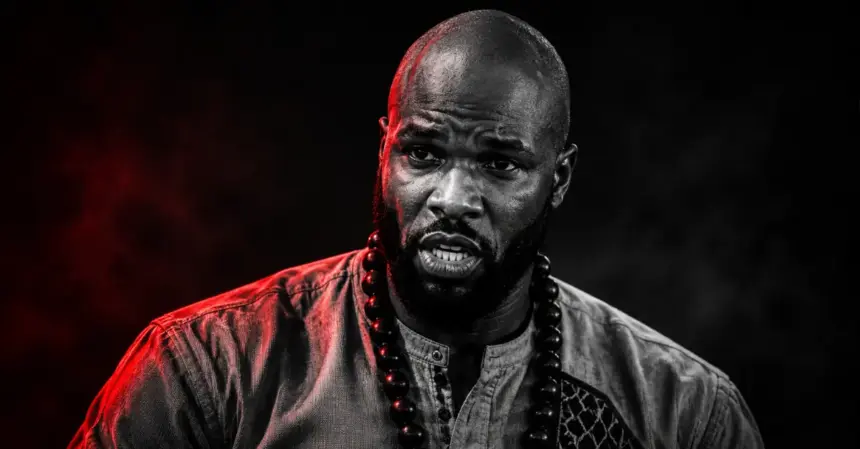
Arrested in Pretoria while trying to leave the country clandestinely, the Pan-Africanist activist is now at the center of an extradition procedure requested by Benin. This situation marks a turning point in a career defined by mobilizations against French influence in West Africa, ties with Russian actors and complex relationships with several African governments.
I have been following this case for several months, cross-checking official statements, court decisions and analyses from the ground. What stands out is less the personality of the individual than the way his case concentrates several competing dynamics: the challenge to Françafrique, the rise of military regimes in the Sahel, and the limits of the protection that diplomatic passports or influence networks can offer.
An activist trained in France, active in Africa
Born in Strasbourg in 1981 to Beninese parents, Kemi Seba first became known in France in the mid-2000s. He founded or led groups such as the Tribu Ka, which was dissolved by the French authorities for incitement to racial hatred. Several convictions followed for offenses related to incitement to hatred. He then left France and stepped up his appearances across West Africa, where he criticized the CFA franc and called for a break with what he describes as neocolonialism.
His activities have earned him expulsions or entry bans in several countries, including Senegal, Côte d’Ivoire and Togo. At the same time, he has built a significant social media audience, estimated at around 1.5 million followers according to several media outlets. In 2024, France stripped him of his French nationality by decree. He responded by publicly burning his French passport, declaring himself “freed from the burden of French nationality.”
A place in the Sahel’s realignments
After the loss of his nationality, Niger issued him a diplomatic passport and appointed him special adviser to General Abdourahamane Tiani, head of the junta that came to power through a coup in 2023. This appointment was confirmed by the Nigerien authorities. It comes in a context where Niger, Mali and Burkina Faso have severed part of their military cooperation with France and moved closer to Russia.
Kemi Seba has regularly criticized the French presence and supported the military regimes of the Alliance of Sahel States. French officials and American analyses have accused him of relaying Russian propaganda. He has himself denied being an agent and presented his work as strictly Pan-Africanist. However, media investigations have reported contacts with networks close to the former Wagner Group and funding linked to Yevgeny Prigozhin.
In April 2025, Bel Campus University in Kinshasa awarded him an honorary doctorate in political science, after an initial postponement. His supporters presented this distinction as recognition of his commitment to African sovereignty.
Support for the failed coup in Benin and arrest warrants
In December 2025, a coup attempt was launched in Benin against President Patrice Talon. It failed quickly. A few hours after the events began, Kemi Seba posted a video in which he called that day a “day of liberation” for the country. Benin’s Court for the Repression of Economic Offenses and Terrorism (CRIET) then issued two international arrest warrants against him. One concerns apology for crimes against state security and incitement to hatred, violence and rebellion; the other concerns suspected money laundering and terrorism financing.
According to sources cited by the press, he was in Niger at the time. He had previously announced his intention to run in Benin’s 2026 presidential election, criticizing the ruling power. These elements led the Beninese authorities to regard him as someone who encouraged an attempt to overthrow an elected government.
Arrest in Pretoria and legal proceedings
On April 13, 2026, South African police arrested Kemi Seba and his 18-year-old son in a shopping center in Pretoria. A third man, François van der Merwe, was also taken into custody. The authorities said they were attempting to cross the border into Zimbabwe illegally via the Limpopo River, with the help of a paid facilitator. Kemi Seba had been staying in South Africa for several months on an expired visa. Sums of money and phones were seized.
South African justice examined a claim of diplomatic immunity based on the Nigerien passport. On October 6, 2026, the judges rejected this argument, finding that nothing showed an effective accreditation in South Africa. The activist therefore remains in detention. The next hearing on the merits of the extradition request to Benin has been set for November 20, 2026.
Rumors that Niger had immediately withdrawn the diplomatic passport and declared Kemi Seba persona non grata circulated. They were denied by fact-checks and by statements from Niger’s foreign minister, who confirmed the document’s authenticity at the time of the arrest. Niamey has nevertheless kept a low profile since April, with no visible diplomatic campaign on his behalf.
Recent timeline
- July 2024: loss of French nationality; issuance of a Nigerien diplomatic passport and appointment as special adviser.
- December 2025: public support for the coup attempt in Benin; issuance of international arrest warrants by Cotonou.
- April 13, 2026: arrest in Pretoria during a clandestine exit attempt.
- October 6, 2026: South African court rejects the diplomatic immunity claim.
- November 20, 2026: extradition hearing scheduled.
Geopolitical stakes and viewpoints
This case illustrates the tensions running through West Africa. On one side, part of public opinion and Pan-Africanist activists see Kemi Seba as a voice denouncing unequal relations inherited from the colonial and postcolonial periods, particularly around the CFA franc and the French military presence. For them, the prosecutions amount to a judicial instrumentalization meant to silence an influential critic. People close to his organization, Urgences panafricanistes, have said the Beninese accusations would not stand up to scrutiny.
On the other side, the Beninese authorities and analysts point to his explicit support for an armed enterprise aimed at overthrowing a constitutional government. They also stress his links with Russian actors, in a context where Moscow seeks to extend its influence in the Sahel, often at the expense of earlier partnerships with France. The arrest in South Africa, in circumstances involving a facilitator linked to white nationalist circles, has also raised questions about the coherence of the activist’s networks.
Strategically, the affair raises the question of the real protection offered by diplomatic passports issued by transitional regimes. It also questions the ability of states to enforce the principle of non-interference when an individual uses digital platforms to weigh on internal political processes. Finally, it is part of a broader realignment of alliances in West Africa, where the rejection of France coexists with new dependencies and risks of destabilization.
As I write these lines, Kemi Seba remains imprisoned in Pretoria. The November 20, 2026 hearing will determine how the extradition procedure moves forward. Whatever the judicial outcome, his path shows the limits of an influence strategy built on digital mobilization and rapprochement with juntas when it collides with international criminal proceedings. For the states concerned, the challenge is to distinguish legitimate political criticism from acts that may amount to support for attempts to overthrow the constitutional order. For observers, the case will continue to shed light on the rivalries for influence playing out in the wider Mediterranean basin and in West Africa.
FAQ
Why is Kemi Seba being held in South Africa?
He was arrested in April 2026 in Pretoria for irregular stay and attempting to leave the country clandestinely. Benin is meanwhile requesting his extradition on the basis of arrest warrants linked to his support for a coup attempt in December 2025.
Did South African justice recognize his diplomatic status?
No. In October 2026, the judges rejected the immunity claim based on the Nigerien passport, finding that no effective accreditation had been established.
What are the main charges in Benin?
Apology for crimes against state security, incitement to rebellion, and suspected money laundering and terrorism financing, according to the warrants issued by the CRIET.
Is Niger actively supporting Kemi Seba since his arrest?
The Nigerien authorities confirmed the validity of his diplomatic passport at the time of the arrest, but they have kept a low profile and have not run a visible diplomatic campaign on his behalf.