A few days later, Nisrine Iouzzi, Director of Construction Monitoring and Supervision, confirmed on the sidelines of the Port Development Middle East & Africa Forum in Casablanca that works have reached 74% completion. The 2027 Finance Bill (PLF 2027) documents, for their part, put progress at around 70% in mid-September. The gap is slim; the signal is clear. The Kingdom’s largest port construction site, according to the PLF 2027 presentation note, has crossed a decisive threshold.
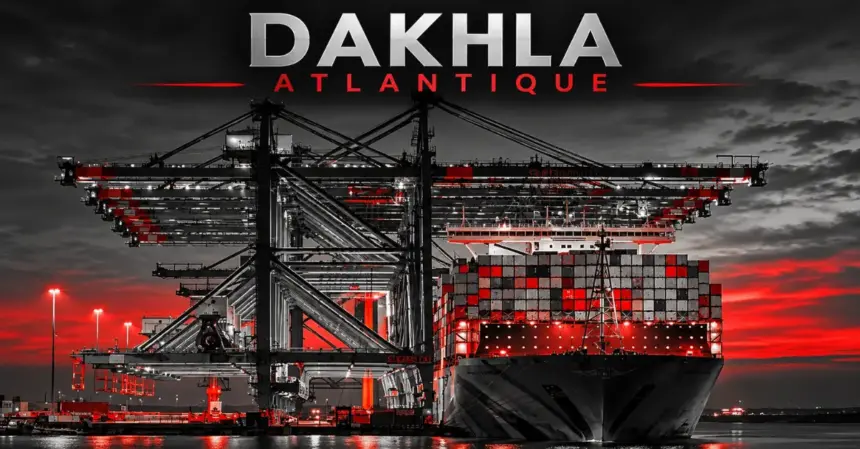
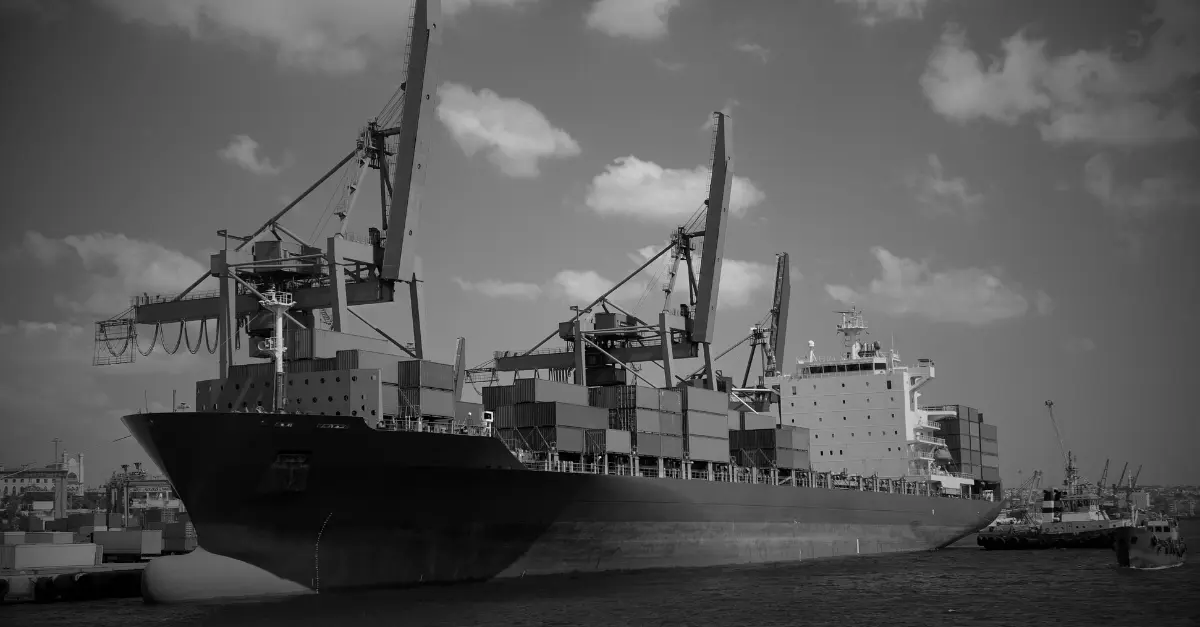
This is not just a percentage. Located about forty kilometers north of Dakhla, in the rural commune of El Argoub, the Dakhla Atlantic port is designed as a deep-water island port, connected to the coast by a 1,330-meter maritime bridge. It will include three specialized basins: commerce, deep-sea fishing and ship repair. The marine protection structures extend over 7.5 kilometers; the planned quay length exceeds 2,300 to 2,500 meters depending on the source. A first multipurpose quay with a depth of less than 12 meters is due for delivery before the end of 2026. The protection structures and the backfilled platforms are expected by the same deadline. Overall completion remains set for the end of 2028, with a gradual entry into service in 2029. Iouzzi reaffirmed that “the 2028 deadline will be met.”
The numbers behind the project
- Updated overall cost: MAD 15.06 billion according to the PLF 2027 (revised upward from an initial estimate of around MAD 13.6 billion, to incorporate extensions).
- Target capacity: 35 million tonnes per year, expandable (sometimes cited as beyond 40 million), split between containers (up to 1 million TEU), general cargo and dry bulk, hydrocarbons and seafood products.
- Adjoining industrial and logistics zone: roughly 1,600 to 1,650 hectares.
- Physical progress at the end of September 2026: over 74% (SGTM and the Monitoring Directorate).
- Schedule: 90% targeted in 2027, completion at the end of 2028, operations from 2029.
The site employs several thousand people working in rotation. The maritime bridge, long the most advanced component, has been past 85% for months; the effort is now concentrated on the breakwaters, the backfilling of the platforms and the placement of the quay blocks. More than 125,000 cubipods have already been produced for the protective armor layer. The expertise is predominantly Moroccan: the SGTM-Somagec consortium carries most of the execution.
An infrastructure serving a continental vision
Why does this pace matter? Because Dakhla Atlantic is not an isolated port. It is part of the new development model for the Southern provinces, launched in 2015, and of the national port strategy through 2030. Moreover, it is one of the material pillars of the Royal Atlantic Initiative announced by King Mohammed VI on November 6, 2023, on the occasion of the 48th anniversary of the Green March. The initiative aims to facilitate access to the Atlantic Ocean for the landlocked countries of the Sahel by making Moroccan road, port and rail infrastructure available to them. In December 2023, in Marrakech, the foreign ministers of Burkina Faso, Mali, Niger and Chad expressed their support and agreed to create national task forces to operationalize the project.
The port is therefore meant to serve both regional development – fishing, agro-industry, renewable energy, logistics – and an ambition of south-south connectivity. It is also identified as a potential terminal for exporting green hydrogen in the form of ammonia as part of Morocco’s offer. The port hinterland is to host competitiveness clusters (seafood, general industry, logistics, shared services). A 7 km connecting road to National Road 1 and the Tiznit-Dakhla expressway strengthen multimodality. Complementary projects – an industrial and logistics zone and a desalinated water supply – are scheduled in the PLF 2027-2029.
Geopolitically, the project is part of a long-term strategy to position Morocco on Africa’s Atlantic coast. It aims to turn a region long perceived as peripheral into an interface between Morocco, West Africa, the Sahel and the maritime routes to the Americas and Europe. Observers note that this dynamic comes with an effort at soft power and economic cooperation in a Sahelian space marked by political transitions and security challenges. Moroccan authorities stress complementarity rather than competition with other ports or corridors. However, the concrete realization of access for Sahel states will depend on upgrading their own land infrastructure and on regional stability – elements that the 2023 royal speech had already underlined as indispensable.
What remains to be built
The remaining 25 to 30% is far from marginal. It covers the finalization of the quays, terminal equipment, superstructures and the establishment of operating conditions. The PLF 2027 still provides nearly MAD 7.3 billion in payment appropriations for 2027-2029. Budget execution stood at about 54% at the date of the documents. The first commercial traffic is not expected before 2029; initial volumes will be well below nominal capacity. Turning technical capacity into real flows will require operators, shipping lines, investors in the industrial zone and reliable connectivity to the markets of the Sahel and West Africa.
The technical challenges remain those of a port built in open sea: swell, backfilling, structural stability. The teams have already adapted the design to preserve the coastal current and to meet environmental requirements. Economically, the challenge is to avoid the infrastructure getting too far ahead of demand for too long. Politically, the port’s ability to genuinely serve the Atlantic Initiative will depend on concrete cooperation with partner countries and on the evolution of land corridors.
I take away a simple lesson from watching this project. Progress percentages are useful, but they say nothing about the quality of the economic and logistical integration that will follow. Dakhla Atlantic is moving from the stage of a project to that of visible infrastructure. The open question is how quickly, and with which partners, this infrastructure will become an effective hub for trade between Morocco, the Sahel and the rest of the Atlantic.
FAQ
What is the exact progress rate of the works?
According to SGTM and the Monitoring Directorate (Nisrine Iouzzi), it exceeds 74% at the end of September 2026. Medi1TV mentioned 75%. The PLF 2027 put progress at around 70% in mid-September.
When will the port be operational?
Completion of the works is planned for the end of 2028, with gradual entry into service from 2029. A first multipurpose quay is due for delivery before the end of 2026.
How much does the project cost?
MAD 15.06 billion according to the PLF 2027, after an upward revision to incorporate extensions. The initial estimate was around MAD 12.5 to 13.6 billion.
How does the port concern the Sahel countries?
It is one of the instruments of the Royal Atlantic Initiative (November 2023), which offers landlocked Sahel states the use of Moroccan infrastructure to access the Atlantic Ocean. Four countries (Burkina Faso, Mali, Niger and Chad) formally joined in December 2023.