The information contained in an official letter addressed to the Tweede Kamer (the Dutch House of Representatives) deserves a closer look. Not because it upends the balance of power in the western Mediterranean, but because it illustrates, with rare precision, how a European state currently assesses a transfer of autonomous naval capabilities to a North African partner.
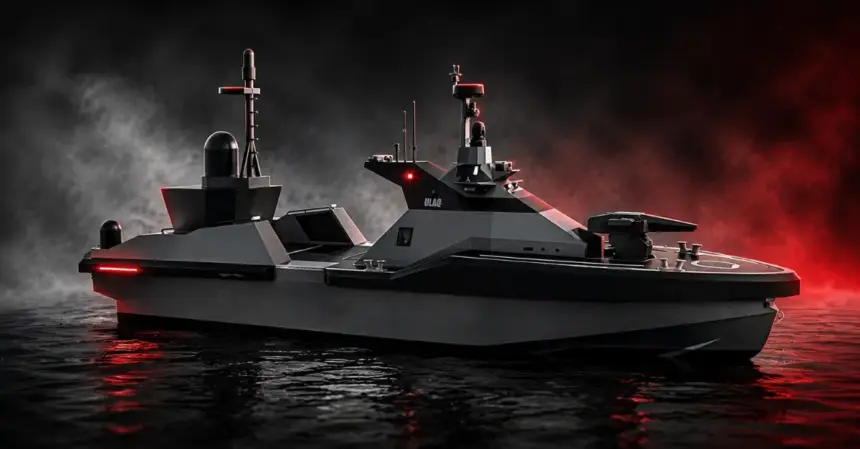
On 13 July 2026, the Dutch Ministries of Foreign Affairs and of Foreign Trade and Development Cooperation informed Parliament that an export licence worth €13 million had been granted. The document (reference 2026D36720) specifies that a Dutch company will be able to deliver two uncrewed autonomous surface vessels, along with their sensors, control systems, spare parts, training and technical support. The end user is the Royal Moroccan Navy, for anti-submarine warfare and mine countermeasures missions.
An authorisation reviewed under European criteria
The authorisation was not granted without scrutiny. In line with the EU Common Position on arms exports, the Dutch authorities assessed the application against the eight usual criteria, including regional stability, the risk of diversion and the nature of the end user. The government concluded that all of the criteria were met.
In the letter, Morocco is described as “a stable and strategic security partner in an unstable region”. The Hague stresses its interest in having a stable, reliable and resilient Morocco on the European Union’s southern border. It also mentions the Kingdom’s role in managing certain migration flows, notably towards the Canary Islands. On the question of Western Sahara, the Dutch authorities examined the risk of the platforms being used in that context. They concluded that there was no clear risk of their being used for aggression or to impose territorial claims by force.
The platforms themselves are presented as designed primarily for defensive maritime tasks. Any protective weapon would be used only to defend the vessel itself and to carry out anti-submarine and mine warfare missions. The document states that they cannot be used for other missions without significant modifications.
What these vessels can bring near ports
Both systems are intended to operate with a high degree of autonomy for several days. This characteristic is central. In port approaches, access channels and anchorage areas, the main threat is not always an oceanic submarine operating far offshore. It may be a laid mine, an improvised explosive device, or simply a submarine creeping closer to the coast. In such environments, sending a crew exposes sailors to danger. An uncrewed vessel makes it possible to keep sensors (sonars, mine detection systems) on station for long periods, while relaying data to a control station ashore or aboard a conventional ship.
Besides the two platforms, the package includes a control station, mission equipment, spare parts, documentation and training. Moroccan sources indicate that the systems would be delivered already integrated with anti-submarine warfare and mine countermeasure equipment, which speeds up operational entry into service.
Key figures and facts of the case
- Value of the export licence: €13 million
- Date of the letter to the Dutch Parliament: 13 July 2026
- Number of platforms: two
- Stated missions: anti-submarine warfare and mine countermeasures
- Announced endurance: multi-day missions with a high degree of autonomy
- Stated nature: defensive, with significant modifications required for any other use
Existing capabilities and the limits of the acquisition
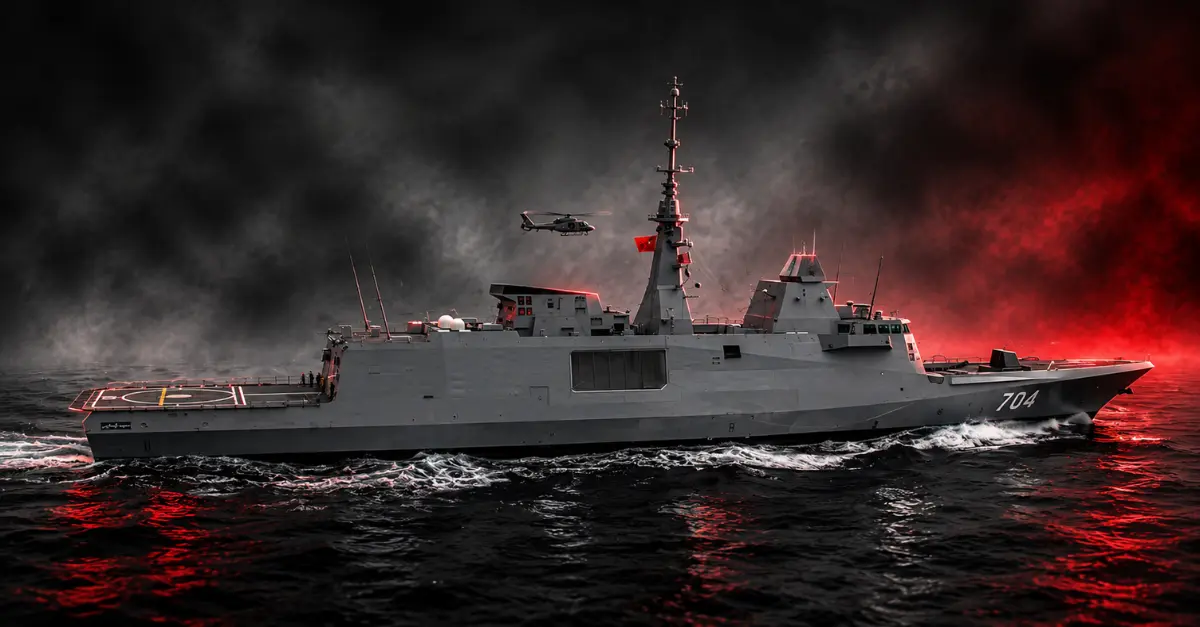
The Royal Navy does not approach this file empty-handed. It already operates the FREMM frigate Mohammed VI, delivered in an anti-submarine configuration, surface ships fitted with sonars, and specialised helicopters (AS565 Panther and Bell 412EPI) equipped with dipping sonars. These assets already allow detection and tracking under certain conditions. However, dedicated mine warfare capabilities were judged to be more limited in the Dutch assessment.
The two uncrewed vessels do not replace these platforms. At €13 million for the whole package (hulls, sensors, control station, training and support), these are modest-sized systems, suited to coastal waters and port approaches rather than prolonged blue-water operations. Their value lies in persistence and in reducing risk to crews, not in a capability revolution.
Stakes in the western Mediterranean
The acquisition comes in a regional context where underwater and mine threats are not purely theoretical. Algeria operates a submarine force made up of Kilo-class boats, which pushes its neighbours to strengthen surveillance of approaches and chokepoints. For Morocco, protecting access to its main ports and securing maritime routes close to its coasts is both a matter of defending economic infrastructure and of the credibility of its maritime posture.
On the Dutch side, the authorisation illustrates an export policy that distinguishes defensive, littoral systems from more offensive platforms. It also reflects a desire to maintain security ties with a country located on the European Union’s southern border, in a region considered unstable. The specific examination of the Western Sahara risk shows that such transfers remain under political scrutiny, even when they are deemed compatible with European criteria.
Conclusion
These two vessels will strengthen Morocco’s ability to persistently monitor port approaches and to carry out mine detection operations without directly exposing crews. They are part of a broader trend towards integrating autonomous systems into regional navies. Their real impact, however, will depend on how well they are integrated with existing assets (frigates, helicopters, command centres) and on the Royal Navy’s ability to maintain them and keep them evolving.
The Dutch authorisation provides a documented example of how a transfer of autonomous naval technology is assessed in Europe today. It does not close the debate on capability balances in the western Mediterranean, but it sheds light on Morocco’s current priorities for protecting its maritime approaches and on the conditions under which a European partner agrees to contribute.
Frequently asked questions
Did the Netherlands really authorise the sale of two uncrewed vessels to Morocco?
Yes. An official letter dated 13 July 2026 informs the Dutch Parliament that an export licence worth €13 million has been granted for two autonomous surface vessels intended for the Royal Moroccan Navy.
What will these systems be used for?
For anti-submarine warfare and mine countermeasures missions, mainly in coastal areas and port approaches, with the ability to operate for several days with a high degree of autonomy.
Can these vessels be used for other missions?
According to the Dutch government, they are designed for defensive tasks and cannot be used for other missions without significant modifications.
Is the manufacturer known?
No. For reasons of commercial confidentiality, neither the manufacturer nor the exact model has been disclosed in the official documents.