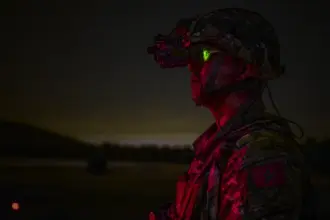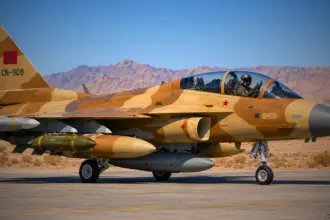
Developed by Indra and EM&E Group (formerly Escribano Mechanical & Engineering), this C-UAS (counter-unmanned aircraft systems) solution demonstrated its ability to fuse sensors, electronic warfare and kinetic neutralization against Class I and II drones, under a single command bringing together the three branches of the armed forces, the Guardia Civil and the National Police.
This sequence comes as Morocco accelerates its military modernization, particularly in unmanned systems. Since 2021, Rabat has acquired Bayraktar TB2 drones (at least nineteen units identified), Akinci drones, Chinese Wing Loong drones and Israeli platforms. In early October 2026, at the Marrakech Air Show, the National Defense Administration signed a contract with the Emirati group EDGE to integrate Desert Sting 16 guided munitions (announced range of up to 15 km) and Thunder P-31 munitions onto its combat drone fleet. Morocco’s 2026 defense budget stands at around 157 billion dirhams (more than 14 billion euros according to published conversions), with a multi-year commitment ceiling raised in the 2027 finance bill.
These developments do not automatically translate into offensive intent toward Spain. Several analyses, including a study by the Istituto Analisi Relazioni Internazionali, suggest that Morocco’s buildup is primarily aimed at regional balance against Algeria and at managing the Sahara dispute, while also strengthening its bargaining position on bilateral issues (migration, fishing, claimed sovereignty over Ceuta and Melilla). Spain retains an overall advantage, but the proliferation of drones raises the cost of any limited crisis.
An integration exercise under a single command
ATLAS 26, led by the Chief of the Defense Staff (JEMAD), organized by the Maneuver Support Command and run by the Anti-Aircraft Artillery Command, brought together around 800 participants. The goal was to validate joint procedures against multilayered aerial threats, with a focus on Class I and II UAS, both within the framework of permanent presence and deterrence operations on national territory and in scenarios of integration into NATO’s IAMD (Integrated Air and Missile Defence) architecture. 5G connectivity was tested to link the C-UAS systems to the air defense network.
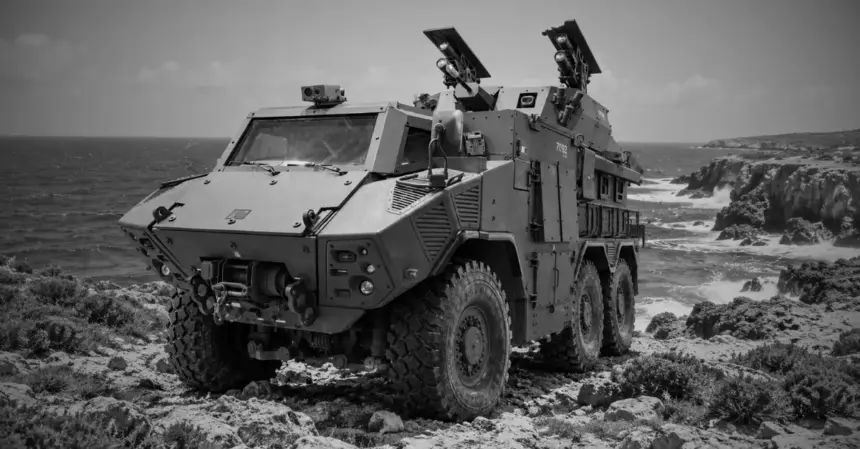
The ARACNE system, whose first units were delivered to Anti-Aircraft Artillery Regiment No. 71 earlier this month, was connected to the COAAAS+ Anti-Aircraft Artillery Operations Center (also built by Indra) and then to the Aerospace Operational Command (MOA). This link made it possible to generate a common operational picture, shorten the decision cycle and coordinate C-UAS assets with anti-aircraft artillery. Indra supplies the NEMUS radar (AESA), the C4ARMS command and control system, the Brontes jammer and the SmartEar radio-frequency scanner (400 MHz to 6 GHz, range of about 6 km). EM&E contributes the OTEOS electro-optical sensor (detection beyond 14 km in the daytime channel and up to 23.1 km in thermal mode for standard NATO targets) as well as the GUARDIAN remote weapon stations.
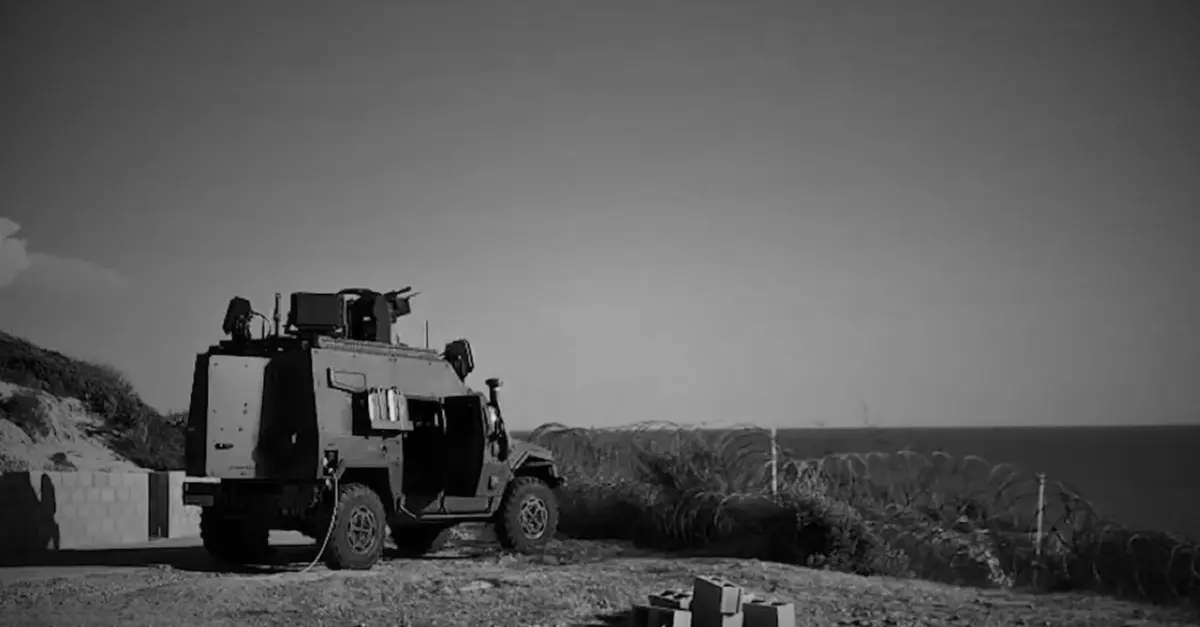
Several configurations were showcased: 4×4 tactical vehicles equipped with GUARDIAN 2.0 for kinetic destruction, a FEROX 6×6 vehicle with a GUARDIAN L-HIT station, and an AUNAV LINK ground robot fitted with an electronic warfare system to disrupt operator-to-drone links. EM&E stated that its systems had detected and shot down several drones, without specifying the exact number. Hard-kill neutralization shots (direct impact) had already been successfully carried out during the preparations for the exercise. The program, costing roughly 30 to 36 million euros depending on the source, provides for 14 systems (fixed and mobile, the latter mounted on the VAMTAC ST5) for the three branches of the armed forces, plus simulators.
The strategic stakes south of the Strait
ARACNE’s “On The Move” protection capability, which makes it possible to escort convoys and command posts thanks to mobile radars, addresses a vulnerability observed in Ukraine and other theaters: small, slow, low-flying drones that are hard to detect with conventional radars, including fiber-optic-guided drones that emit no signal. For Spain, this also concerns the protection of critical infrastructure and, more specifically, the cities of Ceuta and Melilla, where military observers have pointed to the relative absence of medium-range C-UAS systems.
Bilateral relations remain complex. In late July 2026, more than 72,000 people crossed the border at Ceuta; Moroccan vessels moved through waters close to the enclave, an episode the Spanish government described as isolated while adjusting its naval posture. King Felipe VI’s visit to Ceuta and Melilla on October 13 and 14 reaffirmed Madrid’s position that these territories are inalienable, while Rabat continues to claim sovereignty over them. Pedro Sánchez, however, reiterated his willingness to maintain good neighborly relations.
On the industrial side, ARACNE illustrates Spain’s drive for technological sovereignty. The system, brought into service in roughly two years, has already attracted interest from countries on NATO’s eastern flank; one version protects the Spanish contingent in Lithuania. This fits into a European dynamic of a “drone wall” and of strengthening C-UAS capabilities against saturation threats.
Key figures on the ARACNE program and the regional context
- ARACNE contract cost: around 30-36 million euros (February 2025)
- Planned systems: 14 (fixed and mobile) + simulators
- SmartEar range: ~6 km (400 MHz-6 GHz)
- OTEOS detection: >14 km (day) / up to 23.1 km (thermal)
- Moroccan defense budget 2026: ~157 billion dirhams
- Identified Moroccan drones: at least 19 Bayraktar TB2 + Akinci, Wing Loong and Israeli platforms
Views differ on how to interpret this military buildup. For Madrid and its defense industry, it is a necessary response to a widespread technological threat, strengthening both national defense and Spain’s contribution to NATO. Moroccan voices and some independent analyses see a legitimate modernization aimed at regional deterrence, with no desire for direct confrontation with Spain. Other observers stress that the combination of low-cost armed drones and long-standing territorial claims raises the risk threshold in the Strait of Gibraltar, even if open escalation remains unlikely given economic interdependence.
The ATLAS 26 exercise has not closed the debate. It confirms the technical maturity of a European solution against rapidly evolving threats, while reminding us that the protection of Spain’s contested southern territories depends as much on military capabilities as on the political management of relations with Rabat. Future ARACNE deployments and Morocco’s equipment choices will continue to shape the contours of this fragile balance.
FAQ
What is the ARACNE system?
An anti-drone system developed by Indra and EM&E for the Spanish armed forces, combining radars, radio-frequency detection, electro-optical sensors, jamming and remote weapon stations, integrated into the air defense network.
Why was ATLAS 26 held in Huelva?
The Médano del Loro range offers favorable conditions for testing the detection and neutralization of Class I and II drones in realistic scenarios, with joint participation from the armed forces and security forces.
Is Morocco seeking a conflict with Spain?
Available analyses suggest that its buildup is mainly aimed at balancing Algeria and addressing the Western Sahara issue, as well as improving its bilateral negotiating position, rather than at direct armed confrontation.
What is the range of ARACNE’s sensors?
The SmartEar scanner covers about 6 km across the 400 MHz-6 GHz frequency range; the OTEOS sensor detects standard targets at more than 14 km by day and up to 23.1 km in thermal mode.