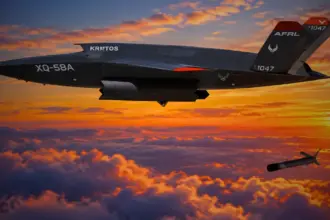
This test, conducted with the United States Air Forces in Europe – Air Forces Africa and the US Marine Corps as part of the preparations for African Lion 2026, marked a concrete step. For Washington, it was about validating the integration of an African partner into coalition command-and-control structures.
For some Spanish observers, it confirmed a trajectory that Rabat now embraces without complexes: Morocco is no longer content to simply buy equipment; it is building the conditions for a capability overtake on its northern flank.
Link-16 is the standard tactical data link of NATO. It enables automatic, jam-resistant sharing of positions, tracks, and communications between aircraft, ships, and ground units. Access remains tightly controlled. Morocco achieved it after ordering six MIDS-JTRS terminals in 2022 for $141.1 million.
A major non-NATO ally of the United States since 2004, the kingdom benefits from preferential access without the guarantees of Article 5. This advance fits into the 2026-2036 US-Morocco military cooperation roadmap, which formalizes a long-term objective: making Morocco the most capable military partner in Africa.
A drone industry and partnerships that change the scale
On the Moroccan side, optimism rests on two levers that Madrid can no longer ignore: large-scale local production of unmanned systems and growing integration with American and Israeli technologies. Morocco’s aerospace sector, which employs around 25,000 people across some 160 companies and aims for $5 billion in exports within three years, views drones as a natural extension of its expertise in materials, assembly, and engineering. Licenses have been granted to local and foreign projects, including initiatives involving Baykar.
In Benslimane, a facility is already producing SpyX loitering munitions in partnership with BlueBird Aero Systems, a subsidiary of Israel Aerospace Industries. Moroccan technicians have been trained for assembly and integration. At the same time, Morocco has acquired dozens of Israeli drones (Hermes, Heron, WanderB, ThunderB) and signed agreements for Barak MX air-defense systems (around $500 million, already deployed) and Elbit’s PULS rocket launchers. A joint venture, Moroccan Military Industry, linked to Elbit technologies, plans to begin delivering turrets for locally assembled 8×8 armored vehicles, as well as ammunition, starting in March 2027. A US-announced drone training center is also set to be established in Morocco to train African operators.

These elements do not yet constitute overall parity. According to SIPRI, Spain spent around $40.2 billion in 2025 (2.1% of GDP) compared with $6.3 billion for Morocco (approximately 3.54% of GDP). Madrid retains a clear advantage in the navy, submarines, and conventional combat aviation. But the Moroccan logic is different: it prioritizes systems that alter the cost-effectiveness ratio on the battlefield—strike drones, saturation artillery, multilayered air defense—and produces or integrates them locally. American partners (around 60% of arms imports) and Israeli partners (around 24%) supply both the equipment and the transfer of skills. For Moroccan officials, this combination, coupled with political stability and a strong industrial will, creates the conditions for a progressive overtaking of Spanish capabilities in the most decisive domains of contemporary conflicts.
The shadow of Al-Andalus and the Spanish reading
This rise in power awakens a historical sensitivity in Spain that numbers alone cannot explain. From 711 to 1492, Al-Andalus lasted nearly eight centuries. Dynasties from the Maghreb exercised lasting domination over a large part of the peninsula. The Reconquista founded part of Spanish national identity on the idea of a definitive expulsion of this presence from the south. Today, a Morocco that industrializes drones, integrates NATO standards, and multiplies high-level partnerships with Washington and Tel Aviv is perceived, in certain circles in Madrid, as the return of a power capable of challenging the established order.

The enclaves of Ceuta and Melilla crystallize this perception. Morocco claims them. Article 6 of the Washington Treaty does not explicitly include these African territories within the geographical scope of NATO’s collective defense. The July 2026 crisis, with more than 70,000 crossings into Ceuta and Moroccan naval incursions acknowledged by Pedro Sánchez as an isolated incident, reinforced the narrative that Rabat’s capability buildup reduces Spain’s margin of security. The Spanish press, notably La Razón, reported the Link-16 test while highlighting the unprecedented nature of Moroccan access to a system until then largely reserved for Alliance members.
Two coexisting readings
On the official Spanish side, bilateral cooperation remains the priority. Statements from high-level meetings emphasize dialogue and the shared management of flows. Sánchez downplays the incidents and recalls the importance of the neighborhood. Part of the opposition and military analysts, by contrast, see a worrying narrowing of the advantage, aggravated by Spanish political choices (embargo on certain Israeli technologies while Morocco acquires and produces them, delays in rocket artillery).
On the Moroccan side, the perspective is more optimistic and assumed. Integration into Link-16, drone and ground-systems factories, the American roadmap through 2036, and co-productions with Israel are presented as instruments of industrial sovereignty and operational capability that will ultimately surpass Spain’s in the most modern segments of warfare. This is not a promise of confrontation, but a reading according to which Moroccan economic growth, sustained investment in defense, and privileged access to the technologies of two leading powers make it possible to close, then reverse, gaps long considered structural. The two readings coexist without neutralizing each other.

These data do not describe an immediate reversal. They illustrate why a technical test in Agadir was read in Madrid as a longer-term signal. Morocco advances through targeted acquisitions, local production, and integration into high-level Western networks. Spain retains significant assets in budgetary volume and in several conventional domains, but finds itself facing a neighbor that is building a defense industry and benefiting from partnerships that Madrid cannot simply ignore.
The open question is that of pace. If Moroccan industrial projects materialize at the announced scale and if US-Israeli cooperation translates into real transfers of skills, the perception of a capability overtake in unmanned systems, precision artillery, and interoperability could strengthen in the years ahead. African Lion 2026 and the budgetary decisions of both capitals will provide further indications on the speed of this evolution.
FAQ
Will Morocco really surpass Spain militarily?
Not immediately in absolute budget or at sea. However, the combination of a developing drone industry, co-productions with Israel, and a long-term American partnership creates a credible trajectory for reducing, then reversing, certain capability gaps.
What are Morocco’s main industrial partnerships?
The United States supplies around 60% of arms imports and Link-16. Israel accounts for around 24% and contributes to local production of systems such as the SpyX as well as equipment like the Barak MX and PULS.
Why is Link-16 important for Morocco?
It enables real-time sharing of operational data with American and allied forces, improving coordination in multinational exercises and joint operations.
Are the drones produced in Morocco already operational on a large scale?
SpyX production has started in Benslimane. Other projects (Baykar, Harmattan AI) are at the agreement or development stage. The industrial scale remains under construction.