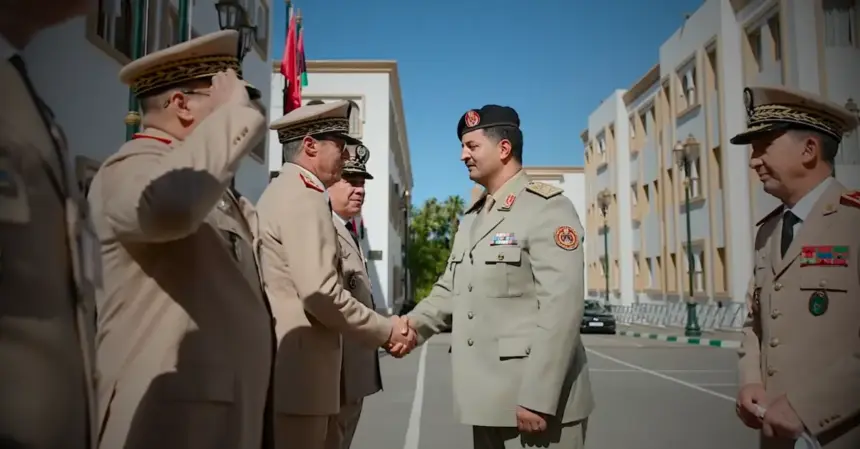
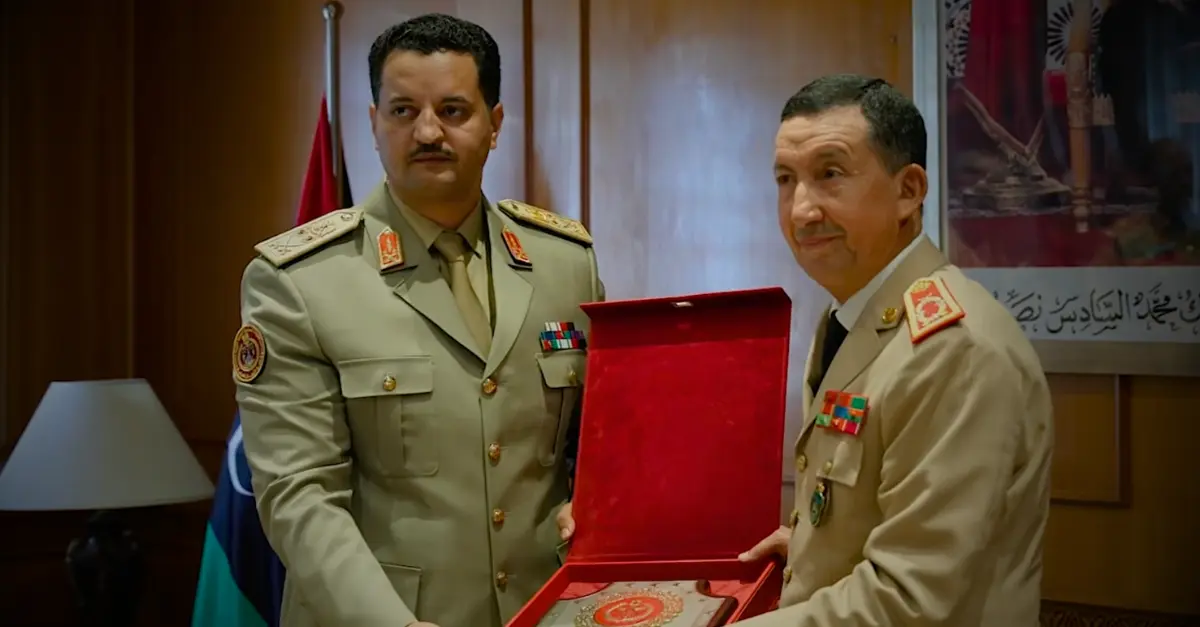
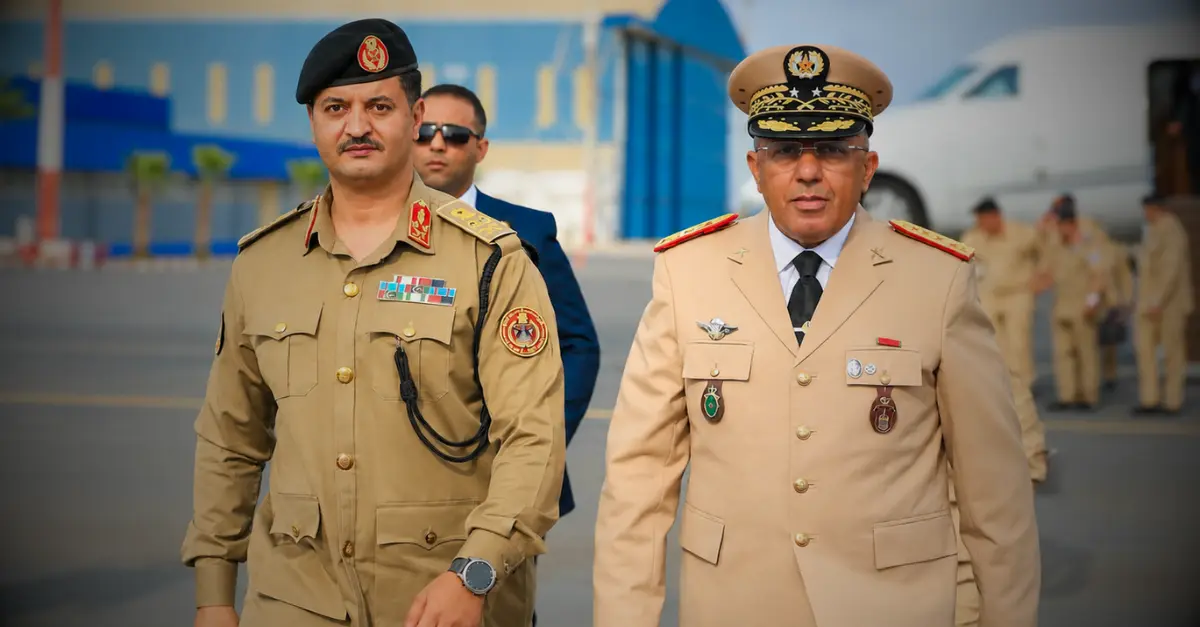
When Khaled Haftar landed in Rabat on Sunday, welcomed by the deputy inspector general of the Royal Armed Forces (FAR) and senior Moroccan military officials, my first thought was of another capital: Algiers. According to several Libyan media outlets, it is the first official visit by a senior officer from eastern Libya to Morocco. The youngest son of Marshal Khalifa Haftar and chief of staff of the Eastern forces, he is arriving in a kingdom that until now has mostly played the role of mediator. Khaled Haftar’s visit to Morocco acts as a revealing moment: that of an Algerian diplomacy watching its regional bets weaken.
There has been no official statement from Algiers, but that silence points to a genuine fear that dares not speak its name.
A Libyan bet that is fraying
For years, Algiers made a clear choice in Libya: back the UN-recognized political process and maintain good relations with the Tripoli government, now led by the much-weakened Abdelhamid Dbeibah. In June 2020, President Abdelmadjid Tebboune even declared that Tripoli was a “red line” for Algeria, just as Haftar’s forces were launching their offensive against the capital.
That position had a security logic: nearly a thousand kilometers of shared border, trafficking issues and armed groups. But it came with a cost that I find is rarely discussed in Algiers: by siding so clearly with one camp, Algeria left the other, which controls most of the East and a large part of southern Libya, to look elsewhere for support. It found it in the United Arab Emirates, Egypt, Russia according to numerous reports, and now, it seems, Morocco.
This, I believe, is the heart of Algeria’s concern: having invested in a partner whose legitimacy is contested inside Libya, and finding itself facing an interlocutor it never truly cultivated.
The fear of isolation
The context makes the unease worse. Since August 2021, Algeria has severed diplomatic relations with Morocco. It then closed its airspace to Moroccan aircraft and chose not to renew the Maghreb-Europe gas pipeline. Four years on, these decisions have not produced the expected effect: Morocco has since consolidated its partnerships with Washington, Abu Dhabi and several European capitals, and its autonomy plan for Western Sahara has gained international support.
Against this backdrop, seeing Rabat open its doors to a key player from eastern Libya looks, from Algiers, like one more episode of the same trend: that of a neighbor growing stronger while its own room for maneuver shrinks. I am not talking about panic, which is too easy a word, but about a strategic fear that I consider well founded: that of losing the initiative on both of its sensitive borders, West and East.
The key takeaways can be summed up in a few lines:
- A symbolic first: a senior officer from eastern Libya officially received by the Moroccan general staff.
- An open diplomatic front: the Dbeibah government’s bid for a Security Council seat for 2027-2028 puts it in competition with Morocco.
- Shared backing: the United Arab Emirates, an ally of Rabat, supports Khalifa Haftar militarily and financially.
- An American channel: Khaled Haftar has been talking for several months with Massad Boulos, Donald Trump’s adviser on African and Arab affairs.
An Algerian diplomacy short on leverage
What strikes me is the contrast between the stated ambition and the results. Algiers likes to present itself as a pillar of regional stability, but on the Libyan file, it is other capitals that are driving the discussions today. Khaled Haftar’s negotiations with Massad Boulos show that mediation increasingly runs through Washington, the Emirates and Egypt. Algeria appears more a spectator than a driving force, or even sidelined…
I see in this situation the effects of a diplomacy long built on rigidity: a refusal to talk with Morocco, a lasting distrust of the Eastern camp, and an attachment to proclaimed principles over real balances of power. These principles have their own coherence, but they leave little room for adaptation when the regional balance shifts.
The domestic side deserves a look too. In a regime where foreign policy is tightly controlled by the presidency and the security apparatus, every external setback carries a political cost. I do not claim to know the internal debates, but recent history shows a tendency to present difficulties as the product of outside hostility rather than the result of questionable choices.
The UN rivalry, a detail that is anything but minor
The timing, again. The visit comes a few weeks after the announcement of the Dbeibah government’s candidacy for a non-permanent Security Council seat for 2027-2028, in competition with Morocco. Nothing proves a direct link, and I am careful not to attribute a specific intention. But in diplomacy, coincidences are rarely seen as such. For Rabat, receiving Tripoli’s military adversary just as Tripoli contests a seat with it is a message in itself. For Algiers, which supports the Dbeibah government, it is a signal that is hard to ignore.
An open conclusion
I do not believe that Khaled Haftar’s visit to Rabat will, on its own, upend the regional map. But it says something important: the Libyan file is now played out among a wider set of actors, where Algiers no longer sets the tempo. The real question, in my view, is whether the Algerian authorities will adapt their approach, or keep seeing a threat rather than a signal. I will keep following Algiers’ reaction in the coming days, because it will tell us whether the concern turns into recalibration or into tension.
FAQ
Who is Khaled Haftar?
The youngest son of Marshal Khalifa Haftar, he is presented as chief of staff of the Eastern Libyan forces and is holding negotiations with American interlocutors.
Why does this visit worry Algiers?
Because it marks a rapprochement between Rabat, its regional rival, and the camp opposed to Tripoli, which Algeria supports. This reading remains an analysis: no official Algerian reaction has been reported.
Does Morocco officially support Haftar?
No official announcement to that effect has been made, to my knowledge. The visit suggests a rapprochement, not an alliance.
What role do the Emirates play?
As an ally of Morocco, they support Khalifa Haftar militarily and financially, which creates a point of convergence with Rabat.