

In Yemen, the question of Houthi armament is no longer framed in quite the same terms. For years, attention focused on deliveries of finished weapons from Iran.
- According to Bloomberg, Chinese components are reaching Yemen through commercial channels.
- Some are dual-use, serving both civilian and military purposes.
- In Aden, parts resembling missile components were found in four containers.
- There is no evidence that Chinese manufacturers knew the final recipient.
- The Houthis now control Mocha and areas near Bab el-Mandeb.
A Bloomberg investigation, published on September 24, 2026, invites us to look elsewhere: at commercial supply chains, machine tools and industrial parts that, for the most part, are not weapons until they are assembled. In this analysis, we look at what these findings establish, what they do not prove, and why they matter for Red Sea security.
An investigation that shifts the focus
Bloomberg draws on three types of sources: shipping data, customs documents and United Nations reports. Cross-checking them indicates that equipment and components of Chinese origin have reached Yemen through ordinary commercial channels. Some of these products are described as “dual-use,” meaning they serve both civilian industry and military applications.
The outlet nonetheless stresses one essential point: nothing shows that Chinese manufacturers knew the final recipient of their goods. Much of this equipment can also be sold legally in the civilian sector. We keep this caveat in mind throughout this article, as it frames the reading of the entire case.
What the inspections at the port of Aden revealed
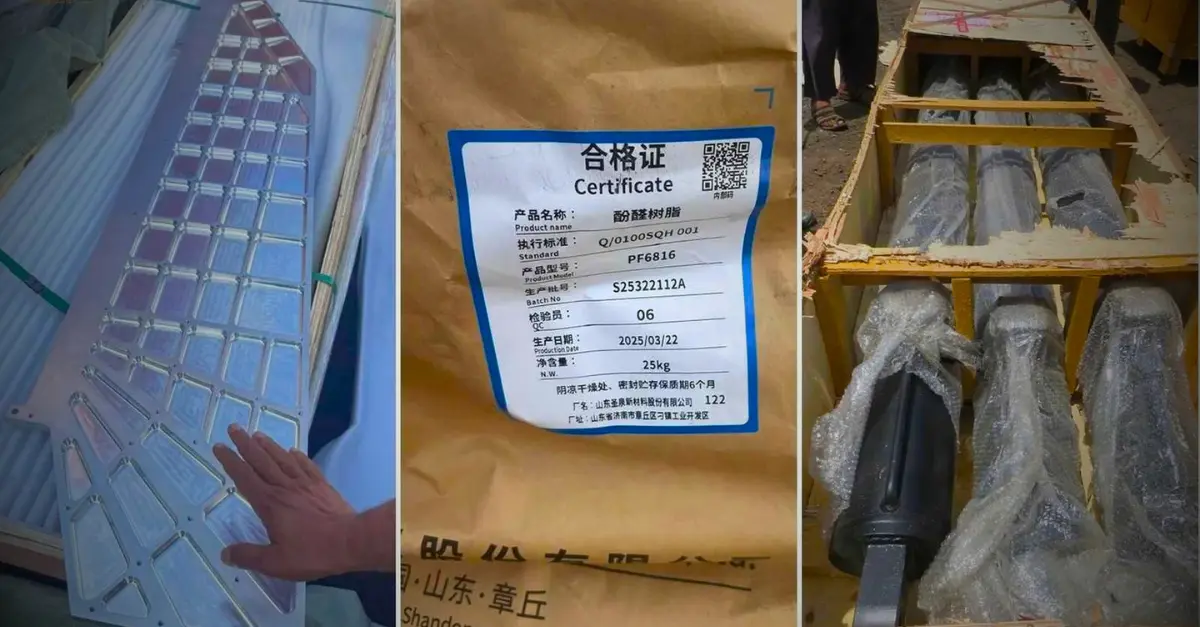
According to the investigation, Yemeni authorities discovered, during inspections at the port of Aden, materials and equipment shipped as part of a supply chain linked to Chinese industrial components.
Several items caught investigators’ attention. There was phenolic resin, a heat-resistant material used in many industrial applications. There were also tail fins and other parts that, according to Yemeni officials, resembled components used in missile systems.
The containers inspected afterwards also held machines and equipment that could be used to manufacture precision parts, control systems, launch equipment and twin-cylinder engines of the type used in certain drones.
What stands out is the nature of the cargo. According to these findings, it does not consist of complete weapons but of links in an industrial chain that would allow certain systems to be assembled or manufactured locally.
A cargo split across four containers
According to the Yemeni officials cited by Bloomberg, the cargo was split across four containers, which made it harder to identify its nature. Fawaz al-Basisi, head of the counterterrorism unit attached to the Aden port authority, explained that the components found complemented one another: once put together, they could form an assembly related to the structure of a missile.
The shipments also included computer numerical control (CNC) machines, capable of producing precision parts, as well as drilling and ventilation equipment. The latter have obvious civilian uses. According to Yemeni officials, they can also be used to build protected facilities or underground infrastructure.
This dispersal of components is at the heart of the difficulty. Taken individually, each part is mundane. It is their combination that changes the picture.
Why dual use complicates controls
Much of the equipment mentioned is not classified as weapons. Engines, electronic components, control devices, certain composite materials and CNC machines supply perfectly legitimate industries. Their passage through international commercial channels therefore does not, in itself, turn them into military cargo.
For port and customs authorities, the challenge is twofold. They must spot suspicious flows amid a vast volume of lawful trade, and often without information on the end user. Controls rely largely on declarations and paperwork, which leaves room for anyone able to split up their orders.
From imported weapons to local manufacturing
This development marks a shift in the nature of the Houthi arms industry. In recent years, the group’s armament has mainly been associated with weapons and components obtained from Iran. But earlier interceptions have shown that supply networks now include separate components, assembled in Yemen.
Two pieces of context point in this direction. In May 2026, reports based on Conflict Armament Research data indicated that missile and drone parts were reaching the Houthis through complex international networks, and that some systems were designed to be assembled from separate elements on Yemeni soil. In July 2026, Reuters reported, citing well-informed sources, that Iran had sent advisers and missile- and drone-related equipment to Yemen.
These accounts are not mutually exclusive. They sketch a broader system in which Iranian technical support coexists with the widening of channels for buying commercial components. The “turnkey” imported weapon model is giving way to a mix of know-how, industrial equipment and foreign parts.
What Chinese components change, and what they do not
The appeal of these channels is simple. The global availability of commercial components provides access to a wide range of technologies without having to acquire entire military systems. Experts interviewed by Bloomberg believe that the availability, from Chinese sources, of engines, electronic components, control units, navigation elements, powertrains and composite materials could make it easier to obtain, on commercial markets, a large share of what drone production requires.
Militarily, the implications are clear. Manufacturing or assembling locally reduces dependence on deliveries of ready-made weapons and makes the supply chain harder to detect.
One caveat is in order, however. Having components is not the same as mastering the production of a complete weapon system. A reliable missile or drone requires engineering, design, testing, guidance and navigation systems, production capacity and quality control. The investigation therefore sheds light on access to parts, not on the performance of the weapons that result, which it does not allow us to assess.
Nor does it show that every Chinese product arriving in Yemen is destined for military use, or that the manufacturers involved know the end user. This absence of proof says nothing about their level of vigilance, but it rules out attributing intent to them.
Drones, the west coast and the Bab el-Mandeb strait
This industrial dimension unfolds in a context where drones play a growing role in the war in Yemen. In August 2026, footage released by the Houthis showed a drone attack on a Saudi M1A2S Abrams tank in Marib province. The damage has not been independently verified, according to analyses of the footage. Other reports from the same period point to increased use of drones and missiles in operations on the west coast.
That coast has just changed profile. On September 10, 2026, the Houthis seized the city of Mocha and its Red Sea port, before extending their control to large stretches of the coastline and to strategic islands near the Bab el-Mandeb strait, according to Reuters and other media. This area borders one of the main shipping routes linking the Red Sea to the Gulf of Aden.
The combination of these two developments, a greater capacity for local production or assembly and control of strategic coastal areas, adds a new dimension to the maritime security equation. At this stage, it does not allow us to predict the concrete consequences for shipping traffic.
Key dates
- May 2026: reports based on Conflict Armament Research describe missile and drone parts moving through complex networks, with some systems able to be assembled in Yemen.
- July 2026: Reuters reports that Iran sent advisers and missile- and drone-related equipment.
- August 2026: the Houthis release footage of a drone attack on a Saudi tank in Marib, with no independent verification of the damage.
- September 10, 2026: capture of Mocha and its port, followed by the extension of control to other coastal areas and islands near Bab el-Mandeb.
- September 24, 2026: publication of Bloomberg’s investigation into Chinese components.
A question that remains open
The shipments tracked by Bloomberg suggest a gradual evolution of the Houthi production model, from reliance on imported weapons toward the use of commercial components and dual-use equipment to manufacture and assemble in Yemen. The accumulation of interceptions, customs data and UN reports shows the extent of a supply network capable of strengthening the group’s local capabilities.
It remains to be seen how the international community can respond to a phenomenon that falls outside conventional arms trafficking. Tightening controls on dual-use goods requires cooperation between exporting states, transit countries and port authorities, along with a delicate balance with the freedom of legitimate trade. As long as fighting continues on the west coast and near Bab el-Mandeb, the ability to produce locally will remain a key factor in reading the balance of power.
FAQ
Have the authorities proved that China is arming the Houthis?
No. Bloomberg states that there is no evidence that Chinese manufacturers knew the final recipient of their products, many of which have legal civilian uses.
What is a dual-use component?
It is a product that can serve both civilian and military purposes, such as an engine, an electronic component or a CNC machine.
What does the discovery in Aden mean for Houthi production?
It indicates that complementary elements, spread across several containers, could allow certain systems to be assembled or manufactured in Yemen, according to Yemeni officials.
Do these components guarantee high-performing weapons?
No. Producing a missile or a drone also requires engineering, testing, guidance systems and quality control.