


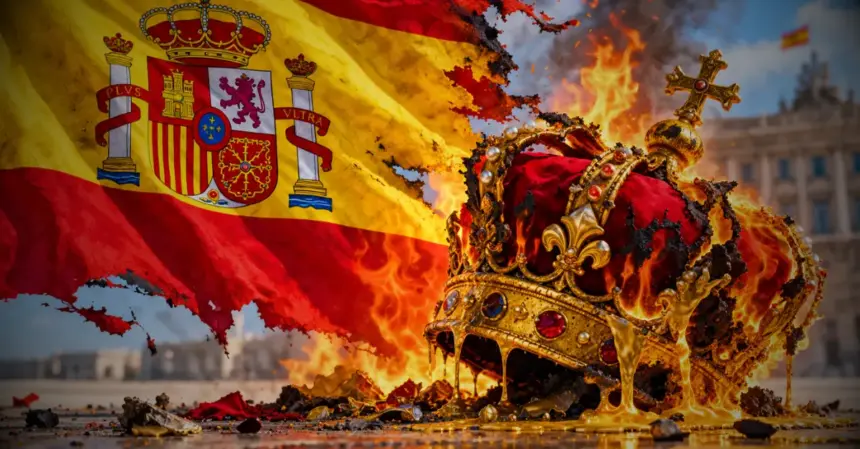
On Monday, in Seville, the former head of government (1996-2004) made a statement that immediately flooded the newspapers and social networks: if the current coalition forms a government again after the general election on 29 November, “the constitutional system” and the parliamentary monarchy “come to an end”. It was a striking line, delivered less than two months before the vote.
Should we read it as a vision or as a campaign argument? I lean toward the second reading, without entirely dismissing the first. Here is why.
Key takeaways
- José María Aznar claims that the constitutional system and the monarchy “come to an end” if the current coalition governs again.
- He was speaking in Seville, ahead of the early general election on 29 November.
- Abolishing the monarchy requires two-thirds of the votes in both chambers, two legislatures and a referendum.
- Catalonia and the Basque Country fuel the debate, but their situations differ.
- His critics see it above all as a campaign argument.
What Aznar actually said
Invited to a lecture series organised by an Andalusian foundation, Aznar presented this election as the most important since the democratic Transition. In his view, what is at stake is not a simple change of occupant at La Moncloa, but a choice between the unity of Spain and its “plurinationality”, between monarchy and republic.
His reasoning follows a chain: Pedro Sánchez’s pro-independence allies would want to give the next legislature a “practically constituent” character. Such an approach would, according to him, open the door to the abolition of the Crown, the keystone of the 1978 settlement. “It is not hidden, it is said openly,” he added.
One point deserves emphasis: Aznar attributes these intentions to partners of the government, not to the Prime Minister himself. And this is where the debate becomes interesting.
🇪🇸❌ Bientôt la fin de la monarchie Espagnole ? L’Espagne file droit vers la République et le séparatisme
👉 https://t.co/ggxDRI44VV
Quand José María Aznar parle, Madrid tend l’oreille, souvent pour s’en agacer. #espagne #España #Españoles #Madrid #Barcelona #Cataluña #PaísVasco https://t.co/sXMCJ1qwgA— Silicon Valley (@SiliconValleyMa) October 7, 2026
What the law says, and what it does not
First I want to recall a procedural fact, too often forgotten in the din. Abolishing the monarchy in Spain is not a matter of a simple majority. Title II of the Constitution, which enshrines the Crown, can only be amended through the reinforced procedure of Article 168: a two-thirds majority in each chamber, dissolution of the Cortes, a new two-thirds vote by the newly elected chambers, and finally a referendum.
In practical terms, no coalition of the left and pro-independence parties, even if returned to office, has such a balance of power today. It would require the support of a large part of the right, which belongs to the realm of political fiction. The PSOE, for its part, officially defends the parliamentary monarchy, even though some of its partners, such as the parties to its left and the pro-independence groups, have long been republican.
That does not mean the issue is absent from the landscape. Since Juan Carlos abdicated in 2014, the Crown has been through turbulence, from the exile of the emeritus king in the United Arab Emirates to questions about his finances. Felipe VI has worked to restore trust, but the “monarchy or republic” debate remains alive among part of the public, particularly among young people.
Catalonia, the heart of the problem
To understand why such a statement resonates, one has to look at Catalonia. The referendum of 1 October 2017, ruled illegal by the Spanish courts, followed by the declaration of independence on 27 October, triggered the most serious institutional crisis since the return of democracy. Madrid then invoked Article 155, suspending Catalan autonomy. Several leaders were convicted in 2019 by the Supreme Court, and others, including Carles Puigdemont, went into exile.
What followed was a long de-escalation led by Pedro Sánchez: pardons granted in 2021 to those convicted, then an amnesty law passed in 2024. For his supporters, it was the price of an easing of tensions that did bring the temperature down. For his opponents, Aznar among them, it was a concession to those who had defied the constitutional order, obtained in exchange for votes in Parliament.
Both readings rest on facts. The support of Junts and Esquerra Republicana was indeed decisive for the 2023 investiture. But Catalonia has also been governed since 2024 by a Socialist, Salvador Illa, which shows that separatism no longer has, for now, the momentum of 2017.
The Basque Country, Galicia and the other regions
I avoid lumping all these claims together, because they share neither the same history nor the same methods.
In the Basque Country, nationalism is longstanding and deeply institutionalised. The Basque Nationalist Party has governed the region for decades and benefits from a distinctive tax regime, the concierto económico. Since the end of ETA’s violence, announced in 2011 and followed by its dissolution in 2018, the pro-independence left of EH Bildu has become a central parliamentary player. In the 2024 regional elections, it almost matched the PNV in the number of seats. Its support for Pedro Sánchez is one of the right’s favourite targets.
In Galicia, the Galician Nationalist Bloc became the region’s second-largest force in 2024, but its demands remain mainly about identity and social issues, far from a fully formed secessionist project. Elsewhere, in the Balearic Islands, the Canary Islands or Valencia, the talk is mostly about funding and language recognition, not independence.
Here is what I believe is important to keep in mind to frame the debate:
- 1978 Constitution: it proclaims the indivisibility of the Spanish nation while recognising the autonomy of the regions.
- 2014: Juan Carlos abdicates, Felipe VI accedes to the throne.
- 2017: Catalan referendum, declaration of independence, application of Article 155.
- 2024: amnesty law, regional elections in Catalonia and the Basque Country.
- 29 November 2026: early general election, presented by Aznar as a turning point.
Sincere alarm or electoral strategy
I will not question the sincerity of Aznar’s convictions. He lived through the ETA attack of 1995 and has made national unity the cause of his life. His supporters see him as a guardian of the Constitution, able to say out loud what others prefer to leave unsaid.
But the analyst in me also notes that the register of existential alarm is a classic of the Spanish right in election season. It mobilises voters, tries to win back to the Popular Party the votes tempted by Vox, and moves the debate onto the terrain of identity rather than the government’s economic or social record.
On the majority’s side, this is seen as a caricature. The Socialists point out that they have never proposed challenging the Crown, and that “plurinationality” does not mean secession. The pro-independence parties, for their part, make no secret of their long-term ambitions, but they know that the current arithmetic does not allow them to realise them in the short term.
What is at stake for Spain and for Europe
Beyond the controversies, there are concrete stakes. Economically, Catalonia weighs heavily in Spain’s gross domestic product, and any territorial instability worries investors, as seen in 2017 with the departure of thousands of corporate headquarters. Geopolitically, Spain, the fourth-largest economy in the eurozone, cannot afford a crisis of regime without consequences for the European Union.
I also observe that polarisation is itself becoming a factor of fragility. When each camp describes the other as a threat to the nation, the ground for agreement shrinks, and substantive reforms, such as regional funding, justice and housing, slip into the background.
A question that remains open
So, is Spain heading toward a republic? At this stage, nothing in the law or in the parliamentary balance of power allows us to say so. But the fact that a former head of government can say it, and be heard, reveals how contested the territorial settlement of 1978 has become. On 29 November we will learn whether Spaniards share Aznar’s diagnosis or see in it one more piece of dramatisation. And you, what do you think?
FAQ
Did Aznar really announce the end of the monarchy?
He claimed that if the current coalition governs again, the constitutional system and the monarchy “come to an end”. It is a political warning, not an institutional forecast.
Can the monarchy be abolished by a simple majority?
No. Article 168 requires two-thirds of the votes in both chambers, two successive legislatures and a referendum.
Does the PSOE want to establish a republic?
No, the party officially defends the parliamentary monarchy. Some of its partners, however, are republican.
Which regions are calling for independence?
Mainly Catalonia and, to a different degree, the Basque Country. Elsewhere, the demands focus mostly on autonomy and language.