

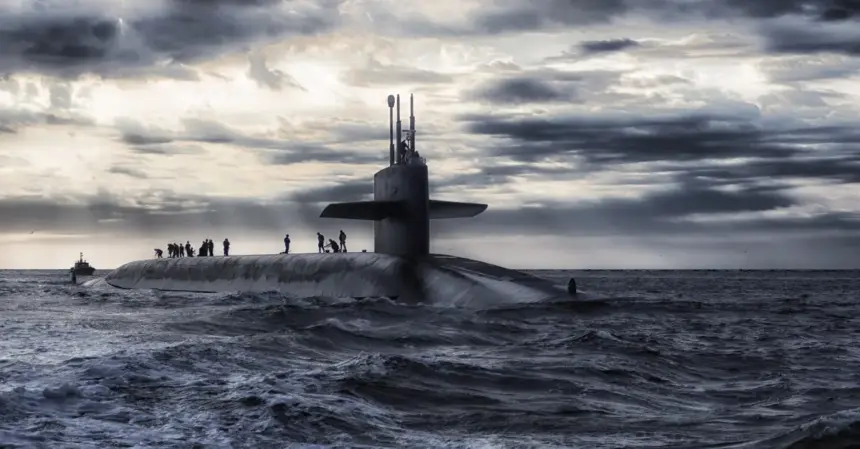
Morocco, which has never operated a submarine, now appears ready to take the step. No official decision has been announced, but the signals are multiplying and point to a delicate choice between France, South Korea, Germany and, further in the background, Russia.
Key takeaways
- Morocco has never operated a submarine and appears to be seriously considering the option.
- No order or official announcement has been made to date.
- The French Scorpène is compact and discreet, suited to narrow waters such as the Strait of Gibraltar.
- The South Korean KSS-III is larger and can launch cruise missiles against land targets.
- The choice is also political: continuity with France or diversification toward South Korea.
An old project that is gaining substance
The idea is not new. For several years, the specialized press has reported Rabat’s interest in a submarine capability. In November 2024, military expert Abdelhamid Harifi still considered the project premature, in comments to Médias24. In his view, the priority should be renewing an aging patrol fleet, and the Scorpène, while an excellent submarine, seemed to him complex and costly given the Royal Navy’s current capabilities.
Since then, the file has changed in nature. In April 2026, Moroccan officers took part as observers in the Turkish exercise Kurtaran-2026, devoted to rescuing submariners in distress. According to Hespress, which relays South Korean projections published by the Spanish outlet Defensa.com, the Kingdom is cited as a possible buyer of three submarines and two patrol vessels, with no official announcement at this stage.
This detail matters more than it seems. A submarine is not bought like a frigate: crews must be trained, a support doctrine built, a base prepared, and safety and rescue procedures mastered. An interest in that last aspect is generally a sign that the thinking is already well advanced.
Why Rabat is thinking about it now
The regional context weighs heavily. According to the media following the issue, Algeria has a fleet of six Russian Kilo-class submarines, some of them able to fire Kalibr cruise missiles at land targets. Spain also operates submarines. In this landscape, Morocco remains without an equivalent beneath the surface.
Geography is also at stake. The Kingdom controls the southern shore of the Strait of Gibraltar, one of the busiest sea passages in the world, and faces the Atlantic along a long coastline. Nizar Derdabi, a defense expert cited by Jeune Afrique, estimates that at least three units would be needed to guarantee a permanent presence at sea, since part of the fleet is always in maintenance or in transit. That figure, three, recurs in most projections.
The Scorpène, or the choice of continuity
Designed by France’s Naval Group, the Scorpène is one of the best-selling conventional submarines on the export market. It is about 67 meters long and has been chosen by several mid-sized navies, with variants fitted with lithium-ion batteries or an air-independent propulsion system, which extends time spent underwater.
Its main strength is its size. More compact, it is suited to confined waters and discreet surveillance missions, which fits the geography of the strait well. It is often likened to a scalpel, a telling image for a precision tool rather than one built for long-range projection.
The French option also has a political dimension. Morocco has already acquired the multi-mission frigate Mohammed VI from Naval Group, bought in 2017 for around 470 million euros according to the specialized press. Renewing this relationship would mean relying on a known partner, proven working habits and industrial support that is already familiar.
The KSS-III, or the bet on power
On the other side, South Korea’s KSS-III, built by Hanwha Ocean, plays in a different category. According to figures relayed by Bladi.net, it displaces about 3,705 tonnes, significantly more than the Scorpène. Hanwha presents it as an ocean-going submarine with lithium-ion batteries and air-independent propulsion, equipped with vertical launch cells.
This architecture allows it to fire cruise missiles at land targets, which extends its role well beyond anti-ship warfare. For a country seeking to project power far from its coasts, this is a weighty argument. Its most advanced version can also carry short-range ballistic missiles, a sensitive capability whose export is strictly controlled. If Morocco were to choose this route, a variant with reduced performance would be required. The information circulating mentions a range limit of 300 km, which corresponds to the threshold set by the Missile Technology Control Regime, although we have not been able to confirm this figure for this specific file.
Several pieces of information point to genuine interest. According to a Hanwha Ocean publication, a high-level Royal Navy delegation, including its chief of staff, was received by the manufacturer. The Spanish daily La Razón stated on July 17 that Hanwha intended to sell two KSS-III Batch-II submarines to Morocco. A report by the investment bank Mirae Asset Securities, relayed by Médias24, anticipates the sale of three KSS-III Batch-I submarines by 2027, at an estimated unit price of 900 million dollars. These estimates are not contractual commitments and mainly serve to identify growth opportunities for South Korean shipyards.
Finally, Hespress reports that the KSS-III is being promoted for shorter production times and costs described as more competitive than European offers, an argument the manufacturer will have to back up with contractual commitments.
The other candidates
The file is not limited to a two-way contest. Germany’s TKMS has confirmed its interest in the Moroccan market, without specifying which model it would offer among the Type 214, 218 and 212CD, according to Médias24. Russia has repeatedly offered its Amur 1650, an option that runs up against the risk of secondary sanctions for a country close to the West. Second-hand units from Greece or Portugal have also been mentioned, cheaper but technologically outdated.
Here are the criteria that should weigh on the decision, as analysts describe them:
- acquisition cost and the cost of keeping the boats operational over several decades;
- delivery times, given that the regional threat is already present;
- land-strike capability, which is absent from some Scorpène configurations;
- technology transfers and the share of production or maintenance carried out in Morocco;
- the supplier’s political and industrial support over the long term.
A technical and geopolitical trade-off
This choice goes well beyond the technical data sheet. Turning to France means consolidating a historic, proven partnership built on trust. Turning to South Korea means diversifying suppliers and opening up to a rising technological power, which is consistent with the interest already expressed in the K2 Black Panther tank and the Cheongung-II air defense system, according to La Razón. In both cases, the message sent is one of strategic autonomy.
Cautious voices are not lacking. Absorbing three submarines for a navy with no experience in the field represents a structural challenge, and specialists warn that such a program is built over ten to fifteen years. A delivery schedule set for 2027, put forward by the South Korean report, seems very optimistic to many of them. Conversely, supporters of a rapid acquisition point out that capability gaps widen as neighbors strengthen their fleets.
There is also the question of Morocco’s Spanish neighbor. The arrival of Moroccan submarines in the strait would force Madrid to review its naval surveillance. It would also raise the question of the balance of power in the western Mediterranean, where every new capability is read by neighboring capitals as a political signal as much as a military one.
What to watch
No firm order has been announced. Several milestones will show how far the file has progressed: a possible call for tenders, the choice of a home base, the launch of a crew training program and the announcement of a budget timetable. Without these milestones, the figures circulating in the press should be read as market hypotheses rather than decisions.
Whoever wins, Morocco is about to join a small club of submarine-operating navies in Africa. It remains to be seen whether it will favor the discretion of the scalpel or the power of the hammer, and above all whether it can build around this choice the ecosystem that will make it truly operational.
FAQ
Has Morocco already ordered a submarine?
No. To date, no order or official announcement has been published. The information available is based on market projections and press reports.
What is the difference between the Scorpène and the KSS-III?
The Scorpène is more compact and designed for stealth in confined waters. The KSS-III is significantly larger and can carry cruise missiles to strike land targets.
Why is Morocco interested in submarines now?
Analysts point to the modernization of the Royal Navy, the surveillance of the Strait of Gibraltar and the desire to close the gap with Algeria, which has six Kilo-class submarines.
How much would such a program cost?
A report by the investment bank Mirae Asset Securities puts the unit price of a KSS-III at around 900 million dollars. This is an estimate, not a negotiated price.