

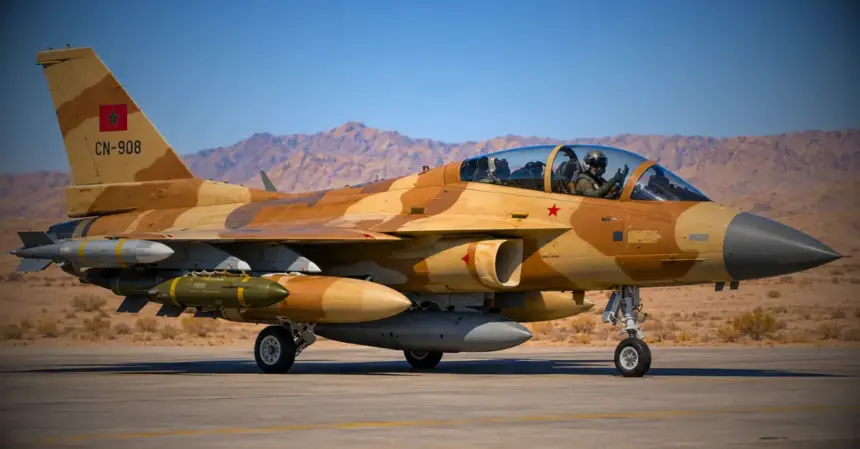
No official announcement has been made at this stage. I am therefore presenting it as a serious and coherent lead, not as a settled decision. It nonetheless deserves analysis, because it fits into a trajectory I have been following for several years: that of a Royal Air Force methodically building a modern, structured combat aviation designed for the long term.
Key takeaways
- Morocco is reportedly considering acquiring the South Korean FA-50, though this has not been officially confirmed.
- The aircraft could succeed the F-5 Tiger III and the Alphajet, without a one-for-one replacement.
- It would serve as both a light fighter and an advanced trainer, alongside the F-16 Block 70/72.
- It would ease the transition of future pilots to the F-16.
- The Marrakech Air Show 2026 could offer the first clues.
A coherent modernization strategy
Morocco does not make its choices haphazardly. The arrival of the F-16 Block 70/72, whose sale Washington approved in 2019, marked a genuine change of scale. This latest-generation aircraft places the Royal Air Force among the best-equipped forces in the region.
Against this backdrop, the thinking around the FA-50 seems logical to me. It would not be a one-for-one replacement of the F-5 Tiger III or the Alphajet, two aircraft that have served steadily and whose crews have built up solid experience. It would rather introduce a new-generation platform capable of taking over part of their missions: light fighter duties, advanced training and close air support.
What the FA-50 would bring in practice
The FA-50 is derived from the T-50 Golden Eagle, developed by KAI in cooperation with Lockheed Martin, the maker of the F-16. This lineage explains its nickname, the “mini F-16”. It does not mean the two aircraft are equals, but it reflects a real technological kinship.
On paper, the aircraft offers several advantages:
- a two-seat airframe, suited to both training and combat;
- a digital cockpit and modern avionics;
- a radar and the ability to employ air-to-air and air-to-ground weapons;
- controlled operating costs compared with a heavy fighter.
I should nonetheless stress that it is a light aircraft, designed to complement the F-16 rather than compete with it.
Pilot training, the decisive asset
In my view, this is the strongest argument in the case. For a force that is developing a fleet of latest-generation F-16s, having a trainer from the same technological family is a strategic investment.
Future F-16 pilots could become familiar with a modern cockpit, with the use of radars, weapons employment and the demands of a high-performance jet, before moving on to the front-line aircraft. It is a natural bridge between advanced training and operations. It improves flight safety, speeds up skills development and optimizes flight hours, which are far more expensive on an F-16.
This approach is shared by many air forces that operate the F-16, and it is one of the reasons the FA-50 has appealed to several of them.
A more robust high-low fighter structure
Specialists use the term “high-low” structure to describe the combination of heavy, high-performance and costly fighters with lighter aircraft that handle the bulk of routine missions.
In this arrangement, the F-16 Block 70/72 would be the spearhead, and the FA-50 a valuable complement. This combination would allow the Royal Air Force to increase the number of combat aircraft available, while reserving its most advanced capabilities for the most demanding missions. I see in this logic the hallmark of careful planning.
A partnership that broadens horizons
Choosing a South Korean supplier would also carry strategic weight. Rabat maintains defense relations with the United States, France and other partners, and this diversification strengthens its freedom of decision. Seoul, for its part, has established itself in recent years among the major arms exporters, and the FA-50 has become one of its flagship products, already ordered by Poland and the Philippines, among others.
Then there is the industrial dimension. Morocco has built a well-regarded civil aerospace sector, with production and subcontracting sites supplying major global manufacturers. A contract of this kind could, if it materialized, open discussions on maintenance, logistical support and possible local spin-offs. Nothing indicates at this stage that such clauses are on the table, but the ground is favorable.
The Marrakech air show as a first milestone
The Marrakech Air Show 2026 will probably offer the first clues: the presence of delegations and exhibitors, and statements on the sidelines of the event. This kind of gathering serves as a showcase for manufacturers and a venue for exchanges with decision-makers.
I will be watching what Rabat says, and above all what it chooses to show. One thing seems certain to me: the Royal Air Force is pursuing a clear move up the capability ladder, built on the latest-generation F-16, and the FA-50 could become its natural complement, both a light fighter and an advanced trainer.
FAQ
Has Morocco officially ordered the FA-50?
No. To date, no order or official statement has been published. The information has been relayed by specialist sources.
Is the FA-50 a “mini F-16”?
The nickname points to a design kinship with the F-16, as Lockheed Martin took part in developing the T-50 from which it derives. It is a lighter aircraft, designed to be complementary.
Which aircraft could the FA-50 replace in Morocco?
It could succeed the F-5 Tiger III for light fighter duties and the Alphajet for advanced training and close support, without a strict one-for-one replacement.
When will we know more?
The Marrakech Air Show 2026 could provide some indications, with no guarantee of an announcement.