


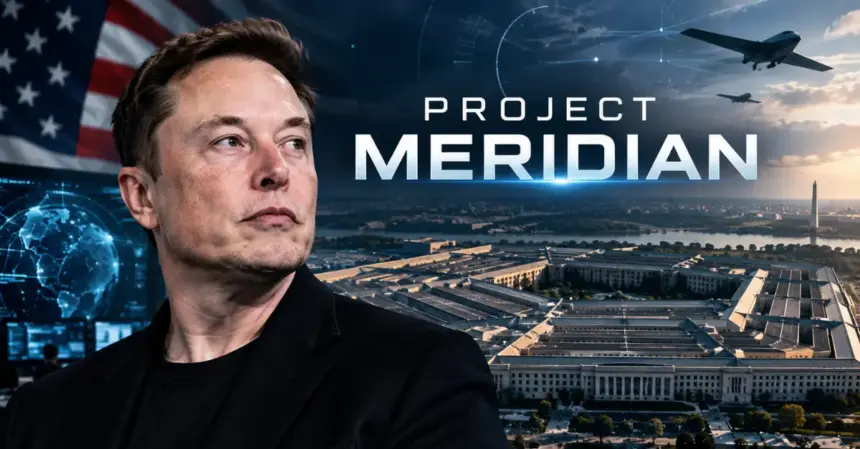
He is taking on an official responsibility for the first time since leaving the Department of Government Efficiency (DOGE) in 2025: co-leading Project Meridian, the 120-day study that Defense Secretary Pete Hegseth announced on September 30, 2026 to rethink the conflicts of the future.
I wanted to understand what this role actually involves, what the Pentagon expects from the entrepreneur, and why his appointment is generating so much debate.
What Project Meridian is
The announcement came during Pete Hegseth’s State of the Force address at Quantico, Virginia. Meridian was one of six initiatives, alongside a command dedicated to autonomous warfare, a competition for a new major military base and an office of religious affairs.
The principle is that of a forward-looking study. Over 120 days, a team is to map next-generation battlefields, from underground spaces to cislunar space, the region between the Earth and the Moon. The phrasing comes from the Pentagon’s own presentation. Hegseth himself spoke of theaters stretching from beneath the Earth to beyond the Moon.
From this mapping, the study is to recommend the technologies and weapons needed to secure American superiority. The secretary was nonetheless careful to say that the project is not about developing new strategies or new policies. It is an exercise in identifying needs, not a decision-making body.
The timeline is precise. The report is due on January 28, 2027, as a public document accompanied by a classified annex.
Elon Musk’s role
Musk is one of three co-leads, alongside Palmer Luckey, co-founder of the autonomous-systems maker Anduril, and Newt Gingrich, the former Republican Speaker of the House. The whole effort is overseen by Emil Michael, the Pentagon’s chief technology officer and a former Uber executive. A broader team drawn from government, industry, academia and think tanks is to support them.
For the entrepreneur, this is a return to the machinery of government by a route other than DOGE. His precise legal status in the mission, whether adviser, special government employee or another arrangement, is not spelled out in the sources I consulted. As I write, I have also found no public statement from him on the appointment. A specialist outlet noted that he had not reacted on the evening of the announcement.
It should be added that the study covers areas where his companies are already active. SpaceX is a major Pentagon supplier for launches and satellite communications. According to the specialist press, the company won a $4.16 billion Space Force contract in May 2026 for threat-tracking satellites, then another worth $2.29 billion for a military communications network. Its artificial intelligence arm, xAI, obtained a contract in July 2025 with a ceiling of $200 million.
Key figures
- Announcement: September 30, 2026, at Quantico, by Pete Hegseth
- Duration: 120 days
- Report due: January 28, 2027, public version and classified annex
- Co-leads: Elon Musk, Palmer Luckey, Newt Gingrich
- Oversight: Emil Michael, the Pentagon’s chief technology officer
- Scope of the study: from underground depths to cislunar space
A close link between the study and Musk’s activities
Several outlets have noted that Meridian’s scope partly overlaps with the activities of Musk’s companies. The tunnels of The Boring Company point to underground environments, and Starship’s lunar ambitions to cislunar space. Musk is not the only one concerned: Palmer Luckey runs Anduril, which produces autonomous systems and, according to the press, holds a contract worth up to $642 million over ten years with the Marine Corps for counter-drone work.
This proximity is at the heart of the controversy. Critical media outlets and watchdog organizations speak of a major conflict of interest, particularly since none of the three co-leads has served in the US military, as some of those outlets point out. The objection does not assume bad faith. The same person can bring real expertise while benefiting from the decisions he helps shape. The question is one of safeguards: disclosure of interests, recusal rules, access to sensitive information. To my knowledge, the department has not publicly detailed these arrangements.
The arguments of the project’s defenders
Supporters of the approach offer a different reading. In their view, the Pentagon absorbs technological breakthroughs too slowly, as the war in Ukraine showed, where low-cost drones upended practices within a few months. Involving those who design these technologies would shorten the gap between innovation and use.
They also point out that Meridian awards no contracts or budgets, that its duration is limited and that its report will be public. Hegseth himself acknowledged that there are obvious biases and risks in the Pentagon asking the questions and answering them on its own, which, in this view, justifies seeking outside perspectives. Gingrich’s presence, as a political rather than an industrial figure, is finally presented as a partial counterweight.
These arguments are reasonable, but they do not settle the question. A public report can durably steer equipment choices without any formal rule being broken.
A project within a broader overhaul
Meridian is part of a reform driven by Pete Hegseth. According to Newsweek, he has notably doubled the target for cutting general and admiral positions announced last year, which Democratic lawmakers have called a dangerous purge, while his supporters see it as correcting an overly heavy hierarchy.
This logic, which consists of lightening traditional structures and creating commands dedicated to emerging technologies, finds its forward-looking component in Meridian. It amounts to a bet on agility, with the risk of weakening institutional expertise.
The relationship between Hegseth and Musk has not always been smooth either. In 2025, the New York Times reported disagreements between the two men over the scale of cuts to the Pentagon’s civilian workforce. The current alliance is therefore far from automatic.
What to watch between now and January 2027
Three elements seem decisive to me. The first is the makeup of the broader team: will it include active-duty officers, military historians and representatives of allies, or mostly industry figures? The second is the ethics regime applied to the co-leads. The third is the substance of the report, and in particular the balance between the public version and the classified annex: what remains secret will, by definition, be hard to assess.
A study judged on its method as much as its conclusions
The three co-leads know their subjects, and nothing suggests that Meridian will not produce relevant analysis. But in a field where the line between expertise and interest is this thin, the credibility of the report will depend as much on how it was conducted as on its recommendations. That is the standard by which the January 28, 2027 document should be read.
FAQ
Has Elon Musk become a member of the military?
No. He co-leads a Pentagon study of future warfare, with no rank or military enlistment. His precise status in this mission has not been publicly detailed.
What is Project Meridian supposed to produce?
A mapping of next-generation battlefields, from underground depths to cislunar space, and recommendations on the technologies and weapons required. The report is due on January 28, 2027, with a public version and a classified annex.
Who leads the project?
Elon Musk, Palmer Luckey and Newt Gingrich co-lead it, under the authority of Emil Michael, the Pentagon’s chief technology officer.
Why is there talk of a conflict of interest?
Because SpaceX and Anduril are already major Pentagon suppliers and sell the kind of technology the study may recommend. Any safeguards have not been detailed.