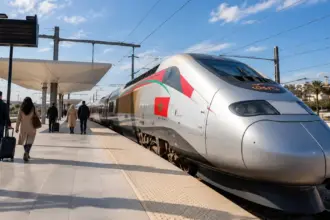


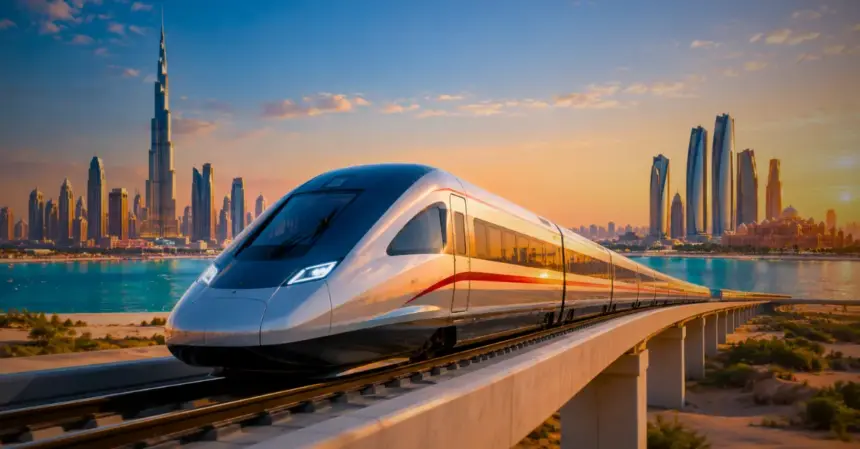
It arrived in Abu Dhabi at 7:18 a.m., making the journey one hour and four minutes, according to Emirati media. I do not see this as simply a transport event: the Dubai-Abu Dhabi corridor is the busiest in the country, and the way it develops will say a great deal about the United Arab Emirates’ mobility strategy.
What is changing in practical terms
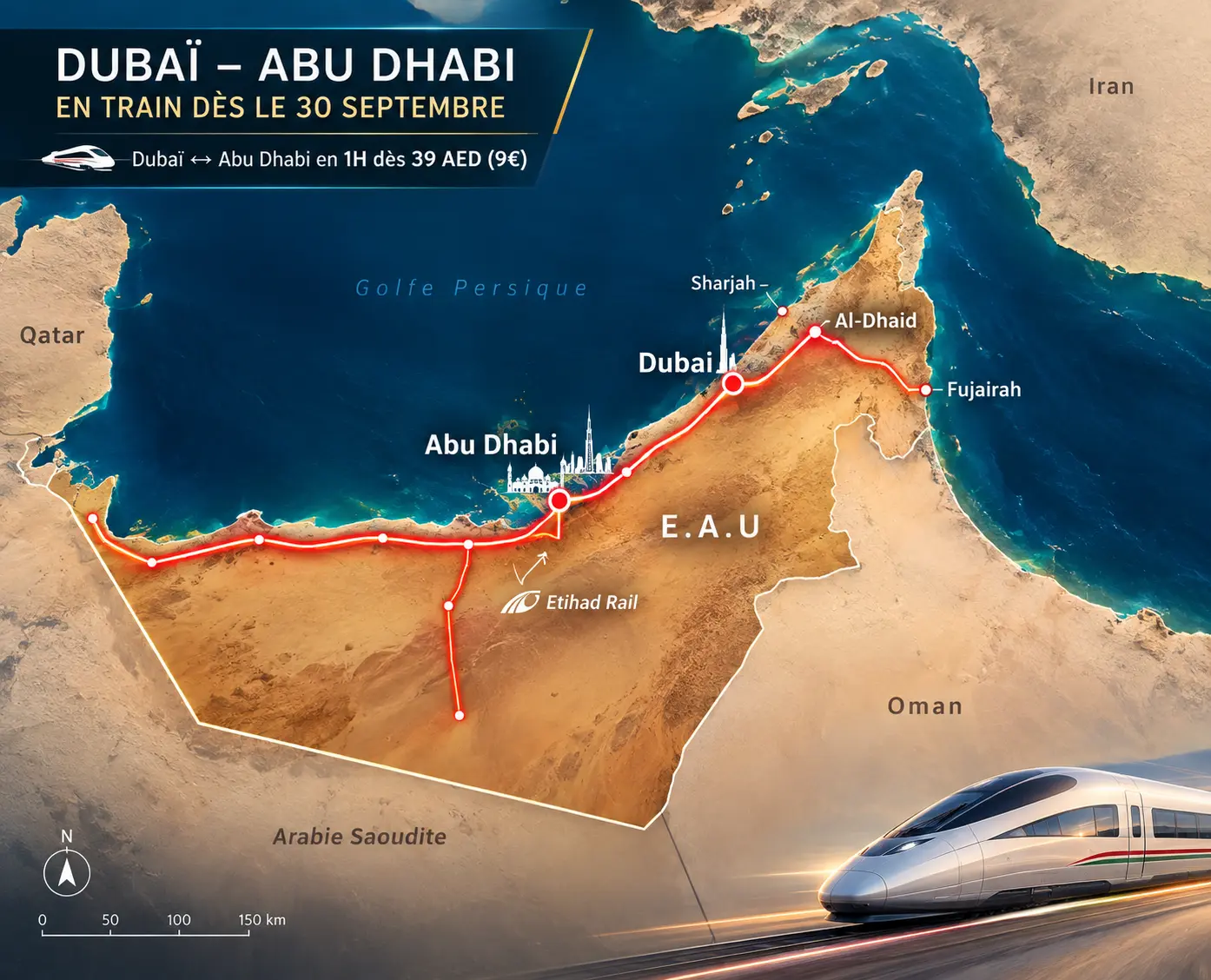
Etihad Rail, the national railway operator, runs ten daily services between Dubai and Abu Dhabi, five in each direction. These are joined by six daily services between Abu Dhabi and Fujairah, which opened on June 30. Dubai is therefore joining the passenger network three months after the country’s first passenger rail line opened. The trains are operated by Etihad Rail Mobility, a joint venture between Etihad Rail and French operator Keolis.
Launch fares start at 39 dirhams (around €9) in Comfort class and 109 dirhams in Premium class. Prices vary depending on the date and time, and each class offers several levels of flexibility. Tickets are available on the operator’s website, through its app and from ticket machines at stations. On board, passengers have access to Wi-Fi, charging outlets and luggage storage areas.
Here are the key figures to remember:
- Dubai-Abu Dhabi journey time: 1 h 04 min for the first commercial train
- Frequency: 10 daily services, 5 in each direction
- Launch fares: from 39 dirhams (Comfort) and 109 dirhams (Premium)
- Fujairah: 6 daily services from Abu Dhabi, with tickets from 29 dirhams from Dubai
- Dubai station: Al Yalayis, located in the Jumeirah Golf Estates area
A highly political inauguration
The previous Monday, Emirati President Mohammed bin Zayed traveled by train from Abu Dhabi to Dubai, ahead of the opening of the new station. The symbolism is far from insignificant. In a federation where the seven emirates retain a high degree of autonomy, particularly in economic and urban matters, a national railway network is also an instrument of integration. Dubai and Abu Dhabi are both competitors and complements: one is a global commercial and tourism hub, while the other is the federal capital and the country’s energy and financial center of gravity.
The railway project was for a long time associated primarily with freight. The first phase of the network, dedicated to cargo transportation, preceded the arrival of passenger services by several years. An Etihad Rail Mobility commercial executive described the launch as a “defining moment” for transportation in the country. Officials had repeatedly said that passenger rail was a long-term ambition, one that has now become a reality.
Reducing road congestion, a central challenge
The main argument put forward by the authorities is the reduction of road congestion. According to information reported by the local press, the country’s vehicle fleet is growing by more than 8% per year. I have not been able to cross-check this figure with a primary source, so it should be confirmed before publication. However, it reflects a reality familiar to anyone who has driven on the E11 highway during rush hour: the approximately 140-kilometer corridor carries a considerable volume of commuters, workers, tourists and freight traffic every day.
The train offers an alternative in one specific respect: predictability. A one-hour journey, regardless of traffic conditions, changes the equation for someone who works on one side and lives on the other. However, the actual time savings will depend on the “last mile.” Dubai’s Al Yalayis station is not located in the historic heart of the city, and a passenger’s total journey also includes getting to the station, waiting and making connections upon arrival. Operators promise integration with the metro and the Dubai Roads and Transport Authority’s nol card, with a single QR code for the ticket. The quality of this intermodal integration will be the real test. It will be a test of usability, not just engineering.
The challenge of changing habits
The UAE is among the countries where private car use is most deeply embedded in everyday life: historically cheap fuel, a dense road network and sprawling urban development. Convincing motorists to switch means making the train competitive in terms of price, punctuality and convenience. The 39-dirham entry fare is a strong signal. The question is whether it will remain at that level beyond the launch period. Operators are also relying on segmentation, with different classes, flexibility levels and variable pricing depending on the schedule, suggesting a more sophisticated business model than a simple flat fare.
Capacity also needs to be considered. Ten trains per day represent a limited offering compared with the daily flows along the corridor. This is therefore more of a first step than a definitive answer to congestion. Any increase in frequency, if announced, will be one of the indicators to watch closely.
Tourism and real estate: effects to watch
For tourism, the train makes Dubai-Abu Dhabi combinations easier (Louvre Abu Dhabi, the Grand Mosque, theme parks) without the need to rent a car. Operators also believe the service should support economic growth. This is a plausible assumption, but the actual effects remain to be measured.
From a real estate perspective, the arrival of a railway station traditionally changes how certain neighborhoods are perceived. Areas close to stations, both in Dubai and Abu Dhabi, could become more attractive to professionals who work between the two cities. I remain cautious, however: no published market data currently makes it possible to quantify this effect, and developers naturally have an interest in highlighting it.
What comes next
The launch opens the door to a more ambitious phase. Operators have indicated that the network, which is approximately 900 kilometers long, is ultimately intended to serve all seven emirates. Passenger services are also expected to reach several cities in the western and eastern parts of the country. A high-speed rail project between Abu Dhabi and Dubai has also been presented, with an announced speed of 350 km/h, although its timeline remains to be confirmed.
One question remains open: will rail become a form of everyday transportation, or will it remain a premium and sightseeing product? Passenger numbers during the first few months, fare levels after the launch period and the speed at which the network is expanded will provide some answers.
Frequently asked questions
How long does the train journey between Dubai and Abu Dhabi take?
Approximately one hour and four minutes for the first commercial train, according to Emirati media.
How much does a ticket cost?
Launch fares start at 39 dirhams (around €9) in Comfort class and 109 dirhams in Premium class. Prices vary depending on the date and time.
Where can tickets be purchased?
On the Etihad Rail website, through its mobile app and from automated ticket machines at stations.
Where is the Dubai station located?
It is called Al Yalayis and is located in the Jumeirah Golf Estates area, according to local media.