The Emirates have accelerated their operational build-up, while Morocco has consolidated an internationally recognized academic and observational foundation. The Moroccan-Emirati Bridge initiative, led by the Space Generation Advisory Council (SGAC), aims precisely to link these two dynamics. A concrete milestone is set for December 9, 2026, with the event “The Moroccan-Emirati Bridge – An Educational Space Mission,” held simultaneously at the École Mohammadia d’ingénieurs in Rabat and at the Sharjah Space and Astronomy Hub.
Coordinated by Zineb Bouaoudate, an aerospace engineer and SGAC’s national point of contact for Morocco, the initiative notably involves Professor Zouhair Benkhaldoun, a Moroccan astrophysicist, founder of the Oukaïmeden Observatory and now director of observatories at the Sharjah Space and Astronomy Hub (University of Sharjah). Backed by the UAE Space Agency, the Mohammed Bin Rashid Space Centre and Airbus, it aims to structure collaborations around astronomy, Earth observation and space technologies.
The assets already in place on both sides
The Emirates have achieved visible milestones. The Hope probe, part of the Emirates Mars Mission, was launched in July 2020 and entered Martian orbit on February 9, 2021, making the country the first Arab state to reach Mars. The mission, originally planned for two years, has been extended until 2028; it has produced around ten terabytes of data on the Martian atmosphere, made available to the scientific community.
In Earth observation, MBZ-SAT, launched in January 2025 and largely developed by Emirati engineers (about 90% of its mechanical structures were manufactured locally), offers high-resolution optical capabilities. Etihad-SAT, launched in March 2025, provides synthetic aperture radar (SAR) capability that is independent of weather conditions. On the lunar front, the Rashid 2 rover, whose development is complete and which notably includes a ground-penetrating radar, is being prepared for a mission to the far side of the Moon planned for 2026 aboard Firefly Aerospace’s Blue Ghost lander.
Morocco is no newcomer. The Oukaïmeden university observatory, located at an altitude of about 2,750 meters in the High Atlas and long directed by Zouhair Benkhaldoun, hosts several international programs. The MOSS (Morocco Oukaimeden Sky Survey) program, active since 2011 with a 500 mm telescope, has contributed to the discovery of numerous asteroids, comets and near-Earth objects. In the first half of 2026, three new near-Earth objects were identified: 2026 GU2 (Apollo type), 2026 GW3 and 2026 LS (Amor types), validated by the Minor Planet Center.
The RENOIR experiment, installed since November 2013 as part of the International Space Weather Initiative, studies the thermosphere and ionospheric disturbances using a Fabry-Perot interferometer and a wide-field camera; this data directly concerns radio communications, satellite navigation systems and space technologies. The observatory has also taken part in major collaborations, including the discovery of the TRAPPIST-1 system. In Rabat, the University Center for Space Technology Research (CURTS) of Mohammed V University, hosted at the École Mohammadia d’ingénieurs, designed and operated two university nanosatellites launched in August 2024 (UM5-EOSat for Earth observation and UM5-Ribat for telecommunications and data collection).
Networking rather than duplicating
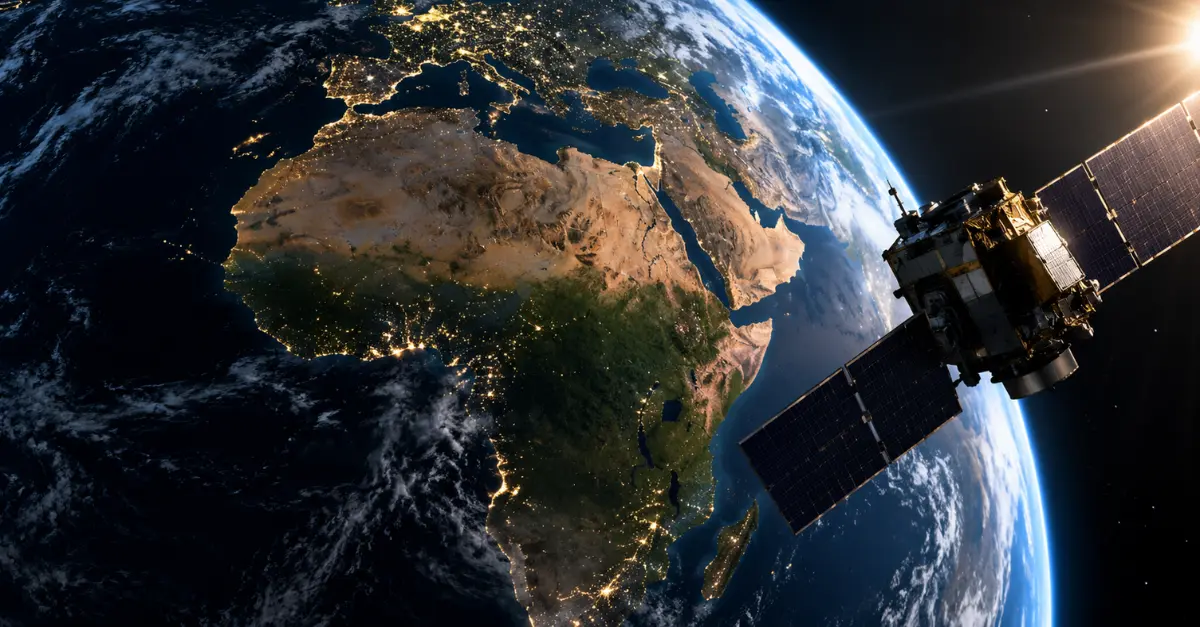
One of the most concrete areas of cooperation lies in networking infrastructure. In Sharjah, the Al Qasimi Observatory project notably includes a one-meter optical telescope, a station for monitoring artificial objects in orbit (Space Situational Awareness) and an optical telecommunications station intended to test space communications by laser. Zouhair Benkhaldoun sees it as a foothold for coordinated campaigns with Moroccan sites: monitoring of satellites and orbital debris, observation of near-Earth objects, and joint research in astrophysics.
The geographical complementarity of the sites (the Moroccan Atlas and Emirati locations) can improve the temporal coverage of certain observations. In space weather, research on ionospheric disturbances is of direct interest to both countries for the reliability of GNSS systems and communications. In Earth observation, using satellite data to monitor water resources, desertification, climate change and environmental risks offers a shared field of application in arid and semi-arid environments. The stated goal is to build mixed teams capable of covering the entire chain: acquisition, processing, modeling and exploitation of results.
- Identified priority areas: orbital monitoring and debris (SSA), tracking of near-Earth objects, space weather (ionosphere), Earth observation applied to the environment and resources, training and mobility of researchers and students.
- Partners involved: Sharjah Space and Astronomy Hub, CURTS (Mohammed V University / EMI), Mohammed Bin Rashid Space Centre, UAE Space Agency, Airbus.
Training, talent and the industrial dimension
Beyond scientific projects, the stakes are institutional and human. The initiative intends to facilitate exchanges between students, researchers, engineers and professionals, as well as partnerships between universities, research centers and industrial players. The December 9, 2026 event, educational in nature and held simultaneously in Rabat and Sharjah, fits into this logic of introducing younger generations to space issues and connecting communities.
Benkhaldoun stresses that the goal is not to replicate the same infrastructure in both countries, but to build a network of complementary skills and resources. For Morocco, this can help better structure an ecosystem combining academic research, technological innovation and training, building on already recognized achievements. The presence of Airbus among the backers also opens a potential industrial dimension, notably around software, electronics, artificial intelligence applied to data, or embedded systems.
Strategic stakes and outlook
This cooperation takes place in a broader context. Political and economic relations between Morocco and the Emirates are already dense, with significant Emirati investments in Moroccan energy and water infrastructure. Space adds a layer of scientific cooperation and soft power. For the Emirates, it is about continuing economic diversification and building national skills beyond hydrocarbons. For Morocco, it is about making the most of existing academic and observational expertise and strengthening its participation in international projects.
The stakes are also practical: monitoring debris and near-Earth objects matters for orbital safety; Earth observation data serves resource management and climate adaptation; space weather determines the reliability of digital infrastructure. The success of the initiative will, however, depend on its ability to move beyond one-off events to produce concrete pilot projects, joint publications, mobility programs and lasting skills. As Benkhaldoun points out, success will be measured less by the number of agreements than by the ability to develop new skills and tangible results.
December 9 will mark a first visible step. What follows will depend on the strength of the collaboration mechanisms and the willingness of institutions on both sides to turn the identified complementarities into operational programs.
Frequently asked questions
What is the Moroccan-Emirati Bridge?
An initiative led by the Space Generation Advisory Council aimed at bringing the Moroccan and Emirati scientific communities closer together around projects in astronomy, Earth observation and space technologies, with a first educational event on December 9, 2026.
What are Morocco’s main assets in this field?
The Oukaïmeden Observatory (notably the MOSS and RENOIR programs), the teams at Cadi Ayyad University, and CURTS at Mohammed V University (university nanosatellites launched in 2024).
Why is this cooperation relevant now?
The Emirates have developed advanced operational capabilities (Mars, Earth observation, lunar program) while Morocco has a solid observational and academic base; the geographical and thematic complementarity (orbital monitoring, space weather, Earth observation) offers concrete avenues.