


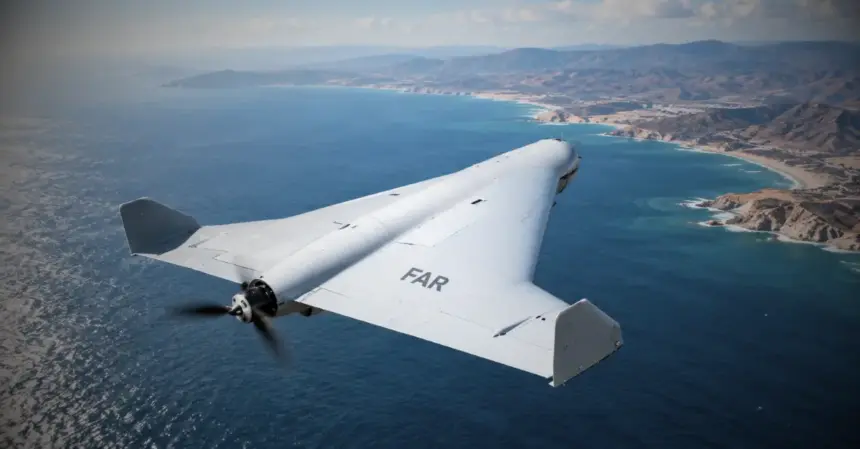
On September 28, a company based in Rabat unveiled the prototype of a Moroccan kamikaze drone said to fly without GPS. Twenty-four hours later, a Madrid daily announced in its headline that the kingdom now had a device capable of reaching any point in Spain. I read that article, then the ones around it. What emerges says less about the drone than about the mindset of the Spanish press.
A Spanish press that worries from the headline
Let’s start with the facts. Ballistic Defense System (BDS), a defense company based in Rabat, announced that it had completed the first version of an autonomous prototype, along with a video of tests carried out in Morocco. It claims a range of 2,000 km, satellite-independent navigation and onboard artificial intelligence. On September 29, The Objective drew an unqualified conclusion in its headline: the entire Spanish territory would fall within the device’s range of action.
The body of the text is more measured, and that is where the gap appears. The newspaper acknowledges that the 2,000 km figure comes from the manufacturer, that no independent verification exists and that the device has not been certified by the Royal Armed Forces. It even specifies that no military order is known. In other words, the hurried reader takes away the fear, while the attentive reader discovers that the article itself defuses it.
What the Moroccan kamikaze drone announcement really says
Let’s take the announcement for what it is. BDS describes a navigation system based on reading the terrain: the drone compares what it perceives of the ground with elevation maps stored onboard, which would allow it to keep its course when the GPS signal is jammed or spoofed. Three AI modules take over from one another, for navigation, target search and the final phase, with all computing done onboard using off-the-shelf sensors. According to the company, the prototype was developed in less than 18 months for less than 1.15 million dollars.
These figures are declarative and I treat them as such. But the trajectory can be verified, and the Spanish press itself points it out: in 2024, BDS showed at the Marrakech Air Show a device that was still remotely piloted. In less than two years, the company says it has crossed the threshold of autonomy. That is the real story, and it is technological before it is military.
🇲🇦🇪🇸 𝗗𝗿𝗼𝗻𝗲 𝗸𝗮𝗺𝗶𝗸𝗮𝘇𝗲 𝗺𝗮𝗿𝗼𝗰𝗮𝗶𝗻, 𝗹𝗮 𝗽𝗿𝗲𝘀𝘀𝗲 𝗲𝘀𝗽𝗮𝗴𝗻𝗼𝗹𝗲 𝗲𝗻 𝗽𝗮𝗻𝗶𝗾𝘂𝗲 ❌ #maroc #España
Le 28 septembre, une entreprise de Rabat a présenté le prototype d’un drone kamikaze marocain censé voler sans GPS.
👉 https://t.co/YFSnZZ5UNl pic.twitter.com/ADLSdoSd77— Silicon Valley (@SiliconValleyMa) September 30, 2026
Concern fueled by a climate of tension
Why does this prototype resonate so strongly in Madrid? Because it lands in an already charged context. In the previous week, the Spanish press had run a string of stories about its southern neighbor: Moroccan F-16s displayed near Melilla, the announced arrival of Israeli defense companies in Morocco, drones spotted around the autonomous city. One incident stood out in particular: according to El Español, a drone operating on the Moroccan side delayed the landing of a commercial flight at Melilla, and the Government Delegation asked Rabat to review the flight altitude of its devices. The media, incidentally, describe the origin of the device in different ways, which shows that the situation is far from clear.
Back in June, the outlet Moncloa was already discussing a “drone race” between the two countries, questioning whether the Spanish SIRTAP drone could compete with the Moroccan arsenal. BDS’s drone therefore arrives in a debate where Morocco is perceived as the threat from the outset, whatever the nature of the announcement. I see a framework of interpretation that precedes the facts.
Fear as a substitute for strategic debate
This is the point I find most troubling. Legitimate concern can lead to a useful question. Here, it mostly leads to a headline. Yet the real questions lie elsewhere: where does Spanish counter-drone defense stand? What low-cost production capacity has Europe retained from the lessons of Ukraine? And how do we explain that a company announcement, with no known public order, takes up more space than the kingdom’s industrial buildup, which is nonetheless well documented?
To my knowledge, and after research, I found no official reaction from the Spanish authorities to BDS’s announcement. The panic, if we hold to the word, is therefore mostly a media one. It sits poorly with the stance of a country that presents itself as a partner of Morocco on migration and security issues. It is telling that a Moroccan technological advance is read first as a danger, and never as the sign of a neighbor building up its skills.
What this drone changes for Spain
If the announced range were confirmed, the whole of Spain would be covered: according to my own as-the-crow-flies calculations, to be verified, there are a little over 1,000 km between Rabat and northern Galicia, and about 1,300 km to Catalonia. But I note that the margin goes well beyond the peninsula. Such a range would concern a good part of Western Europe, which shows that the subject is not specific to Spain. The device, incidentally, did not target any particular country in the video.
What really changes lies elsewhere. A Moroccan private player is demonstrating that it can design jamming-resistant navigation, an issue that has worried every army since Ukraine and the Middle East. The industrial framework, for its part, is solid: Morocco created a legal regime for national military manufacturing in 2020, inaugurated a Tata Advanced Systems plant in Berrechid in September 2025, and attracted BlueBird Aero Systems and Baykar to Benslimane. BDS embodies the next step, national design, with software and data that stay in Morocco.
The usual reservations apply, and I own them: a filmed test is not an operational campaign, and how the system behaves over the sea or flat terrain remains to be demonstrated. BDS, for its part, announces a demonstration in real conditions, which will be the real test.
A concern that says a lot
I take away a contrast from this sequence. On one side, a Moroccan company whose technical progress is measurable and backed by the state. On the other, part of the Spanish press reacting with alarm before analysis. Spain would gain more by questioning its own preparedness than by being moved by a prototype. The real question is whether BDS can move from demonstrator to reliable system, and whether Madrid can respond with something other than headlines.
FAQ
Why is the Spanish press worried about this drone?
Because BDS announces a range of 2,000 km, which would cover the entire Spanish territory, in a context of tension around Melilla.
Is the drone in service in Morocco?
Nothing indicates so. No order from the Royal Armed Forces has been made public.
Who is behind this project?
Ballistic Defense System, a company based in Rabat, led by aerospace engineer Fahd Laamoumi.