


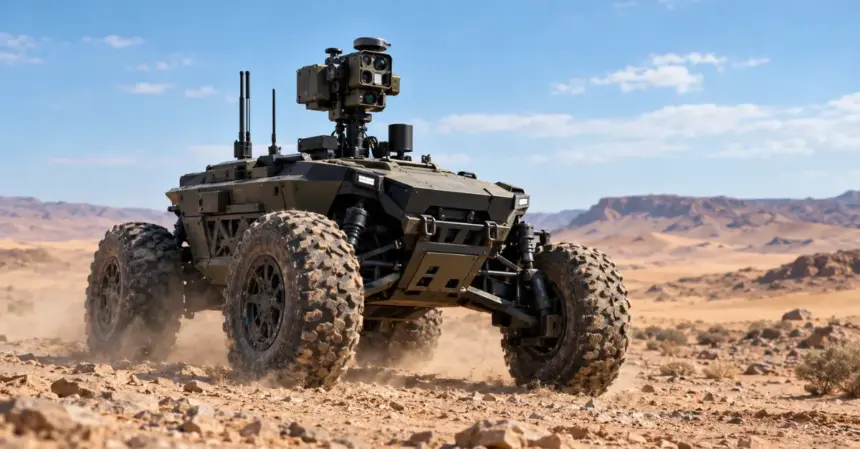
This was no longer simply a matter of testing surveillance drones or electronic-warfare tools, as in previous editions of African Lion, but of integrating autonomous ground vehicles directly into assault maneuvers alongside conventional troops. This discreet but significant evolution illustrates a broader doctrinal change within the US Army, for which Morocco has become a preferred testing ground.
Cap Draa, a Laboratory for Robotic Combat
The exercise took place as part of African Lion 2026, US Africa Command’s largest annual maneuver, held from April 20 to May 8 across several sites in Morocco, Tunisia, Ghana, and Senegal. Soldiers from the US Army’s 173rd Airborne Brigade and 7th Engineer Brigade, along with Marines from the 2nd Combat Engineer Battalion, took part in the scenarios run at Cap Draa, in Morocco’s Sahara Desert.
It was there that industry partner Overland AI stepped in, deploying two autonomous ground vehicles from its ULTRA line. These vehicles carried out coordinated breaching, fire-support, and defensive missions in direct coordination with US forces on the ground at Cap Draa. In practice, one vehicle fitted with a remote weapon station provided stand-off fire support during a simulated counter-attack, while a second, equipped with an obstacle-breaching system, cleared a path through wire obstacles alongside dismounted infantry. In a separate defensive scenario, an ULTRA vehicle also deployed XM204 munitions to shape terrain obstacles.
The guiding idea is straightforward: let the machines absorb the initial risk of contact before soldiers enter the danger zone. According to Moroccan expert Abdelhamid Harifi, quoted by Médias24, African Lion 2026 introduced, for the first time, robots into combat logistics as well as mobile robotic targets at Cap Draa — a setup considered valuable because it confronts soldiers directly with the realities of terrain and operational stress.
Artificial Intelligence at the Heart of Command
The other novelty of this edition lies less in the machines themselves than in how they are directed. For the first time in the exercise’s history, command and control were assisted by artificial-intelligence systems, which noticeably shortened the decision cycle and the kill chain. SETAF-AF, which oversees US forces in Africa, summed up the objective by stressing the goal of turning technological innovation into genuinely operational capability.
This approach fits into a broader trend observed on this theater for several years. Back in 2024, the Arcane Thunder exercise near Agadir already had the US Army’s 2nd Multi-Domain Task Force (2nd MDTF) testing detection and neutralization tools with Morocco’s Royal Armed Forces. That unit’s mission is to hunt down enemy radars and radio transmitters, pinpoint them precisely, and neutralize them — either temporarily, using drone-borne jammers, or permanently, through lethal means. The exercise notably deployed two types of fixed-wing drones: the Kraus Hamadi Aerospace K-1000, a solar-powered aircraft able to stay airborne for days, and the Shield AI V-BAT, heavier but capable of vertical takeoff and landing without any runway. Electronic-warfare data was already being shared in near real time between American and Moroccan units via WinTAK, a civilian version of the tactical software used by the US military.
The 2026 trial at Cap Draa is therefore less a break than a continuation: it extends that same logic from electronic detection to physical assault and breaching operations.
Morocco, a Future Regional Hub for Robotic Warfare
This shift comes alongside an even more structural project: the creation, on Moroccan soil, of a regional training center for unmanned aerial systems intended to serve the entire continent. The announcement was made in March 2026 by General Christopher Donahue, commander of US Army Europe and Africa, at the 13th African Land Forces Summit in Rome. The summit brought together roughly 300 participants from 47 countries to discuss security challenges and the integration of new technologies across the continent. General Donahue described the future center as a sustainable capability, one meant to eventually expand to other parts of Africa once its effectiveness is proven.
A pilot phase, involving around sixteen participants, was folded into African Lion 2026. This multinational drone academy, the first of its kind, wrapped up alongside the close of the exercise and stands as the first step toward a permanent regional center in Morocco. The choice of the Kingdom is no accident: the country offers an uncongested electromagnetic spectrum and largely open airspace, training conditions considered hard to replicate elsewhere. The project has since cleared an additional institutional hurdle: in early June, the US House Armed Services Committee explicitly referenced the center in its markup of the fiscal year 2027 defense budget, while directing the Pentagon to detail its strategy for training African partners on drone systems.
This momentum coincides with the growth of Morocco’s own defense industry. In 2025, Morocco granted licenses for ten drone projects worth more than $260 million, with the stated ambition of building a domestic industrial base able to supply the Moroccan military while also exporting to the region. Among the achievements of this nascent sector is the Atlas Istar, Morocco’s first domestically designed and manufactured military drone, developed by Aerodrive Engineering Services for surveillance and intelligence missions.
A few chronological markers help track the trajectory on this theater:
- August 2024: Arcane Thunder exercise near Agadir, first electronic-warfare trials involving the US 2nd MDTF.
- March 2026: General Donahue announces a regional drone training center for Morocco at the Rome summit.
- April 20 – May 8, 2026: African Lion 2026, including the first multinational drone academy.
- May 4, 2026: robotic assault trial at Cap Draa, featuring Overland AI’s ULTRA vehicles.
- June 2026: the regional center project enters the US Congress’s budget review process.
A Technical Partnership Rather Than Direct Engagement
What these successive exercises trace out is less the image of the US military substituting itself for local forces than a model of gradual capability transfer. The doctrine put forward by American officials entrusts autonomous systems with the most exposed initial missions — reconnaissance, mine clearance, threat identification — in order to protect the soldiers, American and Moroccan alike, who are then committed during the decisive phase. This logic owes much to lessons drawn from the war in Ukraine, where dense adversary sensor networks and strike capabilities have made conventional infiltration considerably costlier in human lives.
For Rabat, the interest goes beyond joint training alone. Access to these technologies, paired with the development of a national drone industry, fits into a declared ambition to reduce the Kingdom’s reliance on foreign arms suppliers. Several unknowns remain, however: the precise timeline for opening the regional center has yet to be set, its funding still depends on decisions by the US Congress, and the planned addition of electronic-warfare modules to the regional training program later this year has not yet been confirmed in detail by the relevant authorities. It is on these points that the coming months will determine whether this technological partnership between Washington and Rabat is truly realized.
FAQ
What exactly happened at Cap Draa on May 4, 2026?
Overland AI’s autonomous ULTRA ground vehicles carried out coordinated breaching and fire-support missions alongside American and Moroccan troops during a simulated combat exercise.
Will Morocco host a permanent US military facility?
A regional drone training center was announced for Morocco in March 2026, but its funding and opening timeline still depend on review by the US Congress.
Are these robots replacing soldiers?
No: the doctrine presented by US officials assigns autonomous systems the riskiest initial missions to reduce troop exposure, not to replace human forces.
How does this connect to the 2024 Arcane Thunder exercise?
Arcane Thunder, held near Agadir in 2024, tested electronic detection tools. The 2026 Cap Draa trial extends that same logic to physical assault operations.