

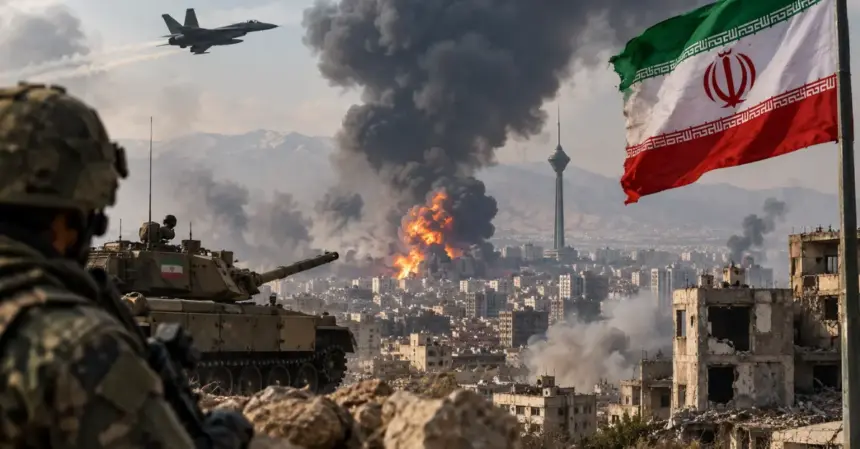
The interview given by General Fabien Mandon, Chief of the Defence Staff, finally offers first-hand answers about what French forces have experienced since that Saturday that plunged the Middle East into war. Between strategic surprise, a lightning naval deployment, and human losses, this account paints the most complete picture to date of France’s role in this conflict.
A war that caught the general staff off guard
What stands out immediately in General Mandon’s account is the total absence of advance warning from the Americans. Despite weekly encrypted exchanges with his American counterpart, France received no prior information about the launch of the strikes. French intelligence services had detected signals of an imminent attack — a buildup of American forces in the region, rising diplomatic tension — but the final decision remained a strictly American-Israeli prerogative.
This lack of upstream coordination is far from a footnote. It’s a reminder of something we tend to forget: even the strongest alliances leave each nation in sole control of its own military timeline. For France, with nearly 400,000 nationals living or working across the Gulf, the news immediately took on existential weight.
France on alert from the very first hours
As soon as the strikes were announced, French bases from the Levant to Djibouti shifted into defensive posture. Rafale pilots already stationed in the region had to switch within hours from an air-to-ground configuration to an air-to-air one, to defend French installations and partner airspace. On the very first day, French crews were already shooting down drones and missiles targeting Gulf countries.
This shift illustrates a principle French military doctrine has championed for years: the need for forward-positioned forces, ready to react “at the drop of a hat.” Without this prior presence in the Gulf, immediate protection of French nationals and interests would simply not have been possible.
The Charles de Gaulle, a record-speed deployment
One of the most striking episodes of this engagement remains the redeployment of the aircraft carrier Charles de Gaulle. Initially taking part in an exercise off Norway, the carrier strike group turned around after missile and drone strikes hit Cyprus, a European territory now targeted by Iranian proxies. Destination: the Eastern Mediterranean, via the North Sea, the English Channel, the Bay of Biscay and Gibraltar — 6,000 kilometers covered in six days, a feat never before achieved by the French navy.
The naval group was later joined by Italian, Spanish and Dutch frigates, while Greece joined in protecting Cyprus. Once in position, the deployment represented roughly 3,000 personnel, twenty Rafale jets, six frigates, a nuclear attack submarine and a supply ship — a force nearly equal to what was already deployed in the Middle East before the crisis.
Against Iranian drones, a war of economic attrition
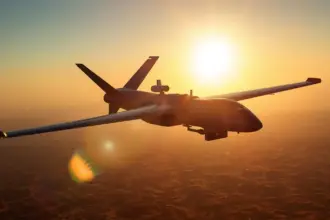
General Mandon points to a dimension of the conflict that’s often underestimated: the “dronization” of the battlefield. Iran relied on massive volumes of cheap drones to saturate enemy defenses, forcing Western armies to rethink their responses, since sophisticated missiles are far too expensive to counter this kind of threat. Several solutions emerged within just a few weeks, a rare display of industrial responsiveness:
- deployment of Tigre helicopters fitted with 30mm cannons, particularly effective against slow-moving drones
- fast-tracked development of anti-drone rockets, far cheaper than conventional missiles
- ongoing work on “drone-killing” drones to protect forces in the field
- round-the-clock coordination between the defense procurement agency’s teams and deployed units
The choice to retain full control over the production chain — with no “black box” from foreign-made equipment — was presented as a cornerstone of French military sovereignty, in contrast to reliance on American hardware.
The human cost of an engagement that was anything but theoretical
What General Mandon shares with particular gravity is the human cost this war has exacted on the French armed forces. Chief Warrant Officer Arnaud Frion was killed in a drone attack on a base in Iraq, where France was supporting local forces. In Lebanon, where roughly 700 French soldiers are deployed as part of the UN peacekeeping mission, a convoy fell into a Hezbollah ambush, killing two more soldiers.
These losses are a reminder that France was no mere bystander in this conflict. Between Iraq, where pro-Iranian militias stepped up attacks on Western forces, and Lebanon, caught between Israel and Hezbollah, French troops found themselves exposed on multiple fronts at once, far from the spotlight trained on Tehran and Tel Aviv.
The Strait of Hormuz, the parallel economic battle
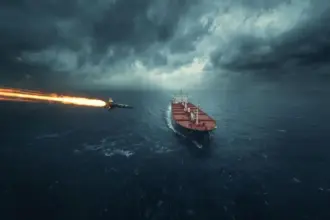
Beyond the military strikes, Iran quickly turned the conflict into a test of economic strength by closing the Strait of Hormuz, a strategic chokepoint for nearly 20% of global oil traffic. This closure directly drove up fuel prices in France and rippled through global supply chains.
Rather than join the blockade unilaterally imposed by the United States, France pursued its own diplomatic initiative, rallying more than 50 countries, to lay the groundwork for a negotiated reopening of shipping lanes. Minesweeping assets and specialized divers were kept on standby, ready to move in as soon as the ceasefire — the Islamabad Memorandum, signed in June 2026 — would allow for a return to safe maritime traffic.
What this war changes for the French military
Looking back, what strikes me most in this testimony is the humility on display from the Chief of Defence Staff. Acknowledging that Iran, despite overwhelming aerial inferiority, managed to preserve a lasting capacity for harm through its regional militias and economic warfare is an admission that no technological edge guarantees a quick victory. That lesson goes well beyond the Iranian case: it raises real questions about any Western power’s ability to anticipate adversaries who play on asymmetry rather than head-on confrontation.
For France, this crisis also confirmed the value of strategic loyalty: by honoring its commitments to Qatar, the United Arab Emirates and Kuwait, it strengthened its credibility with partners historically wary of major Western powers.
FAQ
When did the 2026 Iran war begin?
The conflict began on February 28, 2026, with joint American-Israeli strikes on Iran, in response to which Tehran launched a wave of missiles and drones across the region.
How many French soldiers died during this conflict?
Several French soldiers lost their lives, including Chief Warrant Officer Arnaud Frion in Iraq and two soldiers killed in an ambush in Lebanon as part of the UN peacekeeping mission.
Why did France send the aircraft carrier Charles de Gaulle?
To protect its nationals in the Gulf, support regional allies hit by Iranian retaliation, and eventually help secure shipping through the Strait of Hormuz.
Is the conflict over today?
A ceasefire, the Islamabad Memorandum, was signed in June 2026, but the situation remains fragile, and a full reopening of the Strait of Hormuz still depends on the ground situation stabilizing.