


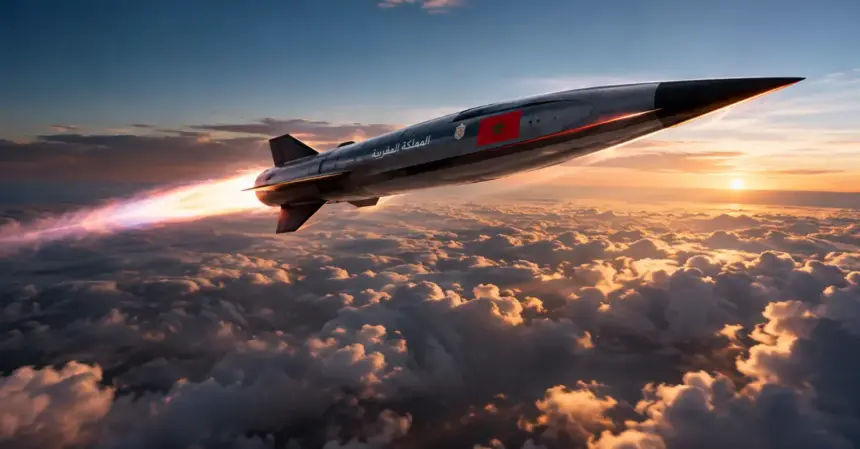
Morocco spent the last decade transforming its armed forces from a conventional structure into a much more networked, precision-driven military — F-16Vs, Barak-8 MX, PULS rocket artillery, Akinci and TB-2 drones, electronic warfare systems. The question now, in 2026, isn’t whether hypersonic weapons look impressive on paper. It’s whether Morocco should start investing today in the technological ecosystem that makes them possible.
I’ve followed Morocco’s modernization path closely over the past few years, and what stands out is the consistency of the strategy: every acquisition fits into a broader architecture of strike and defense capability. Hypersonics is the logical next frontier, even if the timeline remains distant.
What a hypersonic weapon actually is
Mach 5, roughly 6,000 km/h at sea level, is the commonly cited threshold. But reducing hypersonic weapons to a matter of raw speed is misleading — ballistic missiles have reached hypersonic speeds since the V2. What actually changes the equation is the combination of atmospheric flight, in-flight maneuverability, and a drastically reduced reaction window for enemy defenses.
Two main families dominate current research:
- Hypersonic glide vehicles — boosted by a conventional rocket, they separate at altitude and glide through the upper atmosphere while maneuvering, making their trajectory far less predictable than a classic ballistic missile.
- Hypersonic cruise missiles (HCMs) — these stay powered throughout flight using scramjet engines, capable of maintaining stable combustion even as incoming airflow remains supersonic, a formidable engineering challenge.
In both cases, the hard part isn’t reaching Mach 5 — it’s achieving controlled, repeatable, precise flight at that speed while managing extreme aerodynamic heating and the communication blackouts caused by plasma sheath effects.
Why these weapons upend missile defense
A missile defense system has to detect, track, predict, identify, and then engage its target. Hypersonic weapons complicate every one of those steps, especially tracking: a ballistic missile’s trajectory can be modeled fairly reliably after boost phase, while a maneuvering glide vehicle can change course mid-flight. That’s exactly why the United States is building the HBTSS satellite network, designed specifically to track and classify hypersonic and ballistic threats from space.
That said, these weapons aren’t invincible. Their high thermal signature, steep manufacturing cost, and inherently limited stockpiles remain real vulnerabilities — a point regularly emphasized by Western defense analysts in publications like the Center for Strategic and International Studies.
The global hypersonic race in 2026
The strategic landscape has gotten considerably more crowded in recent years. The United States is running multiple parallel programs, including its long-range hypersonic weapon and the Dark Eagle system. China crossed a symbolic milestone with the DF-17, which pairs a ballistic booster with a hypersonic glide vehicle, backed by a mature aerodynamics and materials research ecosystem. Russia promotes the Kinzhal, Zircon, and the Avangard glide vehicle, though Western analysts continue to debate how strictly some of these systems qualify as genuinely hypersonic.
Closer to Morocco, France is developing the ASN4G program meant to eventually succeed the ASMP-A nuclear-capable missile, alongside hypersonic glide research through its experimental V-MAX program. India illustrates a more gradual path: demonstrator vehicles, scramjet propulsion research, and technology transfer from the BrahMos program, well before any operational ambitions.
This diversity of national approaches confirms one essential point: a serious hypersonic capability requires a full technological ecosystem, not just an acquisition contract.
Where Morocco stands today
Morocco currently has no publicly confirmed operational hypersonic capability, and attempting to replicate the American, Chinese, or Russian ecosystem from scratch would be unrealistic. Three broad paths are available to the kingdom.
Foreign acquisition looks simplest on paper but is actually the least accessible option — hypersonic weapons rank among the most export-restricted technologies on earth. Joint development, through research partnerships in materials, propulsion, or sensors, is a far more realistic medium-term route. Finally, building the domestic technological base first — universities, aerospace industry, testing infrastructure — looks like the approach most consistent with Morocco’s current trajectory.
A multi-layered strike architecture
Morocco already has an increasingly sophisticated long-range fires ecosystem, with PULS, EXTRA reaching roughly 150 km, and the Predator Hawk extending to about 300 km. These systems remain considerably cheaper and more mature than any hypersonic solution. But they answer a different, more tactical and operational need than a true long-range strategic strike.
A future Moroccan architecture could reasonably be imagined in layers: conventional artillery, guided rockets, tactical ballistic missiles, long-range cruise missiles, and eventually a strategic hypersonic layer that would sit on top of, rather than replace, everything below it.
What’s missing most at this stage isn’t the missile itself but the intelligence ecosystem that makes it relevant: Mohammed VI-A and VI-B satellites, the future OptSAT-3000, drones, maritime surveillance, ground radar, and data fusion systems. Without that ISR backbone, even the most capable hypersonic weapon would lose much of its strategic value.
The real cost, beyond the missile
This is probably the most underestimated obstacle. A serious hypersonic program requires research facilities, flight-test capability, specialized manufacturing, dedicated training, and costly replacement stockpiles. Every dirham spent on hypersonics is a dirham not simultaneously funding air defense, naval modernization, or cyber capabilities — all competing priorities for the Royal Armed Forces.
There’s still a solid industrial argument for early investment, though: the technologies underlying hypersonics — advanced composites, thermal materials, high-speed aerodynamics — overlap heavily with civilian aerospace. Even without an operational weapon at the end of it, a national research program would strengthen Morocco’s broader aerospace technology base.
My take
Morocco doesn’t urgently need an operational hypersonic weapon today. But it would be a mistake to ignore the technology altogether. The distinction matters: rushing to acquire a small stockpile of extremely expensive hypersonic weapons without the ISR and command architecture to support them would have limited strategic value. Starting the groundwork now — universities, industrial partnerships, materials and propulsion research — would prevent the kingdom from being technologically left behind as this capability becomes more common through the 2030s and 2040s.
The real competition won’t be decided purely by missile speed. It will be decided by who builds the most effective ecosystem around it — sensors, intelligence, command, precision strike, and battle damage assessment. That’s where Morocco’s real room to maneuver lies.
FAQ
Does Morocco already have hypersonic weapons?
No, there is no publicly confirmed operational hypersonic capability within the Royal Armed Forces at this time.
What’s the difference between a ballistic missile and a hypersonic weapon?
A conventional ballistic missile follows a predictable trajectory after boost phase, while a hypersonic glide vehicle maneuvers during atmospheric flight, making it far harder to intercept.
Why are hypersonic weapons so expensive to develop?
Beyond the missile itself, a serious program requires research infrastructure, hypersonic wind tunnels, specialized telemetry, and flight-testing facilities, which drives costs up considerably.
Does PULS or EXTRA make hypersonics unnecessary for Morocco?
No, those systems address tactical and operational needs, while hypersonics would target a strategic, very-long-range strike layer — the two are complementary rather than competing capabilities.