

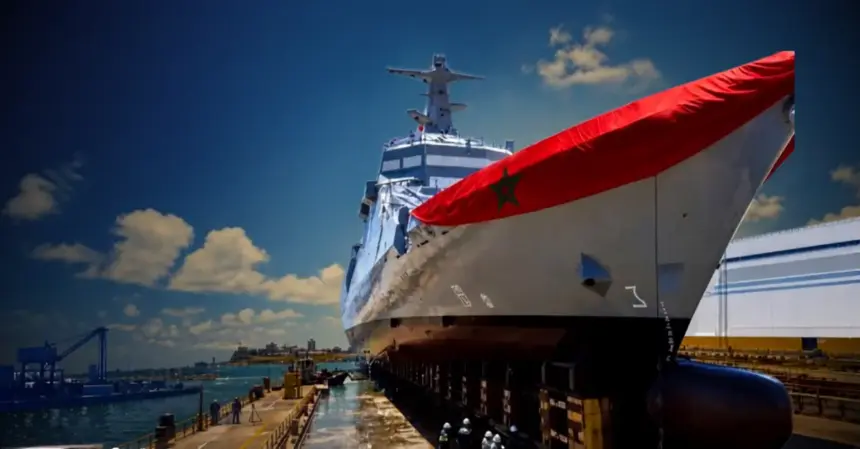
Built at the San Fernando shipyard near Cadiz, the 87-meter vessel belongs to the Avante 1800 range, a platform known for maritime surveillance and exclusive economic zone protection missions.
The delivery comes against a tense diplomatic backdrop between Rabat and Madrid, tied to the ongoing crisis over occupied Ceuta, which led to the cancellation of the official ceremony originally planned. Still, on a purely operational level, this handover is significant: it marks the most important combat vessel Morocco has received since the FREMM Mohammed VI frigate in 2014.
A patrol vessel built for the open sea
The Moulay Hassan I is far from just an upgraded coast guard boat. At 87 meters long, 13 meters wide, and displacing roughly 2,020 tonnes, the vessel can carry up to 60 crew members and reach a top speed of 24 knots. It’s an architecture designed for endurance rather than raw speed, which fits exactly the extended-surveillance mandate the Royal Navy intends to give it.
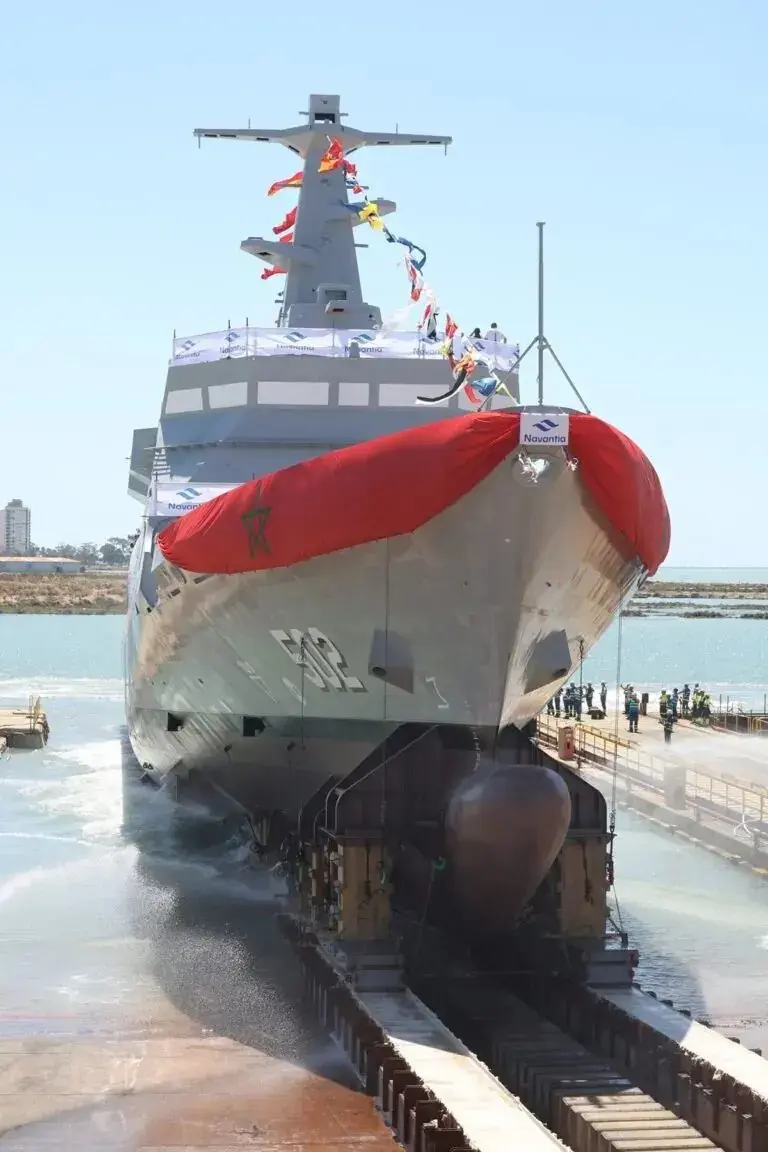
The ship features a flight deck capable of hosting a helicopter of around ten tonnes, plus two rigid-hull inflatable boats for rapid interventions. Another detail worth noting given the current geopolitical climate: it carries nuclear, biological and chemical defense systems, now a standard feature on first-tier naval units but one that confirms the program’s ambition.
On paper, this is not a missile-armed patrol vessel. And that’s precisely what several Moroccan defense analysts have pointed out: while the kingdom was once a pioneer in this field in Africa alongside Egypt and Algeria, it currently has no such vessel in active service. As delivered, the Moulay Hassan I remains primarily a presence-and-control asset rather than a strike platform.
Key figures of the program
- Hull number: 565
- Length: 87 meters / Beam: 13 meters
- Displacement: roughly 2,020 tonnes
- Crew capacity: up to 60 sailors
- Top speed: 24 knots
- Program cost: approximately €130 million
- Workload: over one million labor hours for Navantia and its partners
- Jobs sustained: around 1,100 direct and indirect positions over three years
Three years between San Fernando and the Strait of Gibraltar
Construction began in July 2023 with the first steel cut, followed by the keel-laying in September 2024. The launch itself took place in May 2025, after which the vessel went through a lengthy sea-trial campaign: dockside checks first, then repeated outings in the Bay of Cadiz and into the Strait of Gibraltar to validate seakeeping, propulsion performance and onboard systems.
This timeline, fairly typical for this type of naval program, also reflects Navantia‘s growing industrial capacity, a Spanish state-owned company building here on expertise inherited from the Descubierta class, designed in the late 1970s. The Moulay Hassan I’s design follows that lineage while integrating markedly more modern propulsion and combat systems technology.
The contract doesn’t stop at delivering the ship itself, either. It includes a substantial support package: spare parts, tooling, full technical documentation, plus training for Royal Moroccan Navy personnel in Spain. That’s a detail often underestimated in deals like this, even though it directly determines Morocco’s ability to keep the vessel operational long-term without remaining permanently dependent on the manufacturer.
A low-key handover with heavy political undertones
What stands out most in this story is the contrast between the industrial scale of the program and the discretion surrounding its conclusion. Navantia had originally planned to finalize the process over the summer, with an institutional ceremony bringing together officials from both countries. That event was ultimately scrapped, as tensions between Rabat and Madrid over occupied Ceuta made the diplomatic staging untenable.
The transfer document between Navantia and the Moroccan side was nonetheless signed as scheduled, allowing the vessel to leave Spanish facilities with its Moroccan crew aboard. A move that seems deliberate, separating the purely contractual and industrial dimension of the relationship from the broader political climate.
Having followed several Maghreb defense-acquisition stories over the years, I find this decoupling quite telling of a deeper trend: defense-industrial cooperation between Morocco and Spain keeps moving forward even when official diplomacy stalls. That’s a signal worth taking seriously, given how intertwined the economic and security interests on both sides of the Strait remain in practice.
A Moroccan fleet in the middle of a reshuffle
The Moulay Hassan I is only a first milestone. Morocco has also ordered a second patrol vessel of the same class, part of an overall contract valued at roughly 2.9 billion dirhams for both units. This upgrade comes as the Royal Navy recently decommissioned its two Floréal-class surveillance frigates, Hassan II and Mohammed V, leaving a capability gap these new patrol vessels are meant to help fill.
This fleet renewal fits into a broader trajectory of naval modernization for the kingdom, one that began notably with the stealth FREMM Mohammed VI frigate delivered in 2014. Twelve years on, the Moulay Hassan I confirms that this momentum hasn’t faded, despite tight defense budgets and competing priorities on other fronts, land forces in particular.
It remains to be seen exactly how the Royal Navy will integrate this new vessel into its operational posture, between monitoring Atlantic approaches, controlling the exclusive economic zone, and potential participation in joint missions with regional or Euro-Atlantic partners.
The takeaway
The handover of the Moulay Hassan I tells us a lot on its own about several dynamics running through the Mediterranean naval sector in 2026: the resilience of the industrial partnership between Rabat and Madrid, Morocco’s ability to fund ambitious arms programs despite regional uncertainty, and the way technical cooperation weathers diplomatic turbulence. A single ship, in the end, that reveals more about the true state of Moroccan-Spanish relations than most official statements ever could.
FAQ
What is the Moulay Hassan I patrol vessel?
It’s an 87-meter offshore patrol vessel from Navantia’s Avante 1800 range, delivered to the Royal Moroccan Navy on September 17, 2026, for maritime surveillance and exclusive economic zone control missions.
Who built the Moulay Hassan I?
The vessel was designed and built by Navantia, Spain’s state-owned shipbuilder, at its San Fernando shipyard near Cadiz, under a contract signed in January 2021.
Is the Moulay Hassan I armed with missiles?
No, in its current configuration it’s primarily a surveillance and sea-presence platform without missile-strike capability, unlike some of the Royal Navy’s historical units.
How much did the Moulay Hassan I program cost?
The program is estimated at around €130 million for this first unit, part of a broader contract covering two patrol vessels worth roughly 2.9 billion Moroccan dirhams in total.