

This move follows directly on from the partnership signed in June with the Royal Armed Forces, and above all reveals its real scale, which had until now remained fairly vague.
For anyone who has followed the defense sector in the Maghreb over the past few years, this kind of announcement is only half surprising. The Kingdom keeps multiplying industrial partnerships in the field of autonomous systems, and Harmattan AI, backed by the giant Dassault Aviation, brings a level of technical credibility that few players in “military tech” can claim today.
An engineering center that changes the game in Rabat
The information first circulated through quiet hiring rounds before being officially confirmed. The French defense unicorn is recruiting the teams in Morocco tasked with designing the autonomous systems it must deliver to the Royal Armed Forces, with a schedule of contractual milestones and an engineering capacity designed to be entirely local.
The organizational detail is worth dwelling on. Le Desk had established on August 29 that the program’s engineering work was settling in Rabat, where the company was opening 32 positions out of the 174 on its headcount, built around an engineering department tasked with building six technical modules and around fifty employees in the long run. Fifty hires is no small thing for a company that is only two years old: it points to a genuine long-term foothold, not just a commercial outpost.
In a telling detail about the legal structure chosen, the Moroccan subsidiary is not attached to Paris but to a Delaware-registered company, which raises questions about the group’s financial structuring as much as about its intent to keep its Moroccan activities separate from its French parent.
Three projects announced back in June
The partnership signed this summer already set out a three-part framework. The first covers setting up production capacity in Morocco for the manufacturing of autonomous defense systems. The second concerns the creation, on national soil, of a research and development center dedicated to artificial intelligence applied to defense systems. The third, finally, calls for developing partnerships with Moroccan higher education institutions and research bodies. The Rabat engineering center is the first concrete, visible building block of that roadmap.
What we know about the partnership with the FAR
The founding agreement dates back to June 17, 2026. Harmattan AI announced, at the Eurosatory show in Paris, a strategic partnership with the Moroccan Royal Armed Forces to establish local production of autonomous systems and an artificial intelligence research center in the country. A sign of how much weight is being put on this deal, it marks the company’s first industrial footprint outside France, as well as its first announced customer outside of NATO and Ukraine.
The deliberate vagueness around the figures is nothing unusual in this sector. The June 17 agreement, presented as the starting point of a long-term partnership, was announced without amount, volume, or precise timeline. Yet documents reviewed by the Moroccan press suggest the real negotiations were already well advanced before the media handshake: a technical offer sent to the FAR predates Eurosatory by more than two months, with a cover letter dated April 2 and a revised financial offer dated April 8.
The potential scale of the program is dizzying. Harmattan AI is said to have sized an offer of 24 Gobi Tempest batteries meant to cover 200 kilometers of border — a figure that, if confirmed, would place this contract among the most ambitious VSHORAD deployments on the African continent.
The Gobi interceptor, the machine hunting down drones
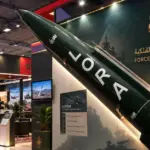
The Gobi is not a conventional anti-aircraft defense system. It is an autonomous kinetic interceptor, built specifically to neutralize low-cost threats such as small drones and loitering munitions of the Shahed-136 type, widely used on the battlefields of Ukraine and the Middle East.
A few technical characteristics help explain why the system is winning over so many armed forces:
- Speed: the Gobi can reach speeds of up to 350 kilometers per hour
- Responsiveness: the system neutralizes its target in under a minute, with no preparation time needed after detection
- Full autonomy: interception is entirely autonomous, with no dependency on ground infrastructure, using hit-to-kill precision
- Heavier Gobi Tempest variant: an all-weather interceptor carrying an 800-gram explosive payload with a range of 12 kilometers
- Centralized control via the KALAHARI command-and-control platform
What truly sets the Gobi apart is its economic logic: against swarms of cheap drones, using conventional anti-aircraft missiles often costs a hundred times more than the threat itself. The kinetic interceptor directly addresses this budgetary imbalance, which has become one of the central challenges of modern air defense.
Why Rabat rather than another capital
Morocco’s selection is not only strategic, it’s also personal. Mouad M’Ghari, founder and CEO of Harmattan AI, was born in February 2000 in Rabat before growing up in Savigny-le-Temple, in Seine-et-Marne. This dual French-Moroccan background is almost certainly not unrelated to how quickly this foothold has taken shape.
On the financial side, the company’s trajectory is impressive. Its current €400 million valuation stems from a deal closed on January 12, 2026, when investors put in $200 million on the basis of an overall $1.4 billion valuation. Just twenty-one months separate the company’s incorporation from that valuation, a first in the French defense industry. To run its Moroccan subsidiary, the company also brought in a profile from the world of data: Amir Benmahjoub, a former Palantir executive, was appointed to head the local structure.
Another sign that this footprint goes beyond the FAR contract alone: the creation of a production department in Rabat shows that the Moroccan presence now extends well past the military partnership announced in June, with Morocco becoming the hub from which Harmattan AI intends to organize its industrial development across two strategic regions. The setup being built in Rabat is meant to support the company’s sales and future programs with its clients in Africa and the Middle East.
Morocco, a new defense hub for Africa
The Harmattan AI story doesn’t come out of nowhere. It fits into a much broader national push for military industrial sovereignty, driven by a series of converging projects.
The Kingdom is indeed multiplying its footprint in the drone and autonomous systems sector, notably with the Tata Advanced Systems Morocco plant in Berrechid, as well as drone production projects with the Turkish company Baykar. An integrated plant is also planned in Benslimane with the same Turkish partner, while a Moroccan company, Aerodrive Engineering Services, is already developing its own military drone designed entirely in-country.
This acceleration rests on a strengthened diplomatic framework. The two countries signed, following the 14th meeting of the Defense Consultative Committee, a roadmap covering the 2026-2036 period, aimed at reinforcing their strategic partnership in the fields of defense industry and cybersecurity. The timeframe is no accident: ten years is roughly what it takes to turn an emerging industry into an export-ready sector.
This industrial build-up echoes other major Moroccan projects, in energy as much as in port infrastructure, where the Kingdom consistently bets on genuine skills transfer rather than simply buying turnkey equipment.
My take from the ground on this acceleration
I’ve followed fairly closely, over the past few years, how Morocco negotiates its technology partnerships in strategic sectors, particularly around energy and infrastructure. What stands out with the Harmattan AI story is the speed of execution: barely three months separate the public announcement of the contract from the actual formation of a fifty-person engineering team. Few defense partnerships move at that pace, usually held back by budget cycles and endless approval processes.
What also strikes me as significant is the choice not to settle for a simple assembly plant. By setting up a full-fledged engineering department in Rabat, spanning six distinct technical modules, Harmattan AI is betting on a genuine transfer of expertise rather than a symbolic presence. That’s exactly the kind of signal that, in this sector, separates a lasting partnership from a mere PR move.
FAQ
What is Harmattan AI’s Gobi interceptor? Gobi is a very short-range autonomous interception system, designed to detect and neutralize small drones and loitering munitions in under a minute, without direct human intervention.
When was the partnership between Harmattan AI and the FAR signed? The agreement was signed on June 17, 2026, at the Eurosatory show in Villepinte, France, between Harmattan AI and the Moroccan Royal Armed Forces.
How many engineers is Harmattan AI hiring in Rabat? The company is aiming for a local engineering team of around fifty people, organized across six distinct technical modules.
Who leads Harmattan AI’s Moroccan subsidiary? The local operation is led by Amir Benmahjoub, a former executive at Palantir.