
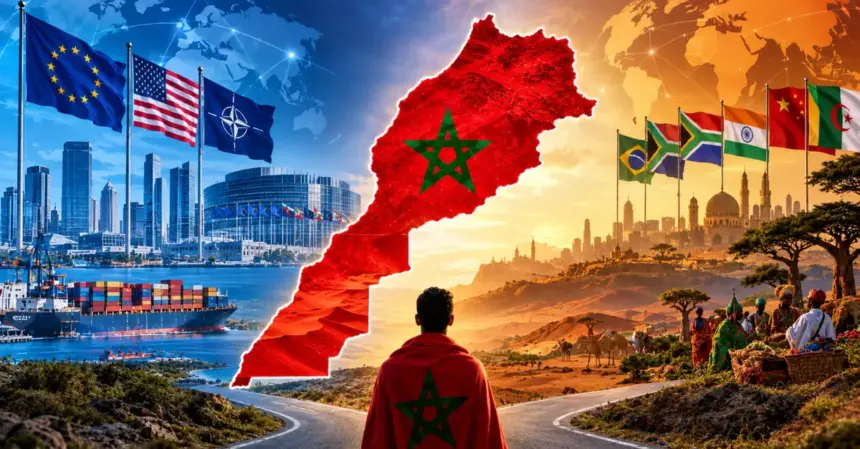
This isn’t indecision. It’s a doctrine.
I’ve been watching Maghreb diplomacy for about fifteen years, and I can’t recall a moment when the gap between how Morocco is perceived from the outside and what it is actually doing was this wide. Analyses still appear urging Rabat to “pick a side.” Meanwhile, Rabat is collecting the dividends from both tables.
The short answer to a badly framed question
The “West or Global South” debate rests on an assumption inherited from the Cold War: that the world has two poles, and that alignment produces security. That assumption stopped working around 2022, when a majority of African, Asian and Latin American states declined to sanction Moscow without breaking with Washington.
Morocco read that shift earlier than most. Its doctrine fits in a single line: maximise the number of partners your regional rival depends on, minimise the number you depend on yourself. It’s portfolio logic, not ideological loyalty.
In practice, that produces a country that belongs to NATO’s Mediterranean Dialogue, hosts the African Lion exercise — the largest American military deployment on the continent — and at the same time promotes South-South cooperation that deliberately bypasses the classic Western channels. The two tracks don’t contradict each other: they fund each other.
What Resolution 2797 actually changed
The turning point came on 31 October 2025. The Security Council adopted Resolution 2797 by 11 votes in favour and three abstentions — China, Russia, Pakistan — with Algeria not taking part in the vote, extending MINURSO’s mandate to 31 October 2026 and backing negotiations on the basis of the Moroccan autonomy plan. Rabat read the vote as a major victory, going so far as to declare 31 October a national holiday.
What interests me here isn’t the legal substance of the text, already widely dissected elsewhere, but its diplomatic mechanics. Morocco secured an American shift without becoming a client of Washington, then converted that shift into European alignment: in January 2026 the European Union announced it had unanimously updated its position to match Resolution 2797. Two Western heavyweights fell in behind a Moroccan position — not the other way round.
What followed is instructive. On 23 and 24 February 2026, Washington hosted a third round of international consultations on the file, while Rabat worked up an institutionally detailed version of its autonomy plan. The dossier remains contested — Algiers judged the resolution to fall short of the legitimate expectations of the Sahrawi people represented by the Polisario Front, and Human Rights Watch has warned that the right to self-determination is being eroded — but the initiative has moved to the Moroccan side.
The Atlantic as a Global South laboratory
This is the most underrated part of Moroccan strategy, and by far the most interesting for anyone following how the Global South is reorganising itself.
The Royal Atlantic Initiative aims to bring together the countries bordering or near Africa’s Atlantic coast, from Tangier to Luanda, hooking landlocked Sahel states into the network. Morocco is preparing an Africa-Atlantic Summit gathering 29 countries around logistical, energy and diplomatic cooperation, and Burkina Faso, Mali and Niger formally backed that opening in April 2025, seeing Moroccan ports — Dakhla Atlantique above all — as a route to global markets.
The building blocks, as they stand today:
- An energy corridor: in July 2026, ECOWAS signed the intergovernmental agreement for the Atlantic Africa gas pipeline, formerly the Nigeria-Morocco pipeline, designed to carry Nigerian gas to Europe via the Kingdom.
- A logistics asset: Tanger Med and Dakhla position the country as the physical connector between Europe and Africa, an argument that has become central to attracting foreign direct investment.
- An industrial lever: Morocco ranks among the leading exporters of cars to the European Union, with more than 500,000 vehicles shipped in 2023, a volume comparable to China’s, Japan’s or South Korea’s.
- A strategic endowment: phosphates, whose role in global food security keeps demand firm, hand Rabat a card few middle powers hold.
- An event-driven accelerator: the AFCON hosted in January 2026 was set to push tourist arrivals to a record, with an expected 20% increase, ahead of the boost tied to the 2030 World Cup.
Taken together, this package amounts to an offer neither Brussels nor Beijing can ignore. And it is written entirely in South-South language.
The real limits of the balancing act
I’d be dishonest to present this trajectory as costless. Three fragilities deserve naming.
European dependence remains structural
The European Union absorbs the bulk of Moroccan industrial exports. A balancing doctrine requires alternative outlets, and those are still embryonic. Beijing has in fact asked Morocco to sign a free trade agreement, a proposal Rabat is assessing without having opened formal negotiations — a telling caution: such a deal would shield the Kingdom from European dependence while exposing its manufacturing base.
The Global South is not a homogeneous bloc
Morocco has not applied to join the BRICS and declined to attend a group meeting in South Africa, with Rabat denouncing South African hostility linked to Pretoria’s support for the Polisario Front. The Sahara is the glass ceiling of any Moroccan multi-alignment strategy: it turns potential partners into structural adversaries.
The Maghreb balance of power remains frozen
Nothing is settled. The October 2026 deadline, with the renewal of MINURSO’s mandate, will harden positions again, and the Algerian stance remains anchored to the principle of self-determination.
My blunt take on the right strategic answer
If you ask me where Morocco “should” stand, my answer is: nowhere, durably and methodically. The Kingdom’s best position isn’t a point on an axis, it’s a function of intermediation.
The countries that win in a fragmented world aren’t the ones that pick the right camp — they’re the ones that become the mandatory crossing point between several camps. Singapore did it between Washington and Beijing. The Emirates did it between the West and Russia. Morocco is doing it between Europe and Atlantic Africa, with an advantage neither of the other two had: geography cannot be taken away from it.
The real Moroccan risk, then, isn’t “choosing wrong.” It’s letting that intermediary position rest on rents — phosphates, proximity, labour costs — rather than on capabilities that are hard to replicate: engineering, decarbonised energy, digital sovereignty. That’s where the decade will be decided, far more than in the geometry of alliances.
For anyone discovering the country beyond the chancelleries, the Atlas and its valleys tell another version of this crossroads story — I cover it in our trekking in Morocco guide and our piece on climbing Toubkal.
Frequently asked questions
Will Morocco join the BRICS?
Nothing suggests so in the near term. Rabat has denied applying and maintains bilateral ties with the group’s members without seeking membership, largely because of the Sahara file.
Does Resolution 2797 settle the Western Sahara conflict?
No. It sets a negotiating framework based on the Moroccan autonomy plan, but the UN’s personal envoy has stressed that it doesn’t dictate the outcome, and the Algerian and Sahrawi positions remain opposed.
Is Morocco a Global South country or a Western partner?
Both, openly and at once. A member of NATO’s Mediterranean Dialogue and an industrial partner of the EU, it simultaneously drives South-South cooperation built around Africa’s Atlantic space.
What is Morocco’s main economic lever through 2030?
The investment cycle tied to the 2030 World Cup, combined with phosphates, automotive manufacturing and Atlantic energy corridors, including the Atlantic Africa pipeline.