


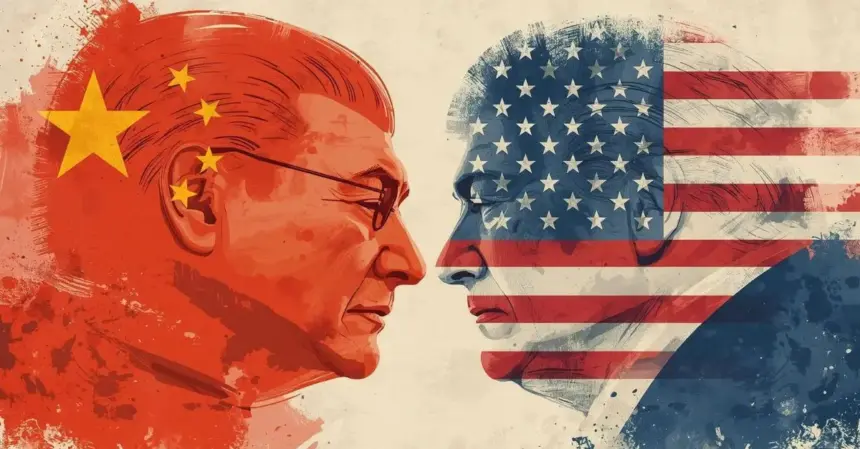
The world as we know it has shifted into a new era where American power is now expressed without restraint. In recent months, Washington has multiplied its demonstrations of force: repeated strikes in Iran, the expulsion of Chinese influence in Panama, extreme pressure on Venezuela, and the maintenance of a strict maritime blockade around Cuba. Since the start of his second term, Donald Trump has already employed force or coercion in at least twelve different countries, marking a diplomatic and military tempo of rare aggressiveness. Yet, faced with this American omnipresence, one observation strikes observers: China seems strangely absent, almost mute.
This discretion is all the more troubling given that Beijing and Washington are engaged in a global tug-of-war touching technology, economy, and security. While its strategic partners like Tehran or Havana crumble under sanctions, the People’s Republic of China remains idle. Why does the primary rival of the United States accept actions so damaging to its own interests? This silence is neither an admission of weakness nor mere indifference, but a profound strategy. To understand this doctrine of absence, one must dive into the gears of modern geopolitics and analyze five fundamental axes dictating Xi Jinping’s conduct.
The Real Limits of Chinese Military Projection
The first explanation, perhaps the most pragmatic, lies in a technical reality often ignored by the general public: China does not yet have the means for its policy. While the People’s Liberation Army is often presented as an industrial military mega-power, its current structure is almost exclusively configured for a confrontation in its immediate sphere of influence, the Pacific. Unlike the United States, which has a global projection capacity, China has virtually no infrastructure to intervene militarily on the other side of the planet, whether in Venezuela or the Middle East.
To project force, having ships is not enough; you need logistics. American aircraft carriers are powered by nuclear reactors, offering them almost unlimited autonomy. Conversely, Chinese ships mainly run on conventional fuel, which drastically limits their prolonged movements. Furthermore, Washington relies on a constellation of allied military bases everywhere on the globe. In times of tension, these support points allow for indispensable logistical and material support. China, despite some facilities abroad, has no equivalent network capable of supporting a large-scale air or naval force far from its coasts.
Another crucial factor is the lack of combat experience. This is a purely mechanical observation: with the exception of the Korean War, the Chinese army has not participated in a high-intensity conflict in its modern history. In contrast, American forces have been engaged in perpetual theaters of operation since 1945. This experience allows Washington to conduct complex operations like “Absolute Resolve” or “Epic Fury,” blending cyber-attacks, space forces, and naval strikes. Beijing knows that a direct confrontation would reveal major operational gaps, thus preferring to avoid any public humiliation of its defense systems.
The Primacy of National Economic Stability
If China refuses to intervene, it is also because it places its economic survival above any diplomatic prestige. The Chinese model is based on exports and remains viscerally dependent on Western, European, and North American markets. Any brutal rupture caused by a military intervention would lead to punitive trade sanctions, like those already brandished by Donald Trump. For Beijing, losing access to these lucrative markets would equate to an economic suicide that would destabilize social peace within its own borders.
This vulnerability extends to the energy sector. China imports the majority of its hydrocarbons from the Persian Gulf via the Strait of Hormuz. Paradoxically, this forces it into extreme caution: during recent tensions between Iran and Israel, it was Beijing that demanded the strait remain open. Since it does not control the global maritime routes, China must deal with those who secure them. Its priority remains securing supplies and protecting its value chains, particularly in semiconductors and high technology, where it remains dependent on the global financial system dominated by the dollar.
Here are some key points explaining this economic dependence:
-
Banking integration: The majority of Chinese international transactions still pass through the SWIFT system.
-
Need for technology: Despite its progress, China still imports critical components for its industry.
-
Price stability: A global crisis would cause the cost of raw materials, which Chinese industry hungers for, to explode.
-
Consumer markets: American and European purchasing power remains the main engine of Chinese factories.
The Absence of Formal Military Alliances
A common mistake is to perceive the bloc consisting of Russia, Iran, Venezuela, and China as an alliance similar to NATO. In reality, Beijing has no friends; it only has strategic partners. Chinese diplomacy is founded on the principle of non-interference and the rejection of rigid military blocs. While China supports its partners politically or economically, no treaty obliges it to shed blood for them. It observes the difficulties of Tehran or Havana with cold pragmatism: it helps, but it does not save at the expense of its own security.
This lack of mutual commitment allows China to maintain total flexibility. It can distance itself from a collapsing regime without losing face. More importantly, Beijing and Moscow are often discreet rivals in Central Asia or Africa for control of resources. By refusing to engage in a common defense alliance, China avoids being dragged into wars that are not its own. It prefers to let its partners absorb American pressure, acting as a spectator counting points while waiting for the storm to pass.
Absolute Focus on the Taiwan Objective
In Beijing’s grand chessboard, one piece dominates all others: Taiwan. It is the absolute priority, the engine of all Chinese foreign policy. To succeed in reunification one day, China must avoid the formation of a large anti-Chinese international coalition at all costs. By remaining discreet about conflicts in the Middle East or Latin America, it seeks not to give a pretext to its neighbors or Europeans to align totally with Washington’s bellicose position. It applies Deng Xiaoping’s doctrine to the letter: “Hide your strength and bide your time.”
This shadow strategy is bearing fruit. The more the United States acts unilaterally and aggressively, the more it erodes its own alliances. China watches with interest the growing discontent in Europe or Canada toward the White House’s exuberance. By letting Washington act as the global “bully,” China builds an image for itself as a reasonable and stable actor. It hopes that at the crucial moment of the Taiwan affair, the international community will be too divided or weary of American hegemony to intervene in a coordinated manner.
A Philosophical Bet on American Decline
Finally, China’s attitude is based on a long-term, almost millennial vision. Chinese leaders seem convinced that the current actions of the United States are accelerating their own decline. Between an out-of-control public debt, internal social tensions, and growing diplomatic isolation, America is perceived by Beijing as a power in a phase of self-destruction. Therefore, why interrupt an opponent making mistakes? Why exhaust oneself in regional wars when time is on your side?
Patience is the central pillar of Chinese strategic thinking. By remaining on the sidelines, China avoids the military and financial wear and tear that once ruined many empires. It sees itself as a perennial civilization that has survived many crises. For Beijing, the game is not played over the next semester, but over the next fifty years. By letting the United States exhaust its political and moral capital, China prepares to be the last power standing, ready to pick up the pieces of a global order in full mutation.
FAQ: Understanding the Chinese Position
Why doesn’t China help Iran militarily? China prioritizes its oil imports and economic stability. Direct military intervention would trigger massive sanctions from the United States and jeopardize its technological development. Furthermore, it lacks the logistical capacity to sustain a conflict in the Middle East.
Is China actually weaker than the United States? In terms of industrial production, China is a giant. However, in terms of military experience and global power projection, the United States maintains a considerable technological and operational lead. China therefore prefers economic competition over armed confrontation.
What is the role of Taiwan in this strategy? Taiwan is China’s ultimate goal. To achieve it, it must ensure the rest of the world does not league against it. Its discretion in current conflicts aims to preserve its relations with third countries and wait for a moment of American weakness to act.