

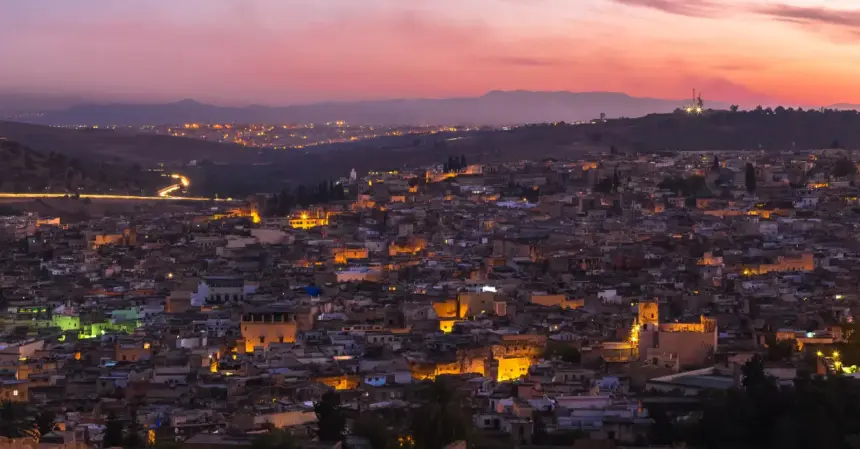
Online administrative counters, incubators popping up one after another, coworking spaces replacing old abandoned riads: the imperial city, long seen as a sanctuary frozen in its centuries-old craftsmanship, has started courting an entire generation of project builders. I’ve gone back to Fes several times over the past few years, and each visit makes the contrast sharper between traditional leather tanning and the touchscreens of collaborative workspaces. This shift isn’t cosmetic, it answers a real economic and demographic urgency: a generation of graduates who used to leave the city the moment they got their diploma. Here’s how the city changed its strategy, and why it’s working.
A city changing its face
For a long time, Fes lived off its heritage reputation. The medina, a Unesco World Heritage site, drew tourists and zellige lovers, yet struggled to keep its young talent. Many left for Casablanca, Rabat, or abroad right after graduating, for lack of local opportunities in tech. This turnaround comes from a fairly simple realization: a city that fails to digitalize its services and its economy loses its youth to better-connected metropolises.
History versus the digital push
The equation wasn’t a given. Fes carries the image of a conservative city, anchored in its craft traditions and its centuries-old religious teaching around the Qarawiyyin. But that strong identity has actually become a marketing asset: the city now sells a deliberate mix of heritage and innovation, a positioning few Moroccan cities can claim with the same credibility. Local authorities understood they didn’t need to reject that past, but rather use it as a showcase to attract a new creative economy, somewhere between connected craftsmanship and digital services.
The infrastructure laying the groundwork
You don’t digitalize a city with good intentions alone. You need physical spaces, reliable internet connections, and administrative counters that actually work online. This is where Fes has invested the most in recent years, with results that anyone trying to set up a business there can now see.
The innovation hub and local incubators
Several support structures have emerged or grown stronger in Fes, backed by both private players and public programs. Initiatives like the Fez Startup Challenge, run by the local incubator IncuBooster, illustrate this dynamic well: full support for project holders, from raising entrepreneurial awareness all the way to preparing a funding round. This kind of program genuinely changes things for a student or recent graduate who, a decade ago, had nowhere local to turn to.
Coworking spaces have also multiplied across the city, often set up in renovated old houses, which gives these workspaces a character that’s hard to find elsewhere. Working on your laptop under a nineteenth-century carved wooden ceiling carries real weight when you’re presenting yourself to clients or investors.
The role of the Regional Investment Center
The Regional Investment Center of the Fes-Meknes region has significantly simplified business creation procedures in recent years. Administrative steps, once synonymous with endless queues and lost paperwork, are now largely handled online. This digitalization of administrative procedures lets a project holder prepare most of their paperwork without shuttling between different offices, saving real time, especially valuable for Moroccans living abroad who want to invest from where they are.
What’s actually drawing young entrepreneurs
Beyond the infrastructure, several very concrete factors explain why more and more young people are choosing Fes over a bigger metropolis to launch their business.
- A cost of living and commercial real estate noticeably lower than in Casablanca or Rabat, which means more money can go into growing the project instead of paying office rent
- A large student pool thanks to the city’s universities, giving easy access to young, motivated talent that’s affordable to hire
- A strategic geographic position, halfway between the north and the center of the country, which makes logistics easier for certain activities
- Guarantee funds and financing programs such as Innov Invest, which specifically support tech startups during their seed phase
- A still-young ecosystem, therefore less saturated, where it’s easier to carve out a space and stand out quickly
This combination creates a kind of window of opportunity: entrepreneurs settling in now benefit from still lightly-contested ground, paired with increasingly mature institutional support.
The sectors that are booming
Not every sector benefits equally from this new momentum. A few are clearly pulling ahead.
Offshoring and digital services
Fes has become Morocco’s second-largest offshoring hub, right behind Casablanca. Call centers, customer relationship management, outsourced software development: these activities employ a young, foreign-language-trained workforce, and in turn build up a pool of digital skills that feeds back into the local startup ecosystem. It’s often after a few years working in this sector that young Fassis gather the experience and network they need to start out on their own.
Digitalized tourism and connected craftsmanship
Tourism is evolving too. Travelers increasingly want more than a quick walk through the medina and are turning toward more authentic experiences in the surrounding countryside or the Middle Atlas. This demand has opened new opportunities: eco-friendly guesthouses bookable online, themed hiking routes sold through digital platforms, and agencies specializing in showcasing intangible heritage. At the same time, some traditional craftspeople have started selling directly on social media and international marketplaces, cutting out the middlemen who used to capture most of the margin.
My take from the field
I genuinely rate this dynamic, with a few caveats. On my last trip, I talked with several project holders working out of a coworking space near Bab Boujloud, and what struck me was their measured enthusiasm: they agree the ecosystem is moving fast, but they’re also quick to point out that not everything is digitalizing at the same pace. Some administrations remain slow despite official announcements, and access to financing, even with programs like Innov Invest, is still an obstacle course for the youngest projects. That gap between the institutional narrative and entrepreneurs’ day-to-day reality is worth keeping in mind before moving in with your eyes closed.
The challenges still ahead
No urban transformation happens without friction, and Fes is no exception.
Internet connectivity, while much improved, can still be unstable in certain outlying neighborhoods, which hurts activities that depend on constant connectivity, such as software development or video streaming. A shortage of experienced mentors in some cutting-edge sectors still pushes many entrepreneurs to seek advice remotely, often from networks based in Casablanca or abroad. And bureaucracy, even digitalized, still carries some heaviness that can discourage the less patient founders.
None of these obstacles undermine the city’s overall trajectory, but they’re a reminder that a successful digital transformation takes time and can’t be decreed through an institutional press release alone.
What to keep in mind before launching
If you’re considering starting a business in Fes, a few reflexes are worth adopting. Start by researching the incubators active in your sector, contact the Regional Investment Center for up-to-date procedures, and don’t forget to protect your brand and concepts with OMPIC as soon as you launch. Don’t underestimate the local network either: in a city the size of Fes, entrepreneurial word of mouth remains a remarkably effective lever, often faster than any online ad campaign.
FAQ
Why is Fes attracting more and more young entrepreneurs? Because the city combines a more affordable cost of operations than the big metropolises, a support ecosystem that’s rapidly maturing, and its position as the country’s second-largest offshoring hub, creating fertile ground for launching a business without the saturated competition of Casablanca.
What are the most promising sectors in Fes in 2026? Digital and offshoring, digitalized tourism, connected craftsmanship, and business services are among the sectors benefiting most from this transformation.
Is it easy to start a business in Fes today? Digitalizing procedures through the Regional Investment Center has clearly simplified the process, although some administrative slowness still remains depending on the sector and the file.
Do you already need a local network to succeed? It’s not essential, but strongly recommended. Going through a local incubator or coworking space lets you build that network quickly, often within just a few months.