
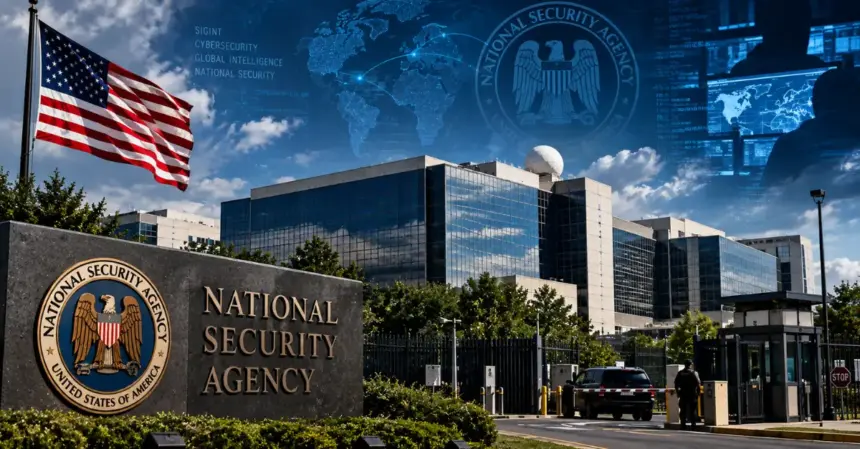
The NSA restructuring launched in September 2026 marks the deepest organizational overhaul the agency has undergone in more than a decade. Army Gen. Joshua M. Rudd, who simultaneously leads the NSA and U.S. Cyber Command, has presented senior officials with a new organizational blueprint built around five mission centers dedicated to artificial intelligence, China, cybersecurity, combat support, and global intelligence. The plan, first reported by the Washington Post and since confirmed by several specialized outlets, is set to begin rolling out in mid-October, with full operating capacity targeted for mid-January 2027.
Behind the announcement lies a simple observation: Fort Meade believes its organizational chart, inherited from another era, no longer matches today’s priorities. Caught between the global race for AI supremacy and mounting strategic pressure from Beijing, Rudd wants an NSA that moves faster, is more legible internally, and above all can push intelligence out to forces on the ground without the usual delays.
Five pillars reshaping fort meade’s organizational chart
The plan replaces existing directorates with five distinct mission centers, each led by a newly created “mission director” role carrying authorities close to those of a deputy director. This architecture, designed to match the priorities identified by U.S. intelligence, covers:
- Artificial intelligence, elevated for the first time into its own standalone mission center
- China, which becomes the central organizing principle of American signals intelligence
- Cybersecurity, the agency’s historic pillar
- Combat support, designed to speed up the flow of intelligence to deployed units
- Global intelligence, which will now include the elite Tailored Access Operations (TAO) unit
That last point is not a minor detail. Folding TAO — famous for running some of the most sophisticated offensive hacking operations in the world — into the global intelligence directorate signals a deliberate push to merge cyber-espionage more tightly with classical strategic analysis, rather than keeping the two working in separate silos.
According to reporting from The Record, this isn’t a cosmetic reshuffle. The new structures are meant to fully replace existing directorates rather than sit on top of them. For an agency believed to employ more than 30,000 people, that’s not a minor adjustment.
A direct response to strategic pressure from china
This reorganization didn’t come out of nowhere. It follows a joint advisory published in early September by the NSA, CISA, and FBI, which accuses six Chinese AI companies — DeepSeek, Moonshot AI, Alibaba, MiniMax, StepFun, and Z.AI — of running malicious distillation campaigns at industrial scale against leading American AI models.
Specifically, these companies are alleged to have exploited billions of tokens across millions of requests to extract reasoning, coding, and analytical capabilities from variants of Claude, GPT, Gemini, and Grok — capabilities they had not developed on their own. The advisory, available on the CISA website, states that this practice forms “the core, not merely a supplement” of China’s AI development strategy. According to the agencies, these operations likely occurred with at least implicit awareness from Chinese authorities — an accusation Beijing has firmly rejected through its embassy.
Against that backdrop, it’s hard not to read the creation of a dedicated AI mission center, alongside one entirely focused on China, as a direct organizational answer to this identified threat. Two issues that were previously handled in a relatively siloed way are now becoming structural priorities in their own right.
What this means in practice for u.s. intelligence
In practical terms, this shift means that analyzing adversary AI capabilities will no longer depend on a technical sub-directorate buried inside a larger unit, but on a standalone center with its own resources and a direct reporting line to agency leadership. From an intelligence-doctrine standpoint, this is a way of formally acknowledging that AI is no longer just one topic among many, but a battlefield in its own right.
Leaders with expanded authority, some recruited from outside the agency
The most discussed aspect internally concerns who will actually run these centers. Rudd has told senior NSA officials that mission director positions could be filled through external hires, a prospect that has unsettled some longtime staff. In an institution where internal promotion has traditionally been the cultural norm, the idea of bringing in outsiders — potentially from the private tech sector or the broader defense world — is a real break from established habits.
Part of the explanation lies in the director’s own unconventional background. A general with a Special Forces career, Rudd simultaneously leads the NSA and Cyber Command, a dual role that’s relatively rare and reflects a more pragmatic, almost entrepreneurial approach to running an intelligence agency. He has reportedly told colleagues internally that speed of execution matters more than scale, innovation, or perfect integration — even if that means the transition “breaks things” along the way.
That mindset is a sharp departure from the traditionally cautious culture of intelligence agencies, where organizational change usually unfolds over years of internal consultation. Here, the logic is closer to a sprint than an administrative marathon — an approach that, while it appeals to some, is clearly unsettling others at Fort Meade.
A tight timeline running through january 2027
The pace chosen for this transformation is itself telling of the current leadership’s mindset. Rollout is expected to begin in mid-October 2026, with “full operating capacity” targeted for mid-January 2027 — barely three months for a redesign touching the agency’s entire chain of command.
Some sources point to an even tighter initial window of just 30 days for the broad outlines of the plan, with future mission directors expected to submit detailed departmental plans by the end of September. That’s an unusually ambitious timeline compared with previous NSA reorganization efforts, which history suggests have typically taken far longer than planned.
In my experience following defense and intelligence stories, this kind of compressed timeline almost always signals a perceived sense of urgency internally rather than a simple methodological choice. When an agency of this size is willing to “break things” in order to move faster, it’s usually a sign it believes it has fallen behind on an issue it considers critical — and here, there’s little mystery about which one: technological competition with China.
Key takeaways from this reorganization
A few points stand out from this announcement beyond the org chart itself:
- Creating a standalone AI mission center formally elevates the technology to an independent strategic priority
- Folding TAO into global intelligence pulls offensive cyber operations closer to classical strategic analysis
- The possibility of external hires to lead these centers breaks with a historically closed internal culture
- The extremely tight timeline, with full capacity targeted for January 2027, stands apart from past reorganization efforts
Whether this acceleration pays off without triggering costly operational disruptions remains to be seen. The NSA did not respond to press inquiries on this story, which is unsurprising given the level of secrecy surrounding its operations.
FAQ
Why is the NSA restructuring in 2026? The agency wants to align its organization with current priorities — artificial intelligence, competition with China, and cybersecurity — and speed up how intelligence reaches forces in the field.
What are the NSA’s five new mission centers? They cover artificial intelligence, China, cybersecurity, combat support, and global intelligence, each led by a “mission director” with expanded authority.
What’s the connection to Chinese AI companies? The restructuring follows a joint advisory from the NSA, FBI, and CISA accusing six Chinese companies — including DeepSeek and Alibaba — of running large-scale distillation campaigns against U.S. AI models.
When will the new organization be fully operational? Rollout is expected to begin in mid-October 2026, with full operating capacity targeted for mid-January 2027.