


The Hong Kong Silicon Valley is literally rising from the rubble of dozens of traditional hamlets. For several months now, bulldozers have been steadily moving through the New Territories, north of Hong Kong, clearing the way for a massive 30,000-hectare project known as the “Northern Metropolis.” I have followed major urban transformations across Asia for a long time, and this one feels particularly brutal: at least 25 villages are set to disappear to make room for what the authorities describe as the territory’s future economic engine.
Behind the official figures, there are faces. Among them, a retiree who had hoped to spend his final years in the brick house where he grew up, like so many residents of these rural hamlets. His situation sums up what’s really at stake here: on one side, an enormous technological and geopolitical ambition; on the other, rural communities that, in the eyes of the administration, simply don’t carry enough heritage value to be spared.
A massive project spanning 30,000 hectares
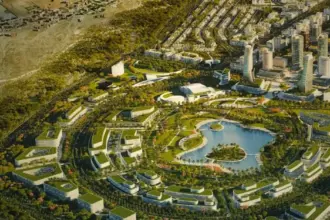
Announced in 2021, the Northern Metropolis is meant to cover nearly a third of Hong Kong’s total territory. Villages, wetlands and entire stretches of farmland are being converted into residential and high-tech industrial zones. The local government’s stated ambition is staggering: 650,000 jobs and housing for up to 2.5 million people.
The cost, unsurprisingly, depends on who’s doing the math. The Hong Kong government puts it at around 24.6 billion euros. A major international rating agency, more cautious, estimates a figure nearly twice as high: over 39.5 billion euros. That gap matters, especially given that Hong Kong’s public finances have already been under scrutiny for several years.
What’s most striking is the timeline the authorities have set for themselves. The bet is that this tech hub will account for as much as 13% of Hong Kong’s GDP within two decades. A distant horizon for a project that is already reshaping the region’s rural landscape today.
Why this specific location
The New Territories were chosen for an obvious geographic reason: they sit at the junction between Hong Kong, Macau and nine neighboring Chinese cities, within what’s known as the Greater Bay Area. In other words, this isn’t just a Hong Kong real estate project — it’s one piece of a much larger regional puzzle, designed to strengthen economic ties across these territories.
Why traditional villages aren’t being spared
This is arguably the most sensitive part of the story. Several local government departments have acknowledged wanting to fold entire rural areas into the development plan. But when it comes to justifying the demolition of ancestral homes, the argument is always the same: these buildings simply don’t carry enough cultural value to warrant preservation.
It’s a position that raises eyebrows, particularly among local heritage advocates. These brick villages, often generations old, tell a story of farming life and community that is unique to the New Territories. Treating them as mere obstacles to an urban plan feels, to many residents, like erasing part of the region’s collective memory.
A local land-rights advocacy group sums up the prevailing concern well: building an entirely new city on land that has been preserved until now will be inevitably destructive, no matter what mitigation measures are put in place. The uncomfortable question being asked is simple: was building on such a massive scale really necessary?
The human and ecological cost of the project
Beyond the heritage argument, several environmental organizations are raising concerns about the concrete consequences of this enormous construction effort. The affected areas include wetlands and farmland that host meaningful local biodiversity, including migratory bird species that pass through this section of the Pearl River Delta.
Here are the main points of tension identified by NGOs and affected residents:
- The disappearance of dozens of traditional villages and their social fabric, often made up of families settled there for generations.
- The impact on sensitive wetlands, essential to certain migratory bird species.
- The public financial cost, with a significant gap between government estimates and those of independent rating agencies.
- The resettlement timeline for residents, which several local associations describe as unclear.
- The question of compensation for displaced landowners and farmers.
These elements give a sense of just how high the stakes are. This isn’t simply a real estate project — it’s a profound reshaping of an entire territory, with consequences that will extend far beyond the villages being demolished.
What China expects from this Hong Kong Silicon Valley
It’s hard to grasp the scale of this project without placing it in its political context. Efforts toward deeper integration between Hong Kong and mainland China have long faced strong opposition in the former British colony. But the national security law imposed by Beijing in 2020, following major pro-democracy protests, has largely silenced dissenting voices.
Several China geopolitics specialists describe this shift bluntly: the law has effectively ended the “one country, two systems” principle that once granted Hong Kong a high degree of autonomy. Within that logic, deeper economic and territorial integration with mainland China follows almost naturally.
What’s also striking is the comparison with the pace of tech development elsewhere on the mainland. Hubs like Hangzhou, the birthplace of Alibaba, are developing at a noticeably faster rate, fueled by massive investment in AI players and robotics companies. The Northern Metropolis clearly positions itself as Hong Kong’s attempt to avoid falling behind this mainland momentum.
My take as a traveler on these urban shifts
A few years ago, before this project was officially launched, I had the chance to pass through some of these New Territories villages during a trip to Hong Kong. What struck me at the time was the stark contrast between the island’s skyscrapers and these brick hamlets nestled among rice paddies and hills, just a few MTR stops from the city center.
That kind of contrast is disappearing, and not just in Hong Kong. I’ve seen similar dynamics in Nepal and across Southeast Asia, where entire rural areas are sacrificed in the name of economic development deemed a priority. It’s never comfortable to witness firsthand, because behind the GDP statistics, there are always people deeply attached to a specific place, for whom no financial compensation can truly replace what they’ve lost.
I don’t claim to have a miracle solution to this kind of dilemma, one that pits economic development against the preservation of rural heritage. But as someone who travels through and observes these regions regularly, I think it’s important not to reduce a project like this to its economic or technological dimension alone.
FAQ about the Hong Kong Silicon Valley
What exactly is the Northern Metropolis? It’s a massive urban and technological development project launched by the Hong Kong government in 2021, expected to cover around 30,000 hectares in the New Territories and become a major new economic hub for the region.
How many villages will be demolished for this project? According to a local land-rights advocacy group, at least 25 traditional villages will be razed as part of this development, not counting the farmland and wetlands also affected.
What is the real cost of the project? Estimates vary widely: the Hong Kong government puts it at around 24.6 billion euros, while a major international rating agency estimates it at over 39.5 billion euros.
Why is this project politically sensitive? Because it fits into a broader context of deeper integration between Hong Kong and mainland China, in a climate shaped since 2020 by the national security law, which has significantly narrowed the space for local opposition.