

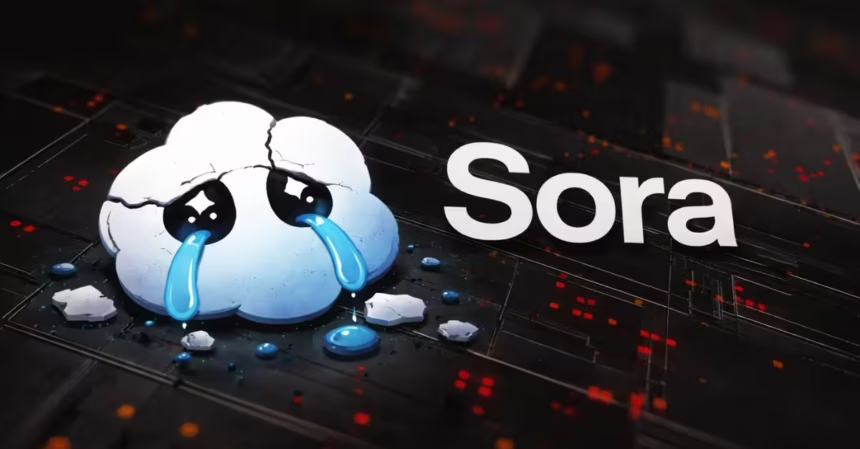
The tech world is in a state of shock: OpenAI closes Sora. Just six months after dazzling the planet with demonstrations of ultra-realistic videos, the flagship platform for 100% AI-generated short videos is taking its final bow. What seemed to be the inevitable future of cinema and digital marketing has come to a grinding halt, leaving thousands of creators and investors in total disbelief. This announcement strikes like a thunderclap in a sector that swore only by exponential growth. In reality, this decision hides much deeper stakes, blending economic viability, political pressures, and a strategic shift toward corporate needs.
Official Reasons for an Unexpected Abandonment
When a company of OpenAI’s stature makes such a radical move, the communication is weighed to the milligram. Officially, management explains that the shutdown of Sora responds to a need for focus. Sam Altman and his teams now wish to allocate their full computing and research resources to “Core” tools: computer coding, office productivity, and complex API integrations. It is in these areas that the added value for professional clients is most immediate and profitable.
The competitive landscape has also weighed heavily in the balance. While OpenAI was playing with video, Anthropic gained considerable market share with Claude, winning over developers with its precision and safety ethics. Not to be outpaced in the field of pure productivity, OpenAI chose to sacrifice its creative flagship. The firm prefers to consolidate its gains in text and code rather than exhausting itself in an animated image race that requires colossal investments for a still-fuzzy return on investment.
The Rise of Professional Tools
The professional tools sector has become the real battlefield for artificial intelligence. Companies are not looking to create dreamlike short films, but to automate workflows, secure databases, and generate bug-free code. By closing Sora, OpenAI is sending a strong signal to investors: the period of spectacular experimentation is over; it is time for process industrialization. The focus on AI integrations allows for a direct response to the demand from large groups wanting robust and private solutions.
The Shadow of Anthropic and Competitive Pressure
Anthropic’s breakthrough with high-performance language models forced OpenAI to review its priorities. Claude‘s success in academic and technical circles proved that a more sober but more reliable approach could triumph over technological “showmanship.” The decision to close Sora is therefore also a tactical response to protect the company’s foundations—namely ChatGPT and the upcoming GPT-5 model—against rivals who are no longer just background players.
Financial Reality Behind the Technological Mirage
Beyond marketing speeches, it appears the OpenAI business model is faltering. Keeping Sora online costs a fortune. Generating a single minute of video requires computing power equivalent to thousands of text queries. Server farms are running at full throttle, consuming energy and Nvidia chips at a rate that even the most spectacular fundraising rounds struggle to match. Infrastructure costs are literally exploding, while revenue from video remains marginal due to the lack of a viable subscription system for the general public.
Profitability has become the watchword in Silicon Valley. After years of “growth at any cost,” tech giants now demand proof of viability. OpenAI, despite its leader status, is no exception to this rule. The closure of Sora is an implicit admission: generative video is currently a financial black hole that is impossible to fill without sacrificing the overall financial health of the organization.
Prohibitive Computing Costs
Every frame generated by Sora represents a real hardware cost. Unlike text, video requires spatial-temporal analysis that saturates GPUs. For OpenAI, the math is simple: either massively increase service prices at the risk of losing users, or cut the most energy-hungry branches. By choosing the second option, they preserve their computing capacity for lighter, more profitable tasks.
Difficult Monetization for Video Creation
The video market is saturated with traditional editing solutions and new specialized players. Convincing users to pay for a premium subscription for videos that are often imperfect, marked by visual hallucinations, proved more complex than expected. The public loves testing the tool for free, but the transformation into recurring paying customers did not meet the targets set by Sam Altman’s finance department.
The QuitGPT Movement and the Trust Crisis
As if technical and financial difficulties weren’t enough, OpenAI faces an unprecedented political storm. The #QuitGPT movement has gained unexpected momentum on social media. This massive boycott was born from controversy linked to the personal commitments of certain leaders. Donations from Greg Brockman, president of OpenAI, to political campaigns—notably Donald Trump’s—set fire to a community of users often deeply attached to the neutrality and progressive values of Silicon Valley.
This trust crisis directly impacts brand image. For many users, using ChatGPT is no longer a trivial act but a political stance. The boycott is resulting in a wave of Plus subscription cancellations. Closing Sora could therefore be a desperate attempt to scale back and make people forget the controversies by refocusing on purely technical and less emotional aspects of artificial intelligence.
-
Massive boycott of paid subscriptions by content creators.
-
User migration toward alternatives like Llama (Meta) or Mistral AI.
-
Heated debates on leader ethics and the use of AI profits.
-
Questioning the independence of research at OpenAI.
The End of Illusions for Consumer Creative AI
Does the stop of Sora mark the end of an era? One might wonder if the dream of creative AI accessible to all was just a speculative bubble. For months, we were promised that anyone could direct a feature film from their couch. The reality is brutal: the technology is there, but it is neither sustainable nor economically bearable for the general public. This rational repositioning shows that AI will likely become a niche tool, reserved for experts and companies capable of absorbing its costs.
This decision also highlights the limits of technological “magic” in the face of material realities. AI is not immaterial; it depends on rare metals, electricity, and capital. By closing Sora, OpenAI admits that priority is given to survival, not wonder. It is a return to reason that could well influence the entire tech ecosystem in the coming months.
A Shift Toward Raw Utility
Tomorrow’s AI will likely be less spectacular but more useful. Instead of generating dreamlike landscapes, it will correct thousands of lines of code in seconds or analyze complex financial reports. This shift toward raw utility may be less seductive for the general press, but it is the only guarantor of a sustainable industry. OpenAI is leaving the entertainment world to become an infrastructure provider once again.
Consequences for Content Creators
For videographers and artists who had begun integrating Sora into their workflow, it is back to square one. Many trained in video-specific “prompt engineering,” hoping for a competitive advantage. They must now turn to tools like Runway or Pika, while fearing that these might follow the same path if computing costs do not drop drastically.
FAQ
Why did OpenAI really decide to close Sora?
The decision is multi-factorial. It combines exploding operational costs, a need to refocus on professional tools to counter Anthropic, and a desire to stabilize the company in the face of the #QuitGPT boycott movement.
Will Sora return in another form?
It is likely that OpenAI will integrate some Sora technologies into business-to-business (B2B) tools or through very expensive APIs, but a free or affordable public platform seems excluded in the short term.
What are the alternatives to Sora today?
Users can turn to Runway Gen-2, Pika Labs, or even emerging open-source solutions, although these tools often require more advanced technical skills or very powerful hardware.
What is the impact of the #QuitGPT movement on OpenAI?
The movement has caused a notable drop in individual subscription revenue and seriously tarnished OpenAI’s image as a company working “for the benefit of humanity,” forcing management into drastic strategic choices.