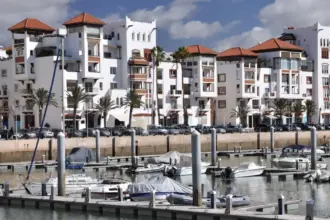



On the night of February 29, 1960, Agadir experienced a tectonic shift that would alter its identity forever. In mere seconds, a devastating earthquake claimed thousands of lives and leveled the historic city. However, this tragedy served as the catalyst for one of the most ambitious urban planning projects of the 20th century. King Mohammed V’s declaration that Agadir would be rebuilt through faith and will set the stage for a modernist miracle. Architects from across the globe converged on this Atlantic outpost, seeing it as a “tabula rasa” to implement Modern Movement principles. The result was not a reconstruction of the past, but a bold leap into the future of urban resilience.
The strategic decision to relocate the city center away from the seismic fault lines allowed for a radical rethink of urban safety. Agadir became a living laboratory for anti-seismic architecture. The focus shifted toward functionality, wide open spaces, and the strategic use of reinforced concrete. This wasn’t just about building houses; it was about designing a secure environment that could withstand nature’s volatility. Today, Agadir stands as a testament to human ingenuity, where the scars of the past are woven into a sophisticated fabric of Brutalist aesthetics and Mediterranean light.
The Vanguard of Moroccan Modernism
The reconstruction effort was led by visionary architects such as Jean-François Zevaco and Elie Azagury, who rejected colonial imitation in favor of a unique “Gadirian” style. They embraced the raw honesty of concrete, using it to create sculptural forms that masterfully managed the harsh Atlantic sun. This architectural language prioritized cross-ventilation and thermal mass, long before “green building” became a buzzword. Public buildings, such as the Central Post Office and the Law Courts, exemplify this era’s commitment to geometric rigor and structural clarity.
Agadir’s skyline is defined by a rhythmic play of light and shadow, achieved through the extensive use of brise-soleil (sun breakers). This wasn’t merely decorative; it was a deeply functional approach to living in an arid climate. The city’s planners implemented the first formal seismic codes in North Africa, creating a blueprint for disaster-resilient cities worldwide. This era of construction offered a new kind of urban dignity, blending the efficiency of the International Style with the social nuances of Moroccan communal life.
Defining Features of Agadir’s Modernist Architecture
The “Agadir School” of architecture is characterized by several distinct elements:
-
Exposed Concrete: Celebrating the strength and texture of the material, a hallmark of the Brutalist movement.
-
Climate-Responsive Design: Utilizing deep overhangs and natural airflow to mitigate heat.
-
Grid-Based Urbanism: Broad boulevards and organized blocks to facilitate emergency access and social flow.
-
Integrated Green Belts: Strategically placed parks that act as “lungs” for the city and safety zones during tremors.
-
Terraced Housing: A modern take on the traditional Moroccan roof garden, maximizing outdoor living space.
Preserving a Modernist Legacy
While Agadir is primarily known today as a premier beach destination, its true cultural wealth lies in its 1960s built environment. These structures represent a moment in history when architecture was viewed as a tool for social progress. Unfortunately, the salt-laden sea air and rapid urban expansion pose significant threats to these architectural gems. In recent years, there has been a growing movement to recognize Agadir’s reconstruction as an UNESCO World Heritage site. Advocates argue that it is the world’s most cohesive example of a modernist city adapted to an African context.
For the cultural traveler, exploring the neighborhoods of Talborjt or the New City Center offers a journey back to the future. The “quiet power” of these buildings, with their clean lines and lack of unnecessary ornament, continues to inspire contemporary Moroccan designers. Preserving this heritage is not about living in the past; it is about honoring the resilient spirit of a city that refused to die. Agadir’s architecture tells a story of collective triumph and creative courage, proving that design can indeed heal a broken community.
The Social Impact of the New Urban Plan
Urbanism is as much about people as it is about buildings. The post-1960 plan for Agadir successfully integrated various social classes through diverse housing typologies. The reconstruction of Talborjt, for instance, aimed to recreate the vibrant street life of the old quarters while providing modern amenities. Public squares were positioned as social anchors, reflecting the importance of the agora in both Mediterranean and Moroccan traditions. This blend of social engineering and high-design resulted in a city that feels both efficient and deeply human.
The city’s layout also paved the way for its economic transformation. By creating a clear separation between industrial, residential, and tourist zones, Agadir managed to grow sustainably. The promenade and beachfront areas were designed to be accessible, fostering a sense of civic pride and welcoming international visitors. This foresight in urban development has made Agadir one of Morocco’s most livable and economically dynamic cities, serving as a beacon of progress for the Souss-Massa region.
FAQ: Agadir’s Architectural Evolution
Why is Agadir’s architecture so different from other Moroccan cities?
Unlike the ancient medinas of Fes or Marrakech, Agadir was built from scratch after the 1960 earthquake using modernist principles that favored concrete, geometric shapes, and seismic safety.
Who were the key architects involved in the rebuild?
Notable figures include Jean-François Zevaco, Elie Azagury, and Mourad Ben Embarek. They are credited with creating the “Agadir Style,” a mix of Brutalism and local adaptation.
Are there any remnants of the pre-earthquake city?
The most significant site is the Kasbah (Agadir Oufella). While mostly ruined, its walls have been restored, and it remains a symbolic link to the city’s medieval past.
How does the city ensure seismic safety today?
All modern construction must adhere to the RPS 2000 code, which dictates rigorous structural reinforcements. The 1960s buildings were the first to test these life-saving techniques in the region.