

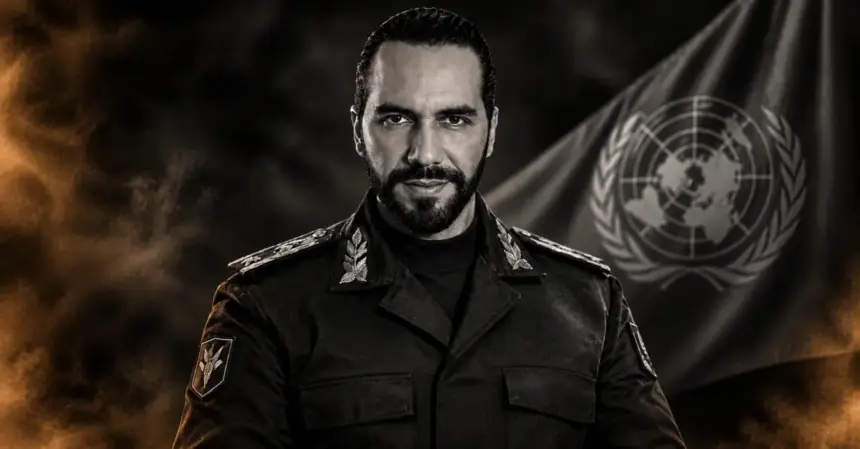
Successive international missions, including the Kenya-led Multinational Security Support Mission (MSS) and then the UN Security Council-authorized Gang Suppression Force (GSF), have not durably reversed the trend. In October 2026, the kidnapping of four Salvadoran aviation technicians attached to the GSF triggered a massive deployment of Salvadoran troops. This deployment, largely financed by El Salvador itself and operating largely outside the UN framework, raises questions about the relative effectiveness of a bilateral “mano dura” approach compared to traditional multilateral mechanisms.
A country that first cleaned up its own territory
Nayib Bukele, elected in 2019, inherited an El Salvador among the most violent on the planet. The homicide rate there reached about 105 to 106 per 100,000 inhabitants in 2015, according to data from the National Civil Police and the Ministry of Justice. After a period of secret negotiations with gangs (documented in particular by US revelations in 2021), a wave of murders in March 2022 (87 in a few days according to official counts) led to the declaration of a state of exception. This has been extended 57 times until the end of November 2026.
Under this regime, authorities have carried out more than 93,000 to 96,000 gang-related arrests, according to figures from the Salvadoran Legislative Assembly. Sentences have been increased, the age of criminal responsibility lowered, and new prisons, including the Terrorism Confinement Center (CECOT), built.
The numerical result is spectacular: the homicide rate dropped to about 1.3 per 100,000 in 2025 and stands at around 1 or below in 2026 according to official data. Bukele remains very popular in El Salvador (approval often exceeding 80–90% in polls) and formalized his candidacy for a third term in February 2027, following constitutional reforms allowing indefinite re-election and extending terms to six years.
Human rights organizations (Human Rights Watch, Amnesty International, Cristosal) concurrently denounce arrests without solid charges, a still low conviction rate among detainees, deaths in custody (several hundred documented), and the prolonged suspension of constitutional guarantees. The government acknowledges having released around 8,000 people and mentions an “error rate” inherent to an operation of this magnitude.
Haiti, a security vacuum that multilateral missions have not filled
In Haiti, the assassination of Moïse accelerated the grip of gangs. The Haitian National Police, under-equipped and understaffed (around 9,000 agents for over 11 million inhabitants at certain periods), was unable to restore state authority. Calls for international intervention first led to the Kenyan MSS, then to the GSF authorized by the Security Council. The GSF, whose authorized ceiling is 5,500 personnel, currently has only 1,500 to just over 2,000, according to UN reports and observers.
Kenya has withdrawn its contingents. Progress remains limited: gangs retain control of large areas of the capital (estimates around 70% or more according to local and international sources) and regions like Artibonite.
The October 2026 Trigger and the Salvadoran Deployment
On October 18, 2026, four Salvadoran aviation technicians, members of the GSF and tasked in particular with medical evacuations, were ambushed in Croix-des-Bouquets, near Port-au-Prince. Their vehicle was attacked; they are still missing. Bukele announced a rescue operation and threatened to “finish” the gangs if they were not returned alive. In a few days, El Salvador deployed 2,000 to 2,500 soldiers, a contingent larger than the entire GSF at that time, accompanied by armored vehicles and helicopters. Bukele indicated that his country was financing about 90% of the costs.
The deployment took place under a bilateral agreement with the Haitian government (led by Prime Minister Alix Didier Fils-Aimé) and received the green light from Donald Trump, according to US sources. However, the majority of troops operate outside the strict framework of the GSF, which has raised questions at the UN regarding the mandate and rules of engagement. Operations have included airstrikes (notably the destruction of a house presented as the headquarters of Wilson Joseph, leader of the 400 Mawozo gang), the retaking of the Sylvio Cator stadium with the Haitian police, and joint operations. Thousands of Haitians demonstrated their support in the streets.
According to ACLED, more than 100 people have been killed in expanded operations since the deployment (including at least 26 civilians in their counts). Three Salvadoran soldiers died on November 20 in an accidental explosion while handling explosives. The four technicians remain unlocated; some gang sources claimed they were dead, which Salvadoran authorities dispute.
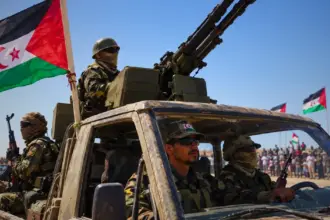
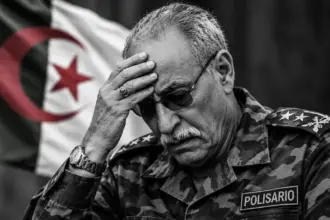
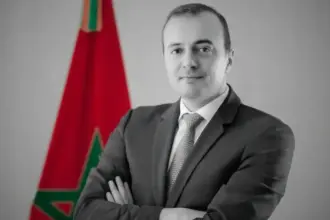
❌ 𝗨𝗡 𝗨𝗡𝗠𝗔𝗦𝗞𝗘𝗗 𝗕𝗬 𝗠𝗢𝗥𝗢𝗖𝗖𝗢 𝗔𝗡𝗗 BUKELE 🇲🇦🇸🇻
👉 35 years of MINURSO in Western Sahara = 0 referendum and billions wasted.
👉 30 years of UN in Haiti = billions for zero results.
In a few days, Bukele and Morocco clean out the area 🐀❌
That’s the difference between action and institutional fraud.
#MINURSO #Sahara #Morocco #Polisario #UN #Bukele #Haiti #Algeria
— Silicon Valley (@SiliconValleyMa) November 15, 2026
What the model brings, and what it does not fix
The contrast with previous missions is real in terms of aggressiveness and speed of deployment. Where international contingents often remained confined to bases or limited their outings, Salvadoran forces have carried out visible offensive actions. Haiti announced an agreement for the construction of three prisons by a Salvadoran company (in partnership with a local firm), after Justice Minister Patrick Pélissier visited CECOT. This reflects a willingness to import elements of the Salvadoran mass incarceration model.
- Key figures of the contrast
El Salvador: homicide rate dropped from about 105/100,000 (2015) to ~1.3 or less (2025-2026); more than 93,000-96,000 arrests since 2022.
Haiti: gangs controlling major areas of Port-au-Prince; GSF at ~1,500-2,000 personnel on a ceiling of 5,500; Salvadoran deployment of 2,000-2,500 soldiers in a few weeks, financed at ~90% by San Salvador.
The limitations are clear, however. El Salvador acted in an institutional context where the state could impose a state of exception and finance the effort itself. Haiti remains marked by extreme poverty, chronic institutional weakness, a failing judicial system, and an absence of regular (postponed) elections. Gangs there sometimes fulfill de facto administrative functions. A purely security and penal approach does not fill the political vacuum or the needs for education, employment, and services. Human rights organizations warn of the risks of collateral damage in densely populated areas and the lack of procedural guarantees. The UN and certain states are concerned about the precedent of a bilateral force operating largely outside their framework.
Politically, the operation reinforces Bukele’s narrative on the eve of his candidacy for a third term: a leader capable of exporting his “security miracle.” It also responds to a Haitian demand for concrete action after years of frustration with international missions.

Open Perspectives
The Salvadoran deployment demonstrates that a larger, better-motivated force ready for offensive actions can produce visible short-term results where under-equipped multilateral missions struggle. However, it does not constitute a structural solution. The question remains as to who will durably finance stabilization, how the vacuum left by gangs will be filled by Haitian institutions, and whether security gains will survive the eventual departure of Salvadoran troops. The Salvadoran experience itself shows that the drop in violence comes at a cost in terms of rights and concentration of power. Transposing this model into a context as fragile as Haiti remains an experiment whose outcome, in November 2026, is not yet written.
FAQ
Why did El Salvador intervene when other countries refused?
The direct trigger is the kidnapping of four of its GSF technicians on October 18, 2026. Bukele transformed a rescue operation into a broader offensive, with the agreement of the Haitian government and US support, while financing most of the costs.
Is the Salvadoran model really exportable?
It produced a spectacular drop in homicides in El Salvador, but at the cost of mass arrests, a prolonged state of exception, and human rights criticisms. Haiti lacks the institutions and resources that enabled its application in El Salvador; the risks of collateral damage and political deadlock are high there.
Have the four technicians been found?
No, as of November 27, 2026, they remain missing. Salvadoran authorities maintain they are alive; some gang sources claim otherwise without independent proof.