

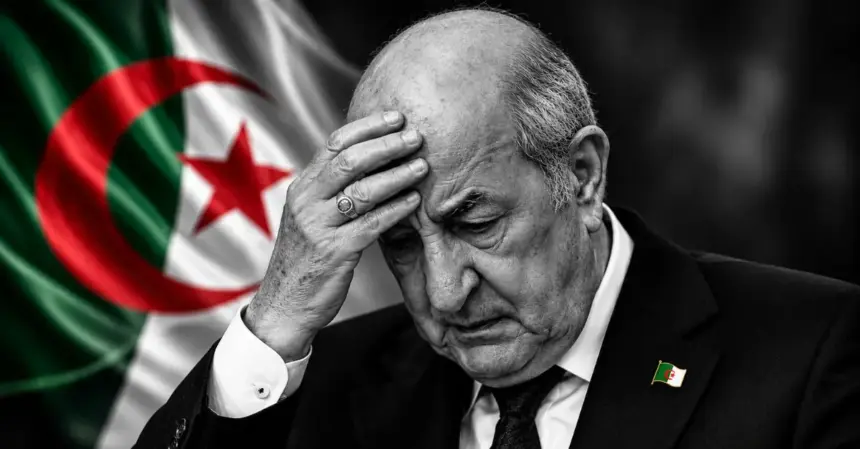
This represents an increase of about 83% in four years. At the official exchange rate of around 136-137 dinars to the dollar, this stock is equivalent to about $126 billion. This data, analyzed in particular by the economist Abdelrahmi Bessaha (a former IMF collaborator) based on table 7 of the Bank of Algeria’s report, comes at a time when President Abdelmadjid Tebboune has regularly presented the absence of external debt as a major achievement of his policy.
This rise is not an isolated anomaly. It fits into a context of persistent budget deficits, dependence on hydrocarbons, and political choices that favor domestic financing. It deserves close examination, not to be alarmist, but to understand the mechanisms, the authorities’ arguments, and the risks highlighted by analysts.
An 83 Percent Jump in Four Years
According to Bank of Algeria data reported by Algeria Business and Bessaha, the outstanding amount has risen every year: 13,703.6 billion in 2021, 15,259.7 billion in 2022, 15,920.4 billion in 2023, then 17,243.4 billion in 2024. In absolute terms, the increase is clear. Relative to nominal GDP (which has itself grown, from about 20,902 billion dinars in 2020 to 35,788 billion in 2024 according to the Bank of Algeria), the ratio of this domestic debt has even declined slightly in some readings (around 32-35% depending on the year and the scope). Bessaha notes, however, that debt has grown faster than GDP in nominal terms (+83% versus +71%), which reduces room for maneuver.
Almost all public debt is domestic. Bessaha and other analyses put the domestic share at 99.5%, denominated in dinars. External debt, for its part, remains very low: about $2.87 billion at the end of 2024 according to the Bank of Algeria, or around 1% of GDP. Finance Minister Laaziz Faid indicated in November 2024 that the total stock of public debt was expected to be around 16,879 billion dinars at the end of 2024 (about 49-50% of GDP), a level he considers below emerging-market benchmarks (often 60-70%). The authorities therefore present this structure as a strength: it avoids the conditionalities of the IMF or the World Bank and preserves financial sovereignty, after the trauma of the 1990s.
Between Promise and the Reality of Monetary Financing
Monetary financing of the state is not new. In 2017, under Abdelaziz Bouteflika, the monetary law was amended (Article 45 bis) to exceptionally authorize the Bank of Algeria to finance the Treasury directly for five years. The mechanism, presented as temporary in the face of the collapse in oil revenues after 2014 and the exhaustion of the Revenue Regulation Fund, mobilized 6,556 billion dinars as of January 2019 according to Bank of Algeria data and subsequent analyses. Part of it went to cover deficits, to clean up public companies (Sonatrach, Sonelgaz), and to finance programs such as housing or the National Pension Fund.
When he took office in December 2019, Tebboune promised to break with this practice and to refuse external borrowing. Statements from 2020 confirm this stance: no recourse to the IMF or to the “printing press.” Yet in July 2021, the Bank of Algeria launched a special refinancing program of 2,100 billion dinars. Analyses (notably in Maghreb Emergent and Le360) saw it as a more indirect form of monetization. The Bank of Algeria’s 2024 accounts still show Treasury bills and similar securities amounting to several thousand billion dinars (a figure of 5,483.4 billion is cited by the journalist Abdou Semmar based on the balance sheets).
More recently, the 2026 Finance Act raised the ceiling on Bank of Algeria advances to the Treasury from 10% to 20% of budget revenues and extended their possible duration (potentially up to two fiscal years). The Finance Minister presented this measure as normal and framed by the monetary law. For critics, it institutionalizes what was supposed to remain exceptional. The Revenue Regulation Fund, once fed by oil surpluses, has been empty for several years, which increases the pressure on other levers.
The Mechanisms Fueling the Debt
Three main channels are described by analysts (Semmar, Bessaha, and others):
- The issuance of Treasury bonds and bills, bought mainly by public banks (BNA, BEA, CPA, BADR, etc.). These institutions hold very large amounts of government securities (several thousand billion according to balance-sheet compilations by Rachid Sekak and others).
- Direct advances from the Bank of Algeria to the Treasury.
- Bank refinancing, where banks pledge their securities to the central bank, which can indirectly facilitate public financing.
These operations are not all pure money creation in the strict sense, but their repeated use strengthens the ties between the Treasury, public banks, and the central bank. Bessaha observes that the share of “current debt” (linked to budget deficits) has increased, while “clean-up debt” remains dominant. State support to economic sectors and the takeover of public companies’ debts has risen sharply (from 6.6% of domestic debt in 2020 to 30.6% in 2024 according to Bessaha). An amount of about 2,635 billion dinars is cited for certain obligations linked to these buyouts.
Key Figures on Domestic Debt
- 9,423.4 billion dinars at the end of 2020; 17,243.4 billion at the end of 2024 (Bank of Algeria, Bessaha’s analyses).
- Increase of about 83% in four years.
- About $126 billion at the official rate (~136-137 DZD/USD).
- 99.5% of public debt is domestic (Bessaha and others).
- External debt: ~$2.87 billion at the end of 2024 (Bank of Algeria).
- 2021 refinancing program: 2,100 billion dinars.
- Ceiling on Bank of Algeria advances raised from 10% to 20% of revenues in the 2026 Finance Act.
- 2024 budget deficit: about 4,930 billion dinars (13.8% of GDP according to the Bank of Algeria).
Official and Critical Views
On the authorities’ side, the message remains consistent: Algeria has virtually no external debt, a deliberate choice that avoids international constraints. Total levels (around 50% of GDP) are presented as reasonable, even comfortable compared with many countries. Domestic financing makes it possible to support social spending, public investment, and non-hydrocarbon growth (which rose by 4.8% in 2024 according to the Bank of Algeria, versus 3.6% for total GDP). Foreign exchange reserves remain significant (around $68 billion at the end of 2024).
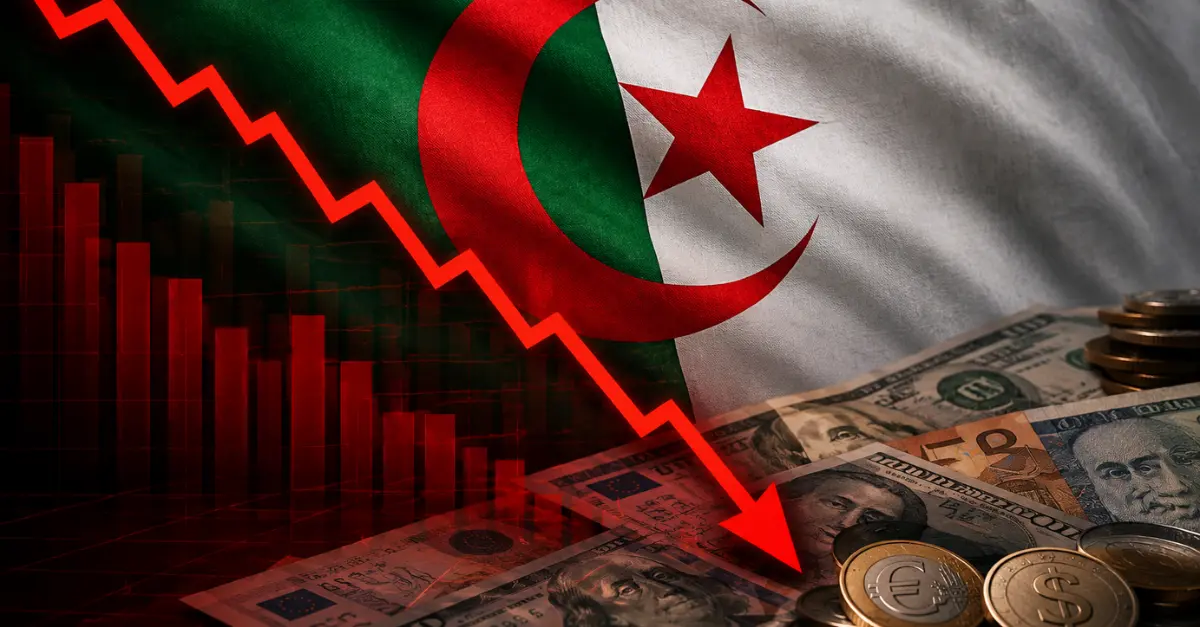
The critics, voiced notably by Bessaha, Semmar, and media outlets such as Le360 or Maghreb Emergent, stress several points. First, the absolute increase during Tebboune’s first term contradicts the idea of a break with previous practices. Second, financing through state-controlled institutions raises the question of real budget discipline. The parallel currency market illustrates the imbalances: gaps of around 80% (for example, around 246 dinars to the dollar on the parallel market versus ~137 officially in some 2026 citations) reflect restricted access to foreign currency and monetary pressures. Bessaha and others link these tensions partly to the monetization of deficits and to the expectations of economic agents. Finally, the IMF projections cited in these analyses anticipate a rise in gross public debt (for example toward 79% of GDP in 2031 in some readings, versus about 52% in 2025), if deficits persist without reforms.
These views are not irreconcilable: debt that is mainly domestic and at still-moderate levels is not a problem in itself if it finances productive investment and if deficits shrink. The risk lies in the quality of spending, the persistence of high non-hydrocarbon deficits, and the growing weight of government securities on bank balance sheets, which can hold back lending to the private sector.
FAQ
What is the exact evolution of domestic debt according to the Bank of Algeria?
From 9,423.4 billion dinars at the end of 2020 to 17,243.4 billion at the end of 2024, an increase of 83%, according to the 2024 annual report and Bessaha’s analyses.
Has Tebboune abandoned monetary financing?
He promised to do so and to avoid external borrowing. However, a refinancing program of 2,100 billion dinars was launched in 2021, and the ceiling on advances was raised in the 2026 Finance Act.
Do the authorities consider the debt problematic?
No. They regard it as mainly domestic, at levels (around 50% of GDP) lower than in many emerging countries, and as a choice of sovereignty. Critical analysts stress the absolute increase and the long-term risks.