
On November 12, 2026, HSBC Bank Middle East Limited announced its intention to wind down its operations in Algeria. The news, relayed notably by Zawya, followed a strategic review of its wholesale banking branch. Present since receiving its license in June 2008, the British bank never built a significant retail network. It essentially served multinationals, institutions and large corporations, with international payments, trade finance and market access services.
In its statement, the group frames the decision as a step in its “continuous simplification,” aimed at concentrating resources where it has a clear competitive advantage and better growth prospects. Discussions with clients have already begun to arrange their transfer to other institutions in Algeria. HSBC pledges to honor its obligations to clients, employees and regulators until the end of the process. No final closing date has been announced.
This is not the first time the subject has come up. As early as 2016, Bloomberg reported that HSBC was considering a possible withdrawal as part of a global refocusing. In 2026, the group also sold its retail banking activities in Egypt to Emirates NBD and is reviewing certain activities in Turkey. The exit from Algeria is therefore part of a portfolio logic, not an isolated, abrupt break. Nevertheless, it comes at a time when international business volumes remain constrained.
A limited presence and a model dependent on cross-border flows
HSBC’s Algerian branch was not a mass-market player. Its model relies on international trade finance, transfers and support for groups that need a global network. When transfer procedures become lengthy and unpredictable, or when investment and foreign trade flows remain modest, the viability of such a structure shrinks. This is not a value judgment: it is the logic of a bank comparing the return of each market.
According to UNCTAD’s World Investment Report 2026, FDI inflows into Algeria reached roughly $1.53 billion in 2025, up from $1.295 billion in 2024. This increase is real, but these flows represented only about 1.3% of gross fixed capital formation. The FDI stock remains relatively limited (around $39.7 billion at the end of 2025, according to the same data). For a bank geared toward international project financing and trade, the potential demand base remains narrow.
Documented constraints on transfers and trade
The U.S. State Department’s 2026 report on the investment climate in Algeria stresses that difficulties with currency conversion and transfers stem mainly from procedures rather than broad statutory prohibitions. The process is described as bureaucratic, with nearly thirty steps; delays, theoretically around one month, often stretch to three to six months. These frictions increase monitoring costs for companies and their banks.
On the trade front, the European Union has launched a dispute settlement procedure under the Association Agreement. It notably challenges an import licensing system whose effects, according to the Commission, come close to bans for certain products, as well as import-substitution measures and foreign ownership caps for certain importing companies. These elements limit the volume of trade finance that international banks can generate.
As for reserves, the IMF’s 2026 Article IV report (published in September) indicates that gross official reserves fell from about $68.9 billion at the end of 2024 to $51 billion in 2025 (estimate), with a projection of $46.5 billion in 2026 and a downward medium-term trajectory if current account deficits persist. The IMF links the 2025 pressure to lower hydrocarbon exports and higher imports. President Abdelmadjid Tebboune has rejected the long-term projections, pointing to efforts to diversify revenue beyond hydrocarbons.
Key figures on the economic context
- FDI 2025: $1.53 billion (UNCTAD WIR 2026), or ~1.3% of GFCF.
- Reserves: $68.9 billion at end-2024 → $51 billion in 2025 (IMF estimate), projected $46.5 billion in 2026.
- Hydrocarbon dependence: over 90% of goods exports according to several recent sources (World Bank and trade data), and a substantial share of budget revenue (often cited at around 40% in recent years).
- Transfers: process described as multi-step and potentially taking several months (U.S. State Department, 2026).
These factors do not mechanically “cause” HSBC’s departure — the group did not present it that way — but they describe an environment where demand for sophisticated international banking services remains constrained.
The contrast with Moroccan expansion in Africa
While some foreign banks are reducing their footprint in North Africa or beyond, major Moroccan groups are pursuing their continental expansion. Attijariwafa Bank, already present in about fifteen African countries, signed an agreement in 2026 to take a majority stake in Société Générale Ghana, marking a first notable foray into English-speaking Africa. Banque Centrale Populaire and Bank of Africa are also expanding their networks, particularly in West and Central Africa. These groups generate a growing share of their revenues outside Morocco and are positioning themselves as regional players in markets where European banks are refocusing.
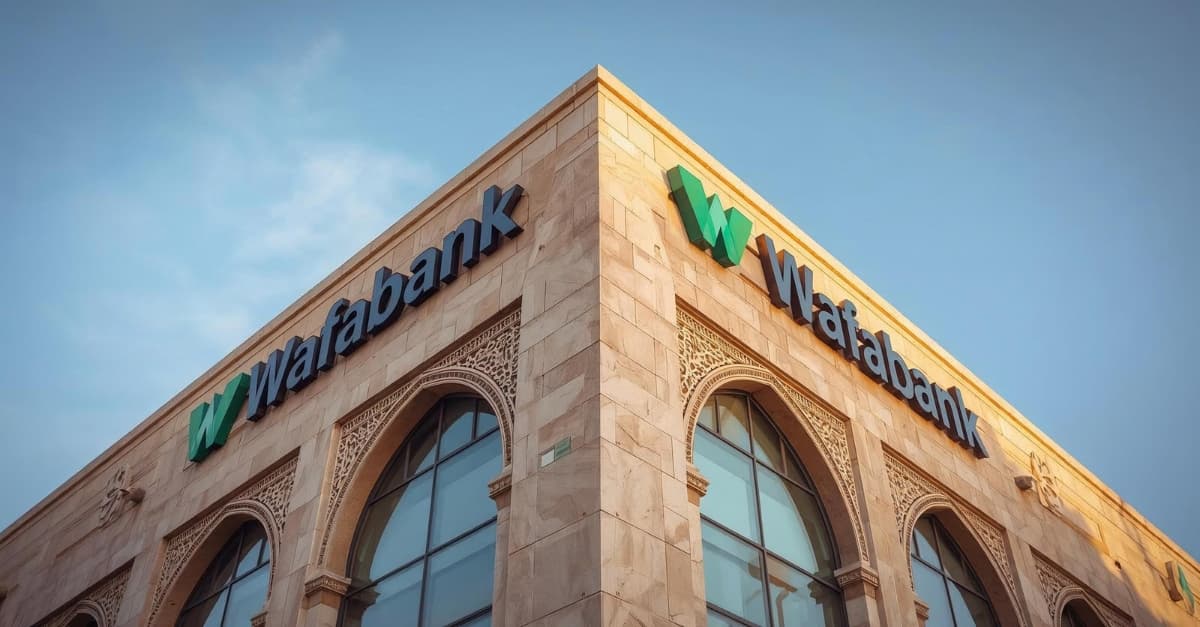
This contrast is not merely competitive. It illustrates different strategic choices: Moroccan banks capitalize on geographic, linguistic and regulatory proximity with part of Africa, while HSBC, a global group, optimizes its portfolio according to growth and competitive-advantage criteria on a worldwide scale.
Challenges and outlook
HSBC’s withdrawal raises the question of how attractive the Algerian market really is for financial institutions specializing in international trade and multinational financing. The Algerian authorities highlight reforms, investment promotion through the AAPI, and the goal of diversifying exports beyond hydrocarbons (a target often mentioned at $29 billion by 2030). Progress exists in some sectors, and non-hydrocarbon growth has been robust in recent years. However, FDI indicators relative to capital formation, the documented transfer delays and trade tensions with the EU show that frictions remain significant for players that depend on smooth cross-border flows.
From a geopolitical and regional perspective, the departure comes amid tense relations between Algiers and Paris, with effects on trade flows, while Rabat strengthens its role as an African banking platform. None of these factors alone determines the decisions of a global bank, but they shape the landscape in which those decisions are made.
In the medium term, Algeria’s ability to broaden its non-hydrocarbon export base, reduce the delays and unpredictability of transfers, and clarify the investment framework will determine whether other international players maintain or strengthen their presence. The IMF stresses the need to consolidate public finances and increase flexibility to preserve reserves. The authorities, for their part, emphasize sovereignty and structural projects (mining, industry, hydrogen). The gap between the two readings remains an open point of debate.
HSBC’s departure is neither a complete surprise nor an isolated event. It is a reminder that, for banks whose model rests on international flows, the size of the potential market and the predictability of the rules matter as much as the rhetoric of openness. What follows — the precise timetable of the wind-down, the actual transfer of clients, the evolution of FDI and reserve indicators — will show whether this withdrawal remains a case of global refocusing or signals a more structural difficulty in retaining financial players oriented toward foreign trade.
FAQ
Did HSBC explicitly link its departure to Algerian restrictions?
No. The November 12, 2026 statement cites a strategic review and the group’s simplification to focus on markets with the highest growth potential.
What are the most recent FDI figures for Algeria?
According to UNCTAD’s World Investment Report 2026, inflows reached about $1.53 billion in 2025 (versus $1.295 billion in 2024), representing about 1.3% of gross fixed capital formation.
How are foreign exchange reserves evolving according to the IMF?
The September 2026 Article IV report indicates a decline from $68.9 billion at the end of 2024 to $51 billion in 2025 (estimate), with a projection of $46.5 billion in 2026 and a still-downward trajectory over the longer term if deficits persist. These projections are disputed by the Algerian authorities.
Are Moroccan banks expanding in Africa?
Yes. Attijariwafa Bank, BCP and Bank of Africa are extending their continental networks; Attijariwafa notably announced in 2026 a majority stake in Société Générale Ghana.