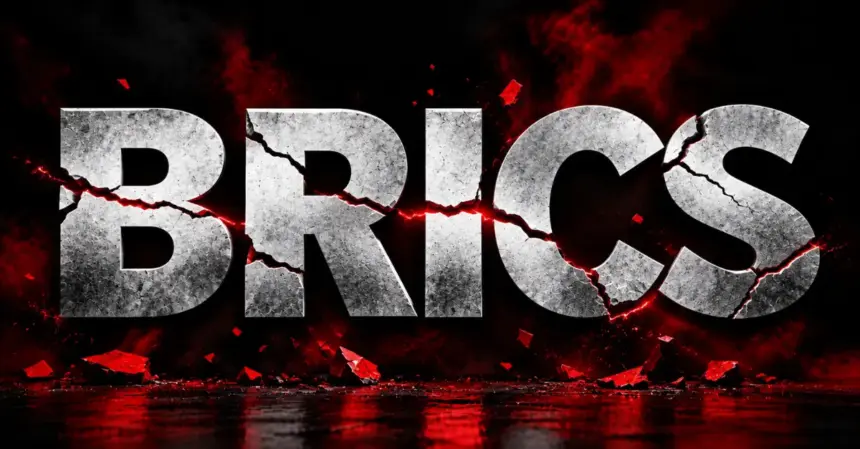
At the New Delhi summit in September 2026, BRICS leaders adopted a 140-point joint declaration after tense negotiations that ran until dawn. The ability to produce a text despite opposing positions on the conflicts in the Middle East is often presented as a success. To me, it mostly illustrates the glass ceiling of this organization: it can agree on cautious wording, but struggles to turn its economic weight into coherent political influence.
The acronym BRIC was coined in 2001 by Goldman Sachs economist Jim O’Neill to designate Brazil, Russia, India and China, emerging markets whose demographic and industrial growth seemed destined to play a major role. The first summit of the four countries was held in 2009 in Yekaterinburg, against the backdrop of the financial crisis that had weakened the credibility of the American model. South Africa joined the group in 2010-2011, turning BRIC into BRICS.
The real expansion only came after the Johannesburg summit in 2023: Egypt, Ethiopia, Iran and the United Arab Emirates became full members in 2024, and Indonesia in 2025. Saudi Arabia, invited in 2023, is treated as a member by the secretariat and the host countries, but Riyadh continues to present itself as an “invited country.” In addition, there are ten partner countries (Belarus, Bolivia, Cuba, Kazakhstan, Malaysia, Nigeria, Thailand, Uganda, Uzbekistan, Vietnam).
Real Economic Weight, Limited Capacity for Action
The eleven members account for about 49.5% of the world’s population, 40% of global GDP in purchasing power parity (PPP) and 26% of international trade, according to figures cited at the New Delhi summit and IMF/UNCTAD data.
- China alone accounts for about 70% of the group’s GDP in nominal terms and nearly half in PPP terms.
- The New Development Bank (NDB), created in 2014, had approved about $44 billion in loans for 141 projects by mid-2026, a large share of which has already been disbursed.
- Intra-BRICS trade has grown strongly, but remains highly asymmetrical, with China by far the leading partner.
These figures give the group a material reality. Yet they do not translate into a solid institutional architecture. BRICS has no defense treaty, no free trade area, no sanctions mechanism and no central command. Decisions are made by consensus, which amounts to a de facto veto for every member. The more the group expands, the more its diverging interests make substantive agreements difficult.
Structural Contradictions That Expansion Has Not Resolved
India and China, the group’s two largest powers, clashed deadly in the Himalayas in 2020. New Delhi also takes part in the Quad with the United States, Australia and Japan. Saudi Arabia and Iran, both within the BRICS circle, stand on opposite sides of regional conflicts, including the tensions linked to the war in the Middle East in 2026. The foreign ministers’ meeting in May 2026 in New Delhi did not produce a joint communiqué on all sensitive issues; the September summit required prolonged negotiations to work around the disagreements between the Emirates and Iran.
Russia pushed for expansion after 2022, partly to dilute China’s relative weight and multiply its trading partners. Beijing, for its part, has already developed its own instruments: a renminbi payment system, bilateral development banks and the Belt and Road Initiative. China no longer needs the BRICS to advance its objectives; it needs them to legitimize a multipolarity of which it is the main beneficiary. The other members often seek a better seat at the existing table rather than a radically new order.
What the BRICS Are Not
Talk of a “new world order” or a common currency remains largely rhetorical. The NDB is a useful institution, but its loan portfolio remains modest compared with those of the World Bank or the Asian Development Bank. Attempts at de-dollarization are advancing mainly through bilateral agreements in local currencies, not through a robust collective infrastructure. At the New Delhi summit, the declaration criticized unilateral tariff measures without naming the United States, and called for restraint in the Middle East without clearly condemning either side. This is the language of the lowest common denominator.
Several analysts, including within member countries, believe that China alone, through its industrial, technological and financial weight, is the real potential counterweight to American influence. The BRICS give it a platform, but expansion has also multiplied the constraints. The requirement of unanimity protects each state’s sovereignty, which is consistent with the group’s discourse, but prevents any ambitious common foreign or monetary policy.
FAQ
Do the BRICS have a common currency?
No. There are discussions about local-currency payments and facilitation mechanisms, but there is no single currency and no concrete plan for a monetary union.
Is Saudi Arabia a full member?
The BRICS secretariat and several host countries count it among the eleven members. Riyadh continues to present itself as an “invited country” without having publicly formalized its membership.
Why is consensus so difficult?
Because the rules require unanimity and the members often have opposing strategic, energy and security interests (India-China, Saudi Arabia-Iran, relations with the West).
Does the New Development Bank rival the World Bank?
No. Its lending volume is far lower. It finances infrastructure and sustainable development projects in emerging countries, but remains a complementary institution.