This is not a sudden hemorrhage, but a pace of attrition that deserves close examination, because it directly affects Russia’s ability to sustain its standoff strikes against Ukrainian positions and cities.
The Su-34, the fighter-bomber that Russian forces use most heavily to drop glide bombs, accounts for most of the destruction. On October 4, drones from the Security Service of Ukraine hit a Su-34 and a Su-35 at the Khanskaya air base in Adygea, about 500 km from Kyiv-controlled territory, along with an ammunition depot.
On the night of October 14 to 15, Ukrainian Navy Neptune missiles struck the Borisoglebsk air base in the Voronezh region. Satellite images showed four Su-34s destroyed and two others severely damaged. On October 29, another Neptune strike destroyed two more Su-34s at Marinovka, in the Volgograd region; satellite imagery confirmed debris on the aircraft’s usual parking spots.
The Su-34 toll for the month therefore stands at seven aircraft destroyed, or nine counting the two damaged at Borisoglebsk. Ukrainian military intelligence (HUR) indicated that as of October 22, Russia had about 140 Su-34s of all versions in service, and that Russian industry had delivered 22 new aircraft between October 2025 and October 2026. October’s losses alone represent a significant share of annual production, which the HUR has estimated at between 14 and 18 aircraft per year in other communications. Russia has not acknowledged these strikes.
Key figures on losses recorded from late September to October 2026
- 7 Su-34s destroyed on the ground by Ukrainian strikes (Khanskaya, Borisoglebsk, Marinovka), plus 2 damaged at Borisoglebsk.
- 1 Tu-95MS destroyed in a takeoff accident on September 29 near the Ukrainka air base (Amur region), with at least six crew members killed.
- 2 Su-30SMs lost on October 21 in training flight accidents (one confirmed by the Russian Ministry of Defense in Kaliningrad, the other reported by Russian and Ukrainian sources, with the announced deaths of two pilots from the Russian Knights aerobatic team).
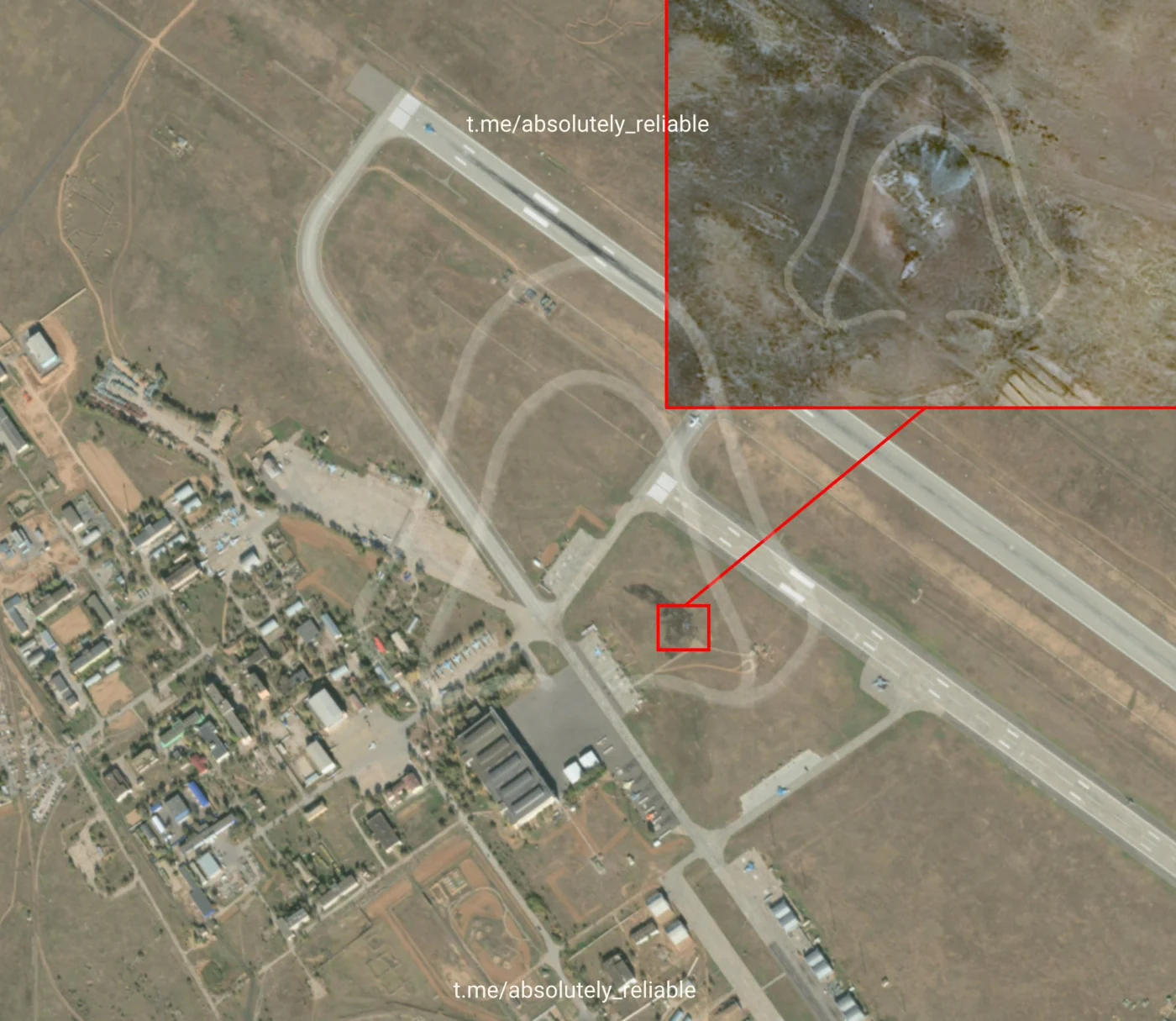
- 1 Su-57 reported destroyed by fire on October 29 at Akhtubinsk during an engine start (satellite images published by a Ukrainian open source; not confirmed by Russia).
- 1 Mi-8 destroyed on October 30 in the Luhansk region by Ukrainian drones after landing.
These details come from the Ukrainian open-source project Oko Gora, which recorded 11 fighter aircraft and one helicopter for October alone, from the HUR, from statements by the Ukrainian Navy and the SBU, from satellite images analyzed by groups such as AviVector and CyberBoroshno, and from official Russian confirmations limited to flight accidents. The Oryx project, which only records visually documented losses, counted 205 Russian aircraft destroyed or damaged since February 2022, including 48 Su-34s.
The Tu-95MS lost on September 29 is a separate case. The aircraft crashed on takeoff near the Ukrainka air base in the Far East. The Russian Ministry of Defense said it was on an unarmed training flight. It is the first accident of this kind since 2015. Russia no longer produces the Tu-95; it uses them to launch Kh-101 cruise missiles at Ukraine. Every loss is therefore irreversible.
The two Su-30SMs on October 21 were accidents. The Ministry of Defense confirmed the crash of one of them in the Kaliningrad region during a training flight; both crew members ejected. Russian and Ukrainian sources reported a second aircraft the same day. A few days later, the Russian Knights aerobatic team announced the death of Colonel Oleg Yerofeyev and Lieutenant Colonel Vladimir Kochetov, without specifying the circumstances. Ukrainian analysts drew a connection; Russian authorities have not confirmed this hypothesis.
The reported loss of the Su-57 at Akhtubinsk, the main flight test center, is the most unusual. A Ukrainian open source published satellite images showing a burn mark on a parking area after a fire during an engine start on October 29. Russia has not commented. If the information is verified, it would be the fourth Su-57 lost or damaged in 2026, after a drone strike in April and a crash near Moscow in July that Moscow blamed on a technical failure. Su-57 production remains limited to a few units per year.
A bad image for Russian aircraft
The Su-34s are the main tool for glide bomb (KAB) strikes, which Russian forces use to saturate Ukrainian positions and towns near the front without exposing themselves to air defenses. Reducing the number available forces Russia either to lower its sortie rate or to accept higher risk by moving bases closer. Ukrainian strikes with Neptune missiles and long-range drones have shown that bases located several hundred kilometers from the front line are no longer out of reach. This forces Russia to disperse its aircraft further or pull them back deeper, which lengthens reaction times and reduces operational effectiveness.
On the industrial side, the production rate of the Su-34, even though it has increased, remains below the combined effect of combat losses, accidents and wear. The HUR has stressed that cumulative losses since 2022 are equivalent to several years of production. Western sanctions have not shut down the assembly lines, but they limit access to certain components and lengthen production cycles. Each Su-34 represents an investment of several tens of millions of dollars and years of crew training.
The accidents also point to pressure on the fleet and its crews. Intensive training flights, the aging of some aircraft and maintenance under constraints show up in the accident reports that Moscow is forced to acknowledge. The loss of a Tu-95MS, an irreplaceable aircraft, also reduces long-range strategic strike capability.
One to watch
These losses are part of a war of attrition in which Russian aviation still holds a quantitative advantage, but where the combination of ground strikes and accidents is gradually shrinking its room for maneuver. Russia continues to deliver new Su-34s and to modernize existing aircraft. Ukraine, for its part, is extending the range of its missiles and drones, which forces adaptations. The question remains open whether the rate of destruction will durably exceed the capacity for replacement, and how this will affect the density of glide bomb strikes on the front and on Ukrainian cities in the coming months. Data from the next few weeks, cross-checked against satellite images and official statements, will help refine this assessment.
FAQ
Has Russia confirmed the Su-34 losses caused by Ukrainian strikes?
No. It has only acknowledged the accidents that occurred during training flights (Tu-95MS and Su-30SM).
How many Su-34s does Russia reportedly still have in service?
According to Ukrainian military intelligence, about 140 as of October 22, 2026.
Do satellite images confirm the destruction?
Yes, for several cases at Borisoglebsk and Marinovka, where debris was observed on the parking spots.
Is the Su-57 fire at Akhtubinsk confirmed?
Not by Russia, which does not want to scare off its future buyers. The information rests on satellite images published by a Ukrainian open source.