
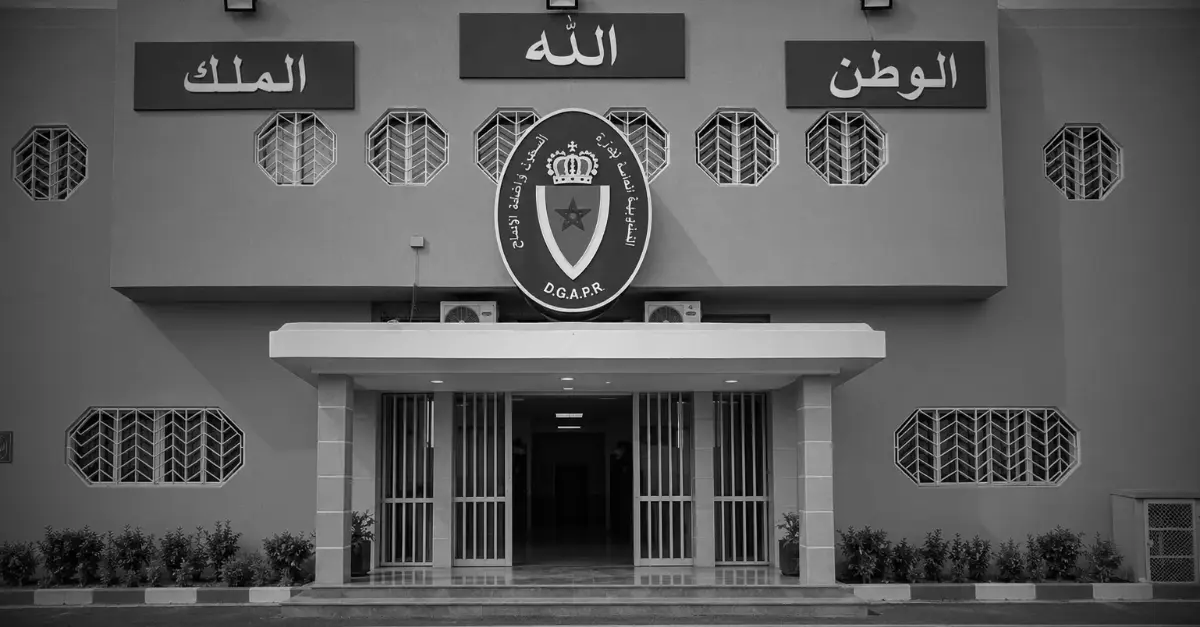
These figures, drawn from data from the General Delegation for Prison Administration and Reintegration (DGAPR) and barely covered by the Moroccan press, offer a useful snapshot of the makeup of a foreign prison population that remains a minority but reveals much about migration flows, trafficking and bilateral relations.
A limited number of inmates in a system under pressure
Foreigners then accounted for roughly 1.7% of all incarcerated people. Among them were 102 women and 1,496 men. The vast majority came from the African continent: 1,228 people, or nearly 77% of foreign detainees. Europeans followed with 287 individuals (about 18%). The rest were split between Asians (41) and nationals of the Americas (24, including 11 Brazilians). Eighteen detainees held dual nationality, with the report not specifying the combinations.
These data represent a stock at a given date. They measure neither the annual flow of admissions nor incarceration rates relative to the populations present on Moroccan territory (residents, tourists, migrants in transit). They therefore do not allow any conclusion about the relative over-representation of a nationality without reference population figures.
The DGAPR’s 2025 annual report, published later, indicated 1,696 foreign detainees as of December 31, 2025, out of a total of 99,366 incarcerated people. The overall prison population fell by 5.45% over the year, thanks to more releases than new admissions.
🇲🇦 The main foreign nationalities in Moroccan prisons
| Rank | Nationality | Number of detainees |
|---|---|---|
| 1 | 🇸🇳 Senegalese | 306 |
| 2 | 🇩🇿 Algerians | 94 |
| 3 | 🇫🇷 French | 102 |
| 4 | 🇪🇸 Spaniards | 74 |
| 5 | 🇳🇱 Dutch | 31 |
| 6 | 🇹🇳 Tunisians | 24 |
| 7 | 🇪🇬 Egyptians | 12 |
| 7 | 🇲🇷 Mauritanians | 12 |
| 9 | 🇱🇾 Libyans | 7 |
The most represented nationalities
Senegalese nationals are by far the largest group, with 306 detainees. They are followed by Algerians (94), French (102), Spaniards (74) and Dutch (31). Tunisians number 24, Egyptians and Mauritanians 12 each, and Libyans 7. Press outlets that have picked up the DGAPR data frequently mention drug trafficking offenses, without providing a detailed breakdown by nationality.
These rankings fit into a well-known geography. Senegal is among the major countries of origin for migrants and workers in West Africa. Algeria and Morocco share a land border and a complex history of rivalry and cooperation. France and Spain remain the Kingdom’s leading European economic and tourism partners, with large flows of people and agreements on judicial cooperation and prisoner transfers.
The question of nationality and origins
DGAPR statistics classify detainees by declared or documented nationality, not by origin. A French citizen of Algerian descent is therefore counted as French, not as Algerian. The same applies to any dual national whose recorded nationality is French.
This methodological rule is standard. It explains why the figure of 102 French nationals potentially includes people born in France or naturalized, of Algerian or other descent. The Moroccan and French press regularly report individual cases of Franco-Algerians imprisoned in Morocco, for reasons ranging from drug trafficking to incidents linked to sporting events (such as the 2025 AFCON) or various legal proceedings. These cases appear under the “French” heading. The 18 dual nationalities mentioned in the September 2025 data remain unspecified; they may partly overlap with this reality, though no precise proportion can be inferred.
What the figures do show is that the official count by nationality inevitably masks part of the diversity of migratory and family trajectories.
Issues and limitations
The relative weight of African detainees (77%) reflects both the migration routes to Europe via Morocco and the trafficking networks that use the country as a hub. Europeans, who are more visible in the media, are often involved in drug cases (hashish in particular) or extended stays. Transfer agreements allow some detainees to serve the remainder of their sentence in their home country, subject to judicial and consular conditions.
Moroccan prison overcrowding, even if slightly down at the end of 2025, remains a structural challenge. Foreigners enjoy the same formal rights as nationals regarding healthcare, visits and training, with consular follow-up. Occasional criticism of detention conditions (notably for Spaniards, as it happens) has been denied by the DGAPR, which stresses compliance with standards and regular visits from consulates.
These statistics say nothing about crime rates. Without data on the number of nationals of each country present in Morocco (legal residents, tourists, irregular migrants), any comparison of “over-representation” is impossible. Nor do they indicate sentence length or the share of pretrial detention.

Outlook
The makeup of the foreign prison population in Morocco evolves with migration flows, border control policies and bilateral cooperation. The September 2025 figures and those from the end of the year show relative stability in the foreign contingent within an overall population that is slightly declining. To go further, these stocks would need to be cross-referenced with consular data, transfer agreements and statistics on specific offenses, information that remains largely internal or fragmentary in public communications.
FAQ
Do the September 2025 figures include all detainees of the year?
No. They represent the number of people held on a given date (a stock), not the total number of people incarcerated during the year.
Can an incarceration rate be calculated by nationality?
No, due to a lack of reliable public data on the number of nationals of each country present in Morocco.
Are French nationals of Algerian origin counted as Algerians?
No. They are counted according to their French nationality.
Did the number of foreigners increase at the end of 2025?
Yes, according to the annual report: 1,696 on December 31, 2025, compared with 1,598 on September 30.