Among the new products, Moog’s MR SLED caught my attention. It is not just another vehicle but an air defense module that, according to reports, can be mounted on several types of platforms, including pickup trucks. Behind this technical choice lies a strategic question: how do you protect light units against drones without burdening them with a heavy armored vehicle?
What Moog unveiled at AUSA 2026
The American company Moog unveiled the MR SLED for the U.S. Army’s M-SHORAD Increment 4 program. The system is meant to provide air defense to maneuvering units without being tied to a specific vehicle. It is based on Moog’s Reconfigurable Integrated-weapons Platform (RIwP) turret.
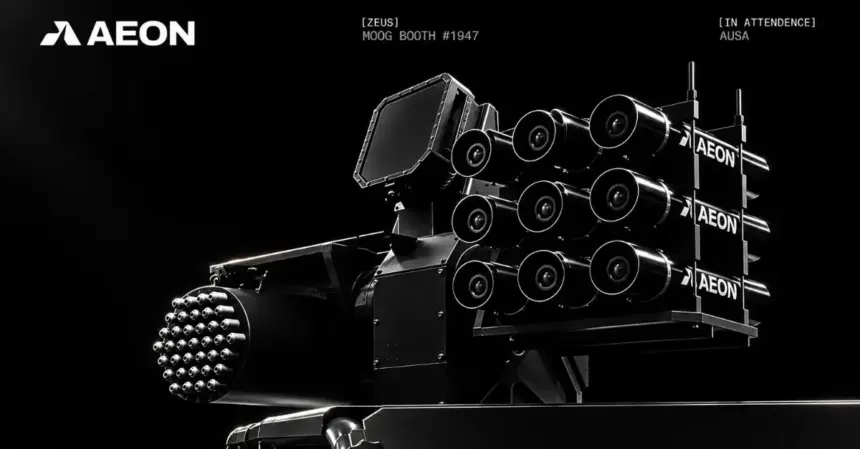
The configuration on display carried 46 missiles: 37 Kestrel interceptors and nine Zeus missiles, developed by the American company Aeon. The Kestrel’s specifications have not been disclosed.
The Zeus was originally designed as an anti-tank missile before also being steered toward air defense. Its reported characteristics are as follows:
- range of about 4 to 5 km (2.5 to 3.1 miles);
- speed of about 800 km/h (497 mph);
- 2.7 kg (6 lb) warhead;
- unit cost of about $50,000.
These figures come from the specialist press and have not been confirmed by an official source. I treat them as orders of magnitude.
Why the U.S. Army wants “sleds”
Here, the word “sled” refers to a platform or pallet on which a complete weapon system is mounted, and which can then be loaded onto different carriers. In 2024, the U.S. Army published a request for information for M-SHORAD Increment 4. It sought a capability to support dismounted maneuver that is C-130 transportable, air-droppable and sling-load capable.
To understand this logic, we need to look at the rest of the M-SHORAD program. Increment 1 mounts missiles and a cannon on a Stryker, Increment 2, fitted with a laser, was canceled, and Increment 3 is meant to upgrade Increment 1 with the NGSRI missile and the XM1223 30 mm cannon. All of this relies on heavy armored vehicles that are hard to deploy at the start of an operation.
Increment 4 addresses a different need. It aims to protect light infantry, for example during airborne assaults, with pallet-mounted weapons that light vehicles, crewed or uncrewed, can haul. The program targets Group 1 to 3 drones, as well as fixed-wing aircraft and close-air-support helicopters.
As for the timeline, sources differ slightly. The Army is aiming for initial operational capability in fiscal year 2029. Other outlets mention fielding around 2030. In either case, we are talking about a system that is not yet in service.
Why drones change the equation
Western armies have been rediscovering in recent years that a small, inexpensive drone can threaten very costly equipment. Recent wars have shown that traditional defenses, designed for fast aircraft, are not always suited to these slow and numerous targets.
This is the central argument for the MR SLED, and it is where the Zeus becomes interesting. A missile at around $50,000 is still expensive against a small drone, but it may cost significantly less than some earlier-generation interceptors. I have not verified current comparative prices, and I would rather not put forward figures without a source. What I can say is that the U.S. Army is explicitly looking for a mix of solutions. Its officials talk about bringing together the best of the counter-drone and M-SHORAD capabilities already fielded, against threats ranging from Group 1 drones up to fixed-wing aircraft.
The choice to carry two types of missiles in the configuration on display points in the same direction. It suggests a layered defense, with light interceptors for numerous threats and a heavier missile for more demanding targets. This reading remains an interpretation: to my knowledge, Moog has not detailed the division of roles between Kestrel and Zeus, and the Kestrel’s characteristics are unknown.
The case in favor of the model
Supporters of a vehicle-independent system put forward three main ideas:
- Flexibility. A module that fits on several carriers avoids dependence on a single platform and makes it easier to adapt to the mission.
- Speed of deployment. For airborne or light forces, air transportability matters more than armor.
- Common logistics. Moog says its lightweight version of the turret shares software, training and support with the standard turret already used by Army M-SHORAD units. This argument applies to the base turret, from which the MR SLED derives.
The reservations
Skeptics raise legitimate questions, and I share some of them.
First, a pickup truck has neither the protection nor the ruggedness of an armored vehicle. An air defense system accompanying infantry will be exposed to artillery fire, attack drones and precision strikes. Mobility is no substitute for survivability.
Second, 46 onboard missiles seem like a substantial reserve, but against drone saturation, the question of resupply remains open. The number says nothing about rate of fire or reload time.
Finally, mixing different types of missiles complicates the supply chain, crew training and fire control. A missile originally designed against armored vehicles requires serious adaptation, particularly for detecting and designating aerial targets. Nothing in the information available to me allows me to judge how mature that adaptation is.
Why the Mediterranean is concerned
The MR SLED is an American system for American units, and I see no signal of an export to the region. It nonetheless deserves attention for what it reveals about a trend.
Around the Mediterranean, cheap aerial threats are already an operational reality. The Red Sea and the Eastern Mediterranean have seen drone and missile attacks against ships and infrastructure. The navies and armies of the region, from Southern Europe to North Africa, are asking themselves the same question as Washington: how do you protect mobile units or dispersed sites without equipping them with heavy systems?
For European manufacturers, the signal is twofold. On one hand, pallet-based or containerized modules are gaining ground as a rapid response. On the other, the pairing of a turret maker with a missile specialist shows that the counter-drone market is being structured around partnerships rather than single-vendor integrated systems. Whether regional buyers will take an interest remains to be seen, and only an order or an official statement could confirm it.
What to watch
The program is still in its early stages, and several factors will determine its future:
- the results of trials and exercises, notably those of Project Flytrap, which is meant to test new counter-drone technologies and feed into Increment 4;
- the publication of the Kestrel’s characteristics;
- official confirmation of the Zeus’s performance and cost;
- the U.S. Army’s final choice, since Moog is probably not alone on this program.
I remain cautious: a trade-show demonstration is not a selection, and the move from prototype to fielded system is rarely linear.
Conclusion
The MR SLED illustrates a simple but demanding idea: separate the weapon from the vehicle to make it easier to deploy. The promise is appealing for light forces exposed to drones. It nonetheless depends on questions that are still open, such as the system’s protection, the logistics of its ammunition and the validity of the Zeus’s reported performance. I will be watching the upcoming trials most closely, as they will show whether this modular approach lives up to its promise.
FAQ
What is the MR SLED?
It is a mobile air defense system presented by Moog, designed for the U.S. M-SHORAD Increment 4 program and intended not to depend on a specific vehicle.
Which missiles does it carry?
The configuration displayed at AUSA 2026 carried 37 Kestrel interceptors and nine Zeus missiles from the company Aeon. The Kestrel’s characteristics have not been made public.
Is the MR SLED already in service?
No. According to the sources cited, the U.S. Army is aiming for initial operational capability around fiscal year 2029, with fielding mentioned around 2030.
Does it concern Mediterranean countries?
No sale or official interest has been established at this stage. The system does, however, illustrate a response to drone threats that also concerns the region’s armed forces.