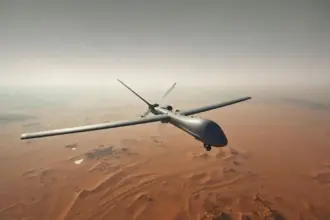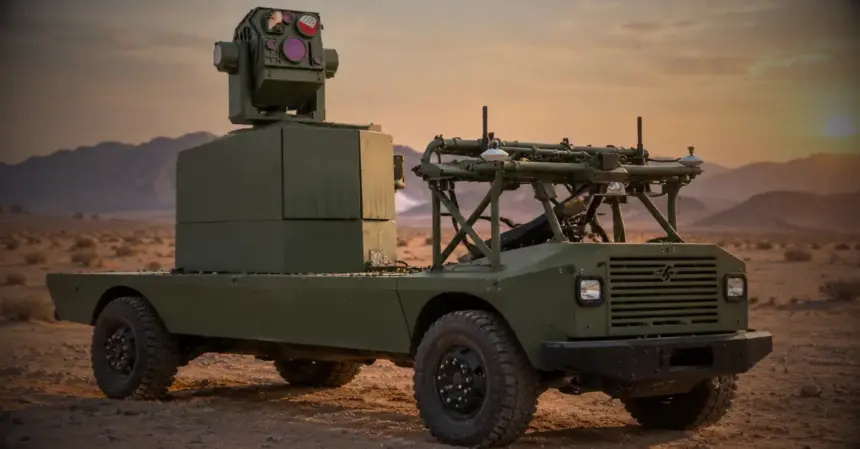
In Washington, the Association of the United States Army (AUSA) annual meeting has put forward a single idea this week, advanced by two different manufacturers. To counter cheap drones, militaries must stop answering them with missiles that cost more than the targets themselves and move to weapons powered by electricity. BAE Systems unveiled a high-power microwave weapon there. On American Rheinmetall’s booth, meanwhile, a driverless truck powers a 30-kilowatt laser.
The two announcements do not rely on the same technology, but they share the same sales pitch: an “inexhaustible magazine.” We set out to understand what that promise really covers, and what the manufacturers have not yet said.
BAE Systems’ bet on microwaves
BAE Systems is presenting a new directed-energy weapon of the high-power microwave (HPM) type. It is designed to disrupt, or even destroy, the onboard electronics of drones. The principle is radically different from that of a laser. Rather than burning through an aircraft’s structure by focusing a very narrow beam on a single point, it emits an intense electromagnetic pulse that saturates or damages the control, navigation or communication circuits.
The company says its system can keep engaging threats for as long as energy is available, without missiles or conventional ammunition. BAE speaks of an “inexhaustible magazine.” The exact range has not been disclosed for security reasons. The group says only that it is sufficient to protect fixed installations and warships.
The absence of a figure is common in the military field, but it limits independent assessment. Without range or rate of fire, it is impossible to compare this weapon with its competitors. It is equally impossible to know what type of threat it is actually sized for.
Why microwaves appeal to armed forces
The appeal of microwaves lies in their geometry. An HPM beam is generally wider than a laser beam, which in principle allows several targets to be engaged within the same emission cone. That is a strong argument against so-called “swarm” attacks, in which dozens of small aircraft converge at once. A laser, by contrast, must stay pointed at a target for a given time before it takes effect, then move on to the next one.
This characteristic is not without trade-offs, however. The effects of a microwave pulse depend heavily on the target’s electromagnetic shielding, its orientation and the distance. A hardened drone, or one whose electronics are protected, may withstand it better than a repurposed commercial model. The manufacturers have not provided data on these points, and that is precisely where the system’s credibility will be decided.
The driverless truck carrying a laser
The other notable announcement concerns a vehicle. A driverless hybrid truck built by California-based Harbinger powers a 30-kilowatt AeroVironment anti-drone laser. It is on display at American Rheinmetall’s booth, No. 2285. Harbinger CEO John Henry Harris presented it in a LinkedIn post on October 12. He describes inexpensive, mass-produced equipment with an “unlimited magazine.” The phrase refers to the fact that a laser keeps firing as long as it is supplied with electricity, unlike systems with a finite supply of ammunition.
The vehicle, called Praesidia, is a militarized version of the plug-in hybrid chassis that Harbinger originally designs for delivery trucks. It has no cab. Electrical systems allow autonomy kits to control steering, braking and acceleration. Here, the software is supplied by Forterra. The vehicle combines a large-capacity battery with a gasoline engine that acts as a generator.
Harbinger claims a range of more than 800 kilometers on a full tank and a full battery, and about 170 kilometers in all-electric mode. The vehicle can also supply up to 350 kilowatts to onboard equipment. That last figure matters more than the others. A high-power laser draws electricity continuously while firing, and the vehicle carrying it must be able to supply that power. In this type of weapon, the vehicle becomes a mobile power plant.
⚔️ Riposte anti-drones, les micro-ondes et les lasers passent à l’offensive ✈️
👉 https://t.co/hOpBx1De3DMicro-ondes et lasers, l’AUSA 2026 consacre la riposte électrique aux drones. #drone #antidrone #army #USA #AUSA #BAESystems https://t.co/KWs2hrHS9t
— Silicon Valley (@SiliconValleyMa) October 14, 2026
Key figures to keep in mind
- Laser power: 30 kW for AeroVironment’s LOCUST X3, according to Mr. Harris. No other detailed specifications have been published.
- Available power: up to 350 kW supplied to onboard equipment by the Praesidia, according to Harbinger.
- Range: more than 800 km in hybrid mode, about 170 km in all-electric mode, according to the manufacturer.
- Associated contract: 18 months, awarded in August by the U.S. Army to American Rheinmetall, for autonomous resupply vehicles (Project Sustainment).
What we know, and what we don’t
The LOCUST laser family comes from BlueHalo, a company acquired by AeroVironment in 2025. The U.S. Army has already tested prototypes mounted on Joint Light Tactical Vehicles (JLTVs), as part of a program aimed at neutralizing small drones without resorting to missiles. The idea of a vehicle-mounted laser is therefore not new. What is new is the platform, a driverless truck, and the ambition to turn it into a mass-produced item.
Two things should nevertheless be kept apart. The truck displayed at AUSA belongs to a program that is already under contract, but that contract covers logistics. It concerns resupply vehicles designed to deliver supplies to company-sized units without a driver. These vehicles will use Harbinger’s chassis, Forterra’s autonomy software and Primordial Labs’ Anura control interface. Nothing indicates that the laser-armed configuration is the subject of a contract or a trial by the U.S. Army. The companies have not said so.
Mr. Harris also did not say whether the system had been tested in the field, whether a U.S. unit was considering using it, or what it would cost. Harbinger says it is configuring the Praesidia for other uses, such as battlefield communications, troop transport, perimeter security and counter-drone missions. The company also received an investment in June from In-Q-Tel, the CIA-backed venture capital firm.
The economics behind the “inexhaustible magazine”
The manufacturers’ reasoning is first and foremost financial. Recent conflicts, in Ukraine as in the Middle East, have shown that a drone costing a few hundred or a few thousand euros can force a defender to fire a far more expensive interceptor. At that rate, the defense runs out before the attacker, both in budget and in stockpiles. Directed energy reverses the equation: the cost per shot approaches that of the electricity consumed.
The expression “inexhaustible magazine” nonetheless deserves some qualification. It is true in a narrow sense: there is no ammunition to reload. It is less true in practice. A laser or a microwave emitter depends on a generator, batteries, a cooling system and, in the case of the laser, favorable weather. Dust, rain or fog degrade the propagation of a beam. Prolonged firing heats up the components. A system’s real availability is therefore measured in hours of use, not in rounds. And even without ammunition, it remains finite.
The two technologies are also complementary rather than competing. The laser offers precision against a single target, the microwave wider coverage against several aircraft. Many experts believe armed forces will have to combine these tools with missiles, guns and jamming rather than replace them.
Promises still to be proven
These announcements are part of a broader movement in which defense manufacturers are trying to sell low-cost systems, produced in large numbers, against a threat that is becoming massified. The trade show is also a commercial showcase: concepts, prototypes and partnerships are displayed there, and some will never lead to a contract.
Several questions remain open. How reliable will these weapons be in real conditions, against drones that evolve quickly and adapt? What will a complete system cost, generator and software included? And are armed forces ready to integrate this equipment into their doctrines, which requires training, maintenance and a logistics chain? Until BAE Systems, AeroVironment and Harbinger publish verifiable test data, these promises will remain intentions rather than demonstrated capabilities.
FAQ
What is a high-power microwave weapon?
It is a system that emits an intense electromagnetic pulse to disrupt or destroy the electronics of a target, here a drone, without a projectile.
What is the range of the weapon presented by BAE Systems?
It has not been disclosed for security reasons. BAE says only that it is sufficient to protect installations and warships.
Has the U.S. Army ordered the AUSA laser truck?
No, not in this configuration, at this stage. The contracted program covers autonomous resupply vehicles, and the companies have not linked the armed version to a contract or a trial.
Can a laser or a microwave weapon really fire without limit?
Not without practical limits. There is no ammunition to reload, but electrical power, cooling and weather restrict its use.