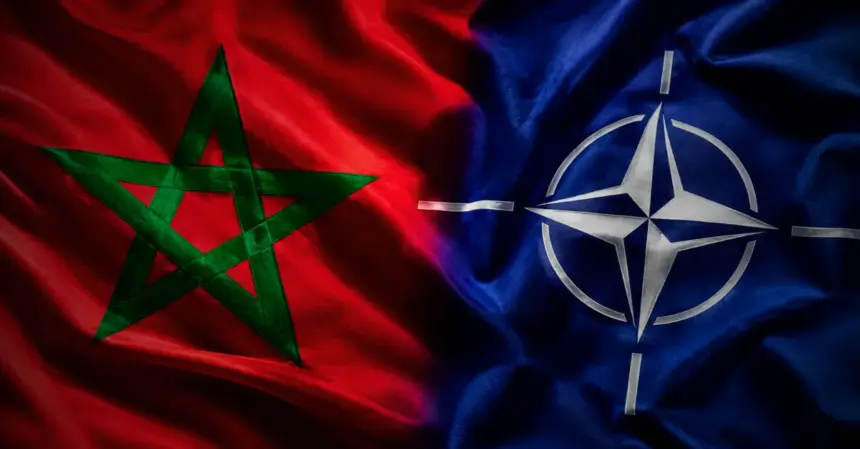
A ten-year roadmap with Washington, access to advanced tactical communication systems, multinational exercises, training programs: the Kingdom is moving forward on every front. In Washington, some voices are even raising the prospect of a deeper integration of Morocco into the Alliance’s structures. Here is what stands out to me in this file.
Three decades of trust
Morocco takes part in NATO’s Mediterranean Dialogue, launched in 1994. According to the Alliance, it was the first partner to sign an Individually Tailored Partnership Programme, which sets out the specific areas of cooperation: training, interoperability, counterterrorism and maritime security. That pioneering role has earned it a special place today.
On top of this comes its status as a major non-NATO ally of the United States, granted in 2004. Morocco is also the only African country bound to the United States by a free trade agreement. The relationship rests on a long history: in 1777, the Kingdom was the first country in the world to recognize American independence, a legacy that Democratic and Republican lawmakers honored on Capitol Hill in January 2026.
A roadmap for the decade
The turning point of the year came in Washington, from April 14 to 16, 2026. At the 14th meeting of the Moroccan-American Defense Consultative Committee, the Moroccan delegation, received at the Pentagon by Secretary of Defense Pete Hegseth, signed a military cooperation roadmap covering 2026-2036. Both sides judged the record of cooperation satisfactory and set the goal of greater operational integration between their armed forces.
American political support is also confirmed in Congress. According to the Moroccan press, the US Senate included the Kingdom in the National Defense Authorization Act for fiscal year 2027, paving the way for a strategy aimed at deepening bilateral relations over ten years. Other media outlets mention a bill seeking to make Morocco a pivot of America’s military architecture in Africa. Democrat Brad Schneider, co-chair of the Morocco Caucus, described the relationship as one of the oldest and most important of the United States.
High-level interoperability
On the ground, interoperability is making concrete progress. According to information published in mid-April, Morocco has crossed a threshold with the Link-16 tactical data network, previously reserved almost exclusively for NATO members and a handful of close allies. According to Médias24, Moroccan forces already mastered this system on their F-16s, FREMM frigates and Abrams tanks. What is new is the creation by the United States of a common communication frequency to conduct operations with a country that is not a member of the Alliance.
Multinational exercises confirm this momentum:
- African Lion 2026: held from April 20 to May 8 in Morocco, Ghana, Senegal and Tunisia, it remains the largest annual military exercise on the African continent.
- ORION 2026: led by France from February 8 to April 30, it saw Morocco deploy the frigate Mohammed VI alongside some twenty countries, including several NATO members.
- NATO final phase: from April 7 to 30, participating forces were integrated into an Alliance exercise, proof of the Royal Armed Forces’ ability to fit into its chains of command.
- Drone training: according to the press, the US Army plans to set up a training center in Morocco, with a first session during African Lion 2026.
A training platform for Africa
The project I find most promising concerns training. In 2025, Morocco joined the DEEP program (Defence Education Enhancement Programme), through which NATO helps its partners modernize their military education. According to Africa Intelligence, a session could be held in Morocco between late 2026 and early 2027, aimed mainly at African non-commissioned officers. Morocco’s ambassador to the European Union, Ahmed Réda Chami, would lead the discussions.
NATO’s 2025 annual report, presented in April by Mark Rutte, describes Morocco as a structuring partner on the southern flank and mentions a trilateral mechanism bringing together the Alliance, the Kingdom and African countries. To me, this is recognition of a role as a bridge between the Euro-Atlantic area and the African continent.
Javier Colomina’s visit to Rabat on October 6 and 7, 2026, carried this momentum further. He met officials from the Ministries of Foreign Affairs and the Interior and from the Royal Armed Forces, and attended a conference on small arms and light weapons co-organized by both sides. His conclusion was unambiguous: Morocco is a key partner in the region and cooperation can only grow stronger.
An army in full modernization
This rise in power rests on a sustained modernization effort. The 2026 Finance Bill earmarks 157.17 billion dirhams in multi-year commitments for the acquisition and repair of the Royal Armed Forces’ equipment and for support to the defense industry, up from 133 billion last year. The budget allocated to the defense administration stands at around 73 billion dirhams, including 11.5 billion for investment.
The announced priorities are border surveillance, Apache helicopters, the renewal of armored vehicles, coastal artillery and the modernization of maritime patrol vessels. The Kingdom is diversifying its industrial partners and building a local defense ecosystem, with projects in aeronautical maintenance and drone production.
Toward deeper integration
This is where the outlook becomes interesting. Morocco is not a member of NATO, and the Washington Treaty was originally intended for European states. But the Alliance’s history shows that its partnerships evolve with strategic realities, and the current rapprochement is moving at a pace few partners have experienced. In Washington, some voices now raise the prospect of a more formal integration of Morocco.
What seems certain to me is that the Kingdom has rare assets: institutional stability, a strategic Atlantic and Mediterranean coastline, an army undergoing modernization, and an Atlantic initiative championed by King Mohammed VI that links security, development and regional integration. Whatever form this rapprochement takes, Morocco is establishing itself as a first-rank partner for the Alliance and for Washington.
FAQ
Is Morocco a member of NATO?
No. It is a partner of the Alliance through the Mediterranean Dialogue and has been a major non-NATO ally of the United States since 2004.
What does the Morocco–United States roadmap provide for?
Signed in Washington in April 2026 for the period 2026-2036, it aims for greater operational integration between the two armed forces.
What is the DEEP program?
The Defence Education Enhancement Programme helps partner countries modernize their military education. Morocco joined it in 2025 and could host a session dedicated to African armies.
What role does African Lion play?
Organized every year by US Africa Command, it is the continent’s main military exercise. The 2026 edition took place from April 20 to May 8.