

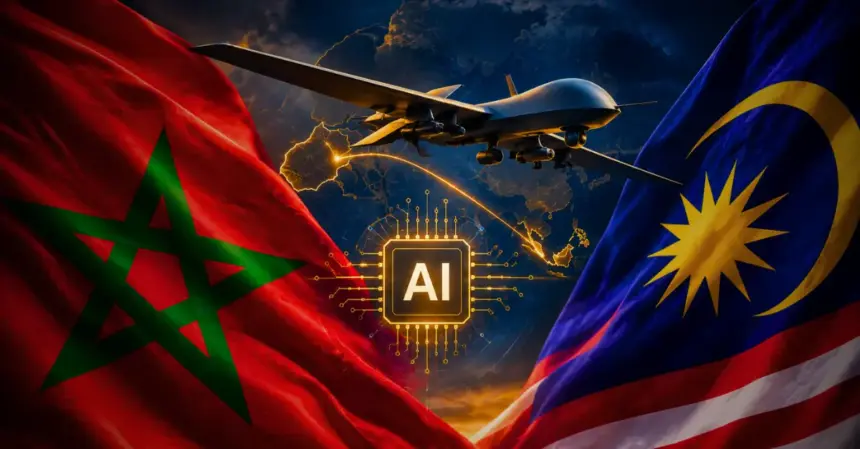
Rabat has just moved a new piece on its defense diplomacy board. In Marrakech, on the sidelines of the Marrakech Airshow, Morocco proposed that Malaysia conclude a bilateral memorandum of understanding covering military training, the exchange of expertise and strategic technologies.
Key takeaways
- Morocco has proposed a bilateral defense memorandum of understanding to Malaysia.
- The offer was made in Marrakech, on the sidelines of the Marrakech Airshow.
- It covers artificial intelligence, drones, cyberdefense and aeronautics.
- The text remains to be negotiated between the two administrations.
- Morocco is invited to the LIMA exhibition in Langkawi, from April 20 to 24, 2027.
I am following this development closely, because it says a great deal about how two middle powers, far apart geographically, are seeking to move closer around a shared goal: mastering their industrial capabilities.
An offer made in Marrakech
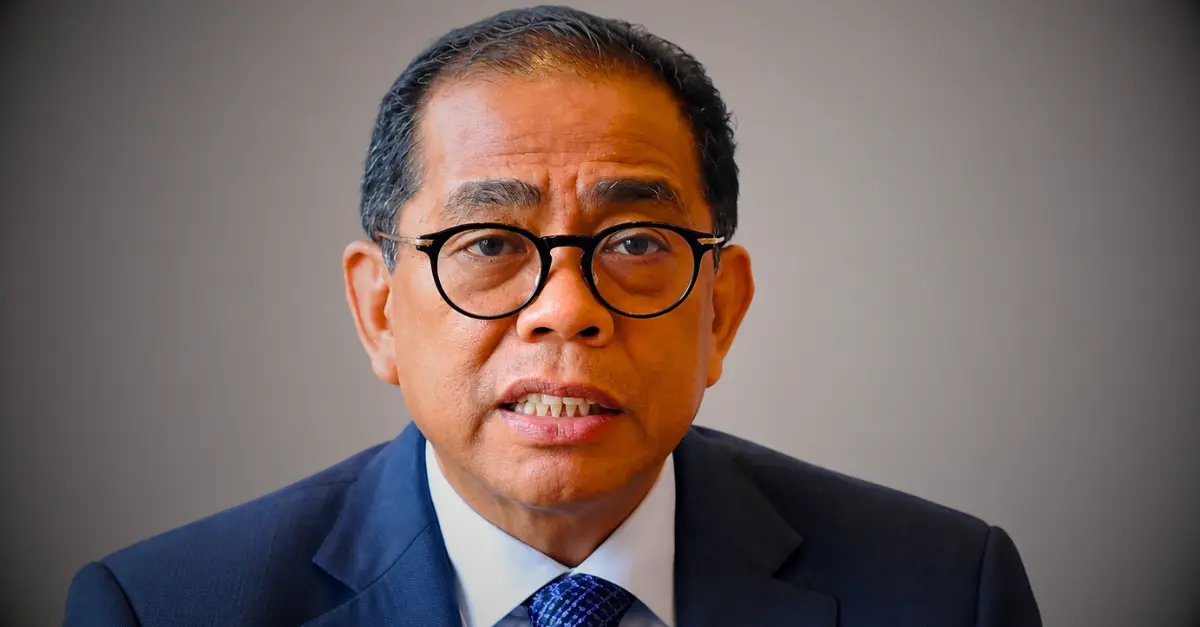
The information was made public by Malaysia’s Ministry of Defence (Mindef). According to the ministry, Abdellatif Loudiyi, Minister Delegate to the Head of Government in charge of the Administration of National Defense, made the proposal during a meeting with Mohd Yani Daud, Mindef’s Deputy Secretary-General for Policy.
Rabat wishes to formalize defense cooperation between the two countries through a memorandum of understanding. At this stage, it is an offer: the text remains to be negotiated between the two administrations, and nothing yet indicates either its final content or a signing timetable. I stress this because the distinction between a proposal and a concluded agreement is essential to gauging the real scope of the announcement.
The meeting took place at the Royal Armed Forces air base in Marrakech. It was held as part of the Marrakech Airshow, whose eighth edition brings together nearly 200 exhibitors from 27 countries and ends this Saturday, October 10. Malaysia is taking part for the first time, which gives the exchange an added symbolic dimension.
Several officials took part in the discussions:
- the Inspector General of the Royal Armed Forces, Mohammed Berrid;
- Malaysia’s ambassador to Morocco, Edi Irwan Mahmud;
- the Chief of Staff of the Malaysian Armed Forces Headquarters, Lieutenant General Muhammad Huzaimi Sabri.
Artificial intelligence, drones and cyberdefense on the agenda
The two delegations reviewed several possible areas of cooperation: automated and interconnected industrial production, artificial intelligence, drone systems, cyberdefense and aeronautics. The choice of these fields is no accident. It reflects what now drives the modernization of armed forces worldwide, where the advantage lies as much in software, data and autonomous systems as in conventional platforms such as aircraft or armored vehicles.
These themes also overlap directly with the priorities of Malaysia’s National Defence Industry Policy, known by the acronym NDIP, launched on January 21 by Prime Minister Anwar Ibrahim. To understand Kuala Lumpur’s interest, it is therefore worth taking a closer look at this policy.
What Malaysia’s industrial policy provides for
The NDIP aims to reduce Malaysia’s dependence on foreign technologies through local capabilities, and to move the national industry from simple maintenance to high-value-added manufacturing. The text sets out concrete rules:
- a local content requirement of at least 30% in every defense purchase;
- maintenance of equipment reserved for Malaysian companies once its warranty expires;
- a rollout in four phases, with global competitiveness targeted from 2030.
Malaysia’s Defence Minister, Mohamed Khaled Nordin, announced on the same day a series of national programs: a defense satellite, a laser system, passive radars, loitering munitions, simulators and land vehicle chassis. He sees them as a strategic investment in the country’s sovereignty and security. Loitering munitions, as a reminder, are weapons that circle over an area before striking a target, halfway between a drone and a missile.
For his part, Deputy Defence Minister Adly Zahari has set Malaysia the goal of becoming a regional defense industry hub by 2030, through structured technology transfers. It is precisely this word, “transfers”, that explains the appeal of a partnership with Morocco: both countries want to stop being mere customers.
Kuala Lumpur builds its drone sector
Malaysia is not content with setting out general industrial ambitions. The day after the NDIP was launched, Mohamed Khaled Nordin tasked the Science and Technology Research Institute for Defence, Stride, with drawing up a national framework for military drones.
Before Parliament, the minister justified this choice by stating that drones and emerging technologies are now among the main threats to security. That sentence neatly sums up the current mindset: the drone is both a threat to counter and a capability to develop. A country that wants to carry weight in this field must therefore equip itself with rules, standards and a coherent industrial base. Morocco, which is also building up its own capabilities, finds in Malaysia a counterpart whose concerns match its own.
A series of agreements concluded since autumn 2025
The offer made to Malaysia does not come out of nowhere. It extends a series of agreements concluded by Abdellatif Loudiyi since autumn 2025:
- on September 22, 2025 in Rabat, a memorandum of understanding with Indian Defence Minister Rajnath Singh, covering training, cybersecurity, cyberdefense, the defense industry and military health;
- comparable texts with Pakistani Defence Minister Khawaja Muhammad Asif;
- a comparable text with Liberian Minister of National Defense Geraldine Janet George, received in Rabat on October 21, 2025;
- with French Minister of the Armed Forces and Veterans Catherine Vautrin, a technical arrangement and a memorandum on the defense industry.
The Marrakech Airshow regularly serves as a setting for this diplomacy. At the 2024 edition, Mr. Loudiyi signed two military and technical cooperation agreements, one with Czech Defence Minister Jana Černochová and the other with Azerbaijani Defense Minister General Zakir Hasanov.
This list reveals a method: diversifying partners, with no geographic exclusivity or single alignment, and focusing on specific fields such as training, cyberdefense and industry. I see in it a desire to build a network of useful partnerships rather than a spectacular alliance.
A meeting already set in Langkawi
The Marrakech talks also point to a calendar. Mohd Yani Daud handed Abdellatif Loudiyi an official invitation to the Langkawi International Maritime and Aerospace Exhibition (LIMA), whose eighteenth edition will take place from April 20 to 24, 2027.
Mindef, a co-organizer of the event, will showcase artificial intelligence, autonomous systems, space and satellite technologies, electronic warfare and digital technologies there. The organizers are aiming for 400,000 visitors. The exhibition could be a natural first milestone for moving the file forward, even though no signing has been announced at this stage.
What is at stake in a Rabat-Kuala Lumpur rapprochement
For Morocco, the interest is twofold. First, widening its network of defense partners beyond its usual counterparts, toward Southeast Asia. Second, anchoring training and industrial cooperation over the long term, an axis already highlighted in previous agreements.
For Malaysia, a partnership with a country that is also developing its industrial and aeronautical capabilities can serve the logic of the NDIP: multiplying relationships capable of feeding technology transfers rather than depending on a single supplier.
Caution is nonetheless warranted on several points. A memorandum of understanding is a political and technical framework, not an arms contract: it sets out intentions and areas of work, but does not by itself commit the parties to purchases or joint programs. Nothing says, at this stage, what concrete form cooperation on artificial intelligence or drones would take, or what resources would be devoted to it. Finally, the NDIP’s own constraints, notably the local content threshold, will have to be reconciled with any bilateral industrial cooperation, which is a matter for negotiation.
What follows will therefore depend on the text the two administrations negotiate and on their timetable. One question remains on my mind: will this rapprochement remain an exchange of training and know-how, or will it lead to joint industrial projects in drones and defense digital technologies? The coming months, up to the Langkawi exhibition in April 2027, will probably provide the first answers.

FAQ
Have Morocco and Malaysia already signed a defense agreement?
No. According to Mindef, Morocco has proposed a memorandum of understanding, the text of which remains to be negotiated between the two administrations.
Which areas could the cooperation cover?
The discussions covered automated and interconnected industrial production, artificial intelligence, drone systems, cyberdefense and aeronautics, as well as military training and the exchange of expertise.
Why is Malaysia interested in these partnerships?
Its National Defence Industry Policy, launched on January 21, aims to reduce dependence on foreign technologies, develop local capabilities and become a regional hub by 2030.
When could the two countries meet again?
Morocco is invited to the LIMA exhibition in Langkawi, scheduled for April 20 to 24, 2027.