


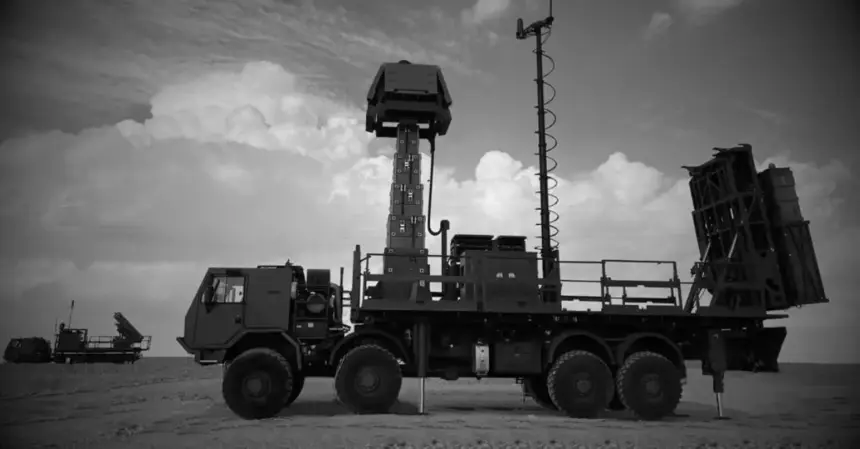
The report comes from the German journal Europäische Sicherheit & Technik (ES&T). I am relaying it with caution: no official confirmation has been made public, and for now the matter looks like an ongoing negotiation, not a signed contract.
Key takeaways
- Morocco is reportedly negotiating the purchase of Israel’s David’s Sling missile defense system, according to the German journal ES&T.
- There is no official confirmation, and no price or timeline is known.
- The system, designed by Rafael and Raytheon, targets ballistic and cruise missiles, with a stated range of 40 to 300 km.
- Morocco already operates the Israeli Barak MX and SPYDER systems.
- The price of a Stunner missile, estimated at about one million dollars, does not reflect the cost of a complete system.
What the sources report
According to ES&T, the discussions concern integrating this Israeli system into the arsenal of the Royal Armed Forces. It would strengthen the protection of the Kingdom’s airspace, amid ever-closer military cooperation with Israel.
The exact scope of the talks remains unclear. No sum is mentioned, the number of batteries is not specified and no delivery date is given. It would therefore be rash to conclude that a decision has been made. I stick to what the sources establish: advanced talks, the outcome of which remains uncertain.
An air defense fleet already largely of Israeli origin
If this lead were confirmed, it would extend a well-established industrial relationship. Morocco has already turned to Israeli defense groups for several pieces of equipment. ES&T cites two, which provide air defense at different ranges:
- Barak MX, produced by Israel Aerospace Industries, a state-owned aerospace and defense group;
- SPYDER, manufactured by Rafael Advanced Defense Systems, a state-owned arms company.
These two systems protect against short- and intermediate-range threats. David’s Sling would add an upper layer aimed at ballistic threats. In my view, this is the decisive element of the story: it would not be a matter of expanding an existing setup, but of moving it across a capability threshold.
David’s Sling, a shield designed for long-range threats
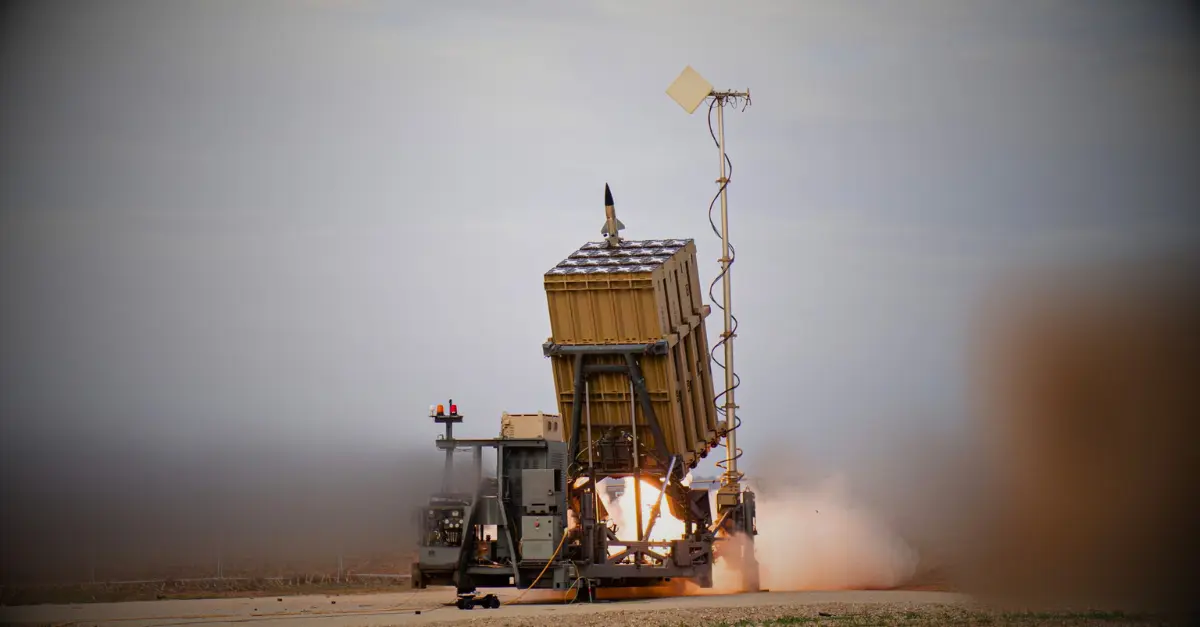
This medium-range missile defense system is the result of a collaboration between Rafael and the American company Raytheon, a subsidiary of the RTX group. It has been operational in Israel since 2017. A battery combines vertical launchers, an ELM-2084 fire-control radar, a command center and Stunner-type interceptors.
According to the German journal, these interceptors cover a range of 40 to 300 kilometers. This allows them to handle a variety of targets, from cruise missiles to ballistic projectiles. ES&T notes, however, that these figures describe the system in general terms. They do not indicate the configuration that would be delivered to Morocco, which may differ.
The Stunner, a missile that destroys by impact
The Stunner interceptor measures 4.6 meters and operates in two stages. Its solid-fuel motor, which fires in several pulses, provides the initial thrust and then allows it to correct its course in flight. ES&T credits it with a speed that could reach 7.5 times the speed of sound, and a maximum operating altitude of around fifteen kilometers.
It does not rely on a conventional explosive charge. It destroys its target by direct collision: the energy of the impact, made possible by its speed and guidance accuracy, neutralizes the threat. To achieve this, it combines a radar seeker with optical and infrared sensors, and also receives information from the ground radar. Put simply, the radar sends it in the right direction, then its own sensors refine the aim in the final moments.
A price that must be interpreted with caution
ES&T estimates the production cost of a single Stunner at about one million dollars, or nearly 9.25 million dirhams. This figure covers only the missile, and it rests on industrial assumptions. It in no way represents the bill for an acquisition.
A complete battery also requires launchers, radars, command posts, spare missiles, as well as training and long-term technical support. In Morocco’s case, the precise content of the order would therefore weigh heavily on the final amount. Limiting oneself to the price of the missile would underestimate the real financial effort, a shortcut often seen in this type of story.
A cooperation that has grown since 2020
Military ties between the two countries have developed since the restoration of their diplomatic relations in December 2020, in the wake of the Abraham Accords. They cover air defense, artillery, drones and surveillance tools.
ES&T lists among Morocco’s purchases the PULS rocket launchers and ATMOS self-propelled howitzers, both made by Elbit Systems. The journal also mentions plans for local production of drone-related technologies. I note this point with interest, because it suggests an objective that goes beyond equipment: acquiring skills and establishing industrial activity on Moroccan soil. It remains to be seen whether these projects will materialize and on what scale.
Integrating a system, an operation more complex than a delivery
Installing a missile shield is not simply a matter of placing launchers in the field. It must communicate with the radars and command centers already in place, otherwise its operational value remains limited. This technical stage, less spectacular than a contract signing, is often what determines whether an acquisition succeeds.
The American dimension of David’s Sling should also be recalled. Washington is involved through Raytheon, which took part in manufacturing several components. Depending on the parts concerned, an agreement might therefore not concern only Rabat and Tel Aviv. I have no information on the procedures that would apply here, and I prefer to assume nothing.
International precedents that serve as benchmarks
The system has already appealed to other states. Finland signed a contract in November 2023 to strengthen its medium- and long-range defense. More recently, on August 31, 2026, Israel and Greece concluded an agreement worth about three billion euros for a multilayer air defense system that includes David’s Sling, SPYDER and Barak MX.
This amount obviously does not correspond to David’s Sling alone. It covers several types of equipment, along with their detection and command installations. These examples show that the system finds buyers beyond Israel, often paired with other solutions, which echoes the layering logic described for Morocco.
What this would mean for the Kingdom
Militarily, an anti-ballistic capability would reduce the territory’s exposure to threats that short-range systems cannot counter. For a country engaged in modernizing its forces and diversifying its partners, it would be a marker of ambition.
Interpretations differ, however. Some analysts see an evolution consistent with earlier purchases and with the 2020 rapprochement. Others point out that closer military ties with Israel remain a sensitive subject in public opinion, and that they unfold in a tense regional environment where arms rivalries are closely watched. These two views are not mutually exclusive: a decision can be strategically logical and politically delicate.
A decision yet to be written
If the discussions succeed, Morocco would add to its defenses a rare building block in the region, capable of facing threats that its current systems do not handle. But between an intention reported by the press and an operational contract, there is often a long road of budgetary, technical and diplomatic trade-offs. It is these trade-offs, more than the announcement itself, that will need to be followed in the coming months.
FAQ
What is David’s Sling?
It is an Israeli-American medium-range missile defense system, designed by Rafael and Raytheon, that targets ballistic and cruise missiles.
Has Morocco signed a contract?
No, nothing indicates so at this stage. The sources mention advanced discussions, with no official confirmation or financial details.
What is the system’s stated range?
According to ES&T, interception is possible from 40 to 300 kilometers, for a general configuration that may differ from the one offered to Rabat.
How much does a Stunner missile cost?
The German journal estimates it at about one million dollars per unit, excluding launchers, radars, command systems and support.