
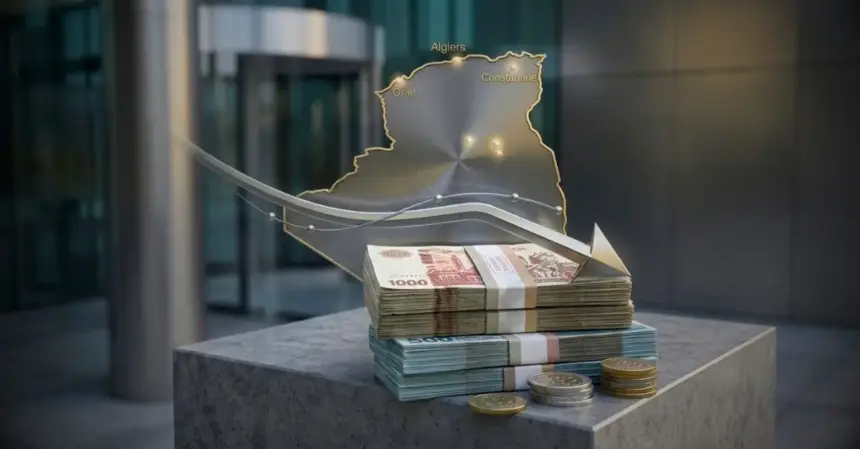
I think it mostly serves to divert attention. While it is being waved around, another debt is growing in dinars, out of sight, inside public banks and the central bank. According to the IMF, it stands at 52.1% of GDP and could climb to 71.2% by 2029. Taken together with the deficit, inflation, falling reserves, youth unemployment and the exodus of those who attempt the crossing, these signals form a picture I find worrying.
Key takeaways
- Algeria has almost no external debt, but its public debt stands at 52.1% of GDP.
- The IMF expects it to reach 71.2% of GDP in 2029.
- The state finances itself through public banks and the Bank of Algeria, by creating money.
- Inflation, falling foreign exchange reserves and high youth unemployment add to the concern.
- Solutions exist, but their political cost holds back their implementation.
A state living beyond its means
The underlying mechanism is not mysterious: the state spends more than it earns. Civil service salaries, subsidies (bread, milk, fuel, electricity, water), housing, pensions, health, defence, major construction projects: the bill is immense. Revenues, for their part, depend on hydrocarbons and therefore on global prices. Since the oil shock of 2014, they no longer suffice.
To be fair, this deficit does not date from the current presidency. But it is becoming entrenched, and it would reach about 10.5% of GDP in 2025. When more than a tenth of annual wealth must be financed by something other than ordinary revenue, the question is no longer technical. It is vital.
Who pays the bill
States that borrow usually do so on the markets, where creditors examine their accounts. Algeria has taken the opposite route, and that is precisely what worries me: nobody is looking closely. Three channels provide the financing.
Public banks
BEA, BNA, CPA and BADR buy Treasury bills. These banks belong to the state, which is therefore lending to itself. Several economists consider the repayment schedule hard to read, which makes this debt difficult for an outside observer to track.
The printing press
The Bank of Algeria creates money for the Treasury. Around 6,500 billion dinars were created this way between 2017 and 2019. According to unofficial estimates, the practice is active again: 3.7% of GDP in 2025, perhaps 5.5% in 2026. If these orders of magnitude are confirmed, this is a mechanism economists rank among the riskiest, because the money created corresponds to no new production.
An empty piggy bank
The Revenue Regulation Fund, fed by oil surpluses, was exhausted around 2017. The country has lost its cushion.
The figures that raise alarm
- Public debt: 52.1% of GDP, 71.2% expected in 2029 (IMF).
- Budget deficit: about 10.5% of GDP in 2025.
- Money creation: 3.7% of GDP in 2025, possibly 5.5% in 2026 (estimates).
- Inflation: from -2.0% in September 2025 to 5.2% in April 2026.
- Foreign exchange reserves: from $68.9 billion to $51 billion in one year.
- Unemployment among 15 to 24 year olds: nearly 30% according to international estimates.
Why “52%” is not reassuring
The official argument is familiar: France is around 115% and Italy above 135%. It is accurate, and I do not dismiss it. But the comparison is misleading, because France and Italy borrow at market rates, with diversified economies and robust tax revenues. Algeria depends on a rent and finances part of its debt by creating money.
The level matters less than the speed. Going from 52.1% to 71.2% in a few years, with a double-digit deficit, is a trajectory that is accelerating. And the way it is financed makes all the difference. Debt placed with savers is not monetised debt.
Four breaches
Inflation, a tax that does not say its name. When the money supply grows faster than output, prices rise. Low-income households, for whom food weighs heavily in the budget, pay first. Inflation went from -2.0% in September 2025 to 5.2% in April 2026. It is not explained by money creation alone, but it belongs to the same movement, and the reversal is sharp.
A private sector starved of air. Every dinar lent to the state is a dinar that does not finance a business. Creating money to build productive infrastructure can be defended. The problem arises when those funds mostly cover current spending, with no expected return. Less credit means fewer factories and fewer jobs, in a country where the scarcity of jobs already shows in youth unemployment.
Banks under strain. Heavily exposed to government securities, they depend on the state’s ability to honour its commitments, and so does Algerians’ savings. The liquidity tensions reported in recent years and the supporting documents required for some cash withdrawals are read by several analysts as a warning sign. The authorities see measures against money laundering and tax evasion. Both readings coexist, but public distrust is a fact.
Melting reserves. When the currency loses value, households turn to foreign currencies and gold, which widens the gap with the parallel market. The dinars created also feed imports paid for in foreign currency. Reserves would have fallen from $68.9 billion to $51 billion in one year. This erosion is the point I would watch first.
A youth that no longer believes in the country
These budget balances are not abstract. They can be read in the life of a generation. Nearly 30% of young people in the labour force are reportedly jobless according to international estimates, and that rate says a great deal about a labour market that no longer absorbs its graduates.
Many leave. According to Frontex data, Algerians are among the most numerous nationalities attempting irregular crossings to Europe, particularly on the Western Mediterranean route. I do not claim this migration is explained by the economy alone: the search for opportunity, family networks and geographic proximity all play a role. But when young people risk their lives at sea rather than wait for a job, it is a social verdict that debt figures do not express.
Selon l’agence Frontex, le nombre d’arrivées irrégulières vers l’Union européenne est en baisse sur toutes les routes migratoires depuis les côtes africaines… sauf au départ de l’Algérie. pic.twitter.com/roa44rPG6h
— TV5MONDE Info (@TV5MONDEINFO) October 2, 2026
The scenario economists fear
The sequence is well known: deficit, debt, money creation, inflation and imports, then erosion of reserves. Algeria still holds about eight months of import cover, which gives it time. I want to state that it is not on the brink. But that time is being used up, and the cushion that once absorbed shocks is gone.
If the margin ran out, the options would narrow to a sharp devaluation of the dinar or outside support, the IMF included, which the country has avoided for nearly thirty years. This is a scenario, not a forecast. A rebound in hydrocarbon prices could push back the deadline, but it would not solve the underlying problem.
Known remedies, rare courage
The options have been identified for a long time: tax the informal economy better, reserve subsidies for the poorest, spend more efficiently, and finance the state through savings rather than the printing press.
Each is politically costly. Reforming subsidies hits purchasing power, and taxing the informal sector requires an effective administration. In my view, the difficulty lies less in the diagnosis than in the absence of a decision. Each year of delay raises the bill.
A question that can no longer wait
Domestic debt does not pose a default risk in the classic sense, since the state borrows in its own currency. But its effects run through inflation, credit, savings and reserves, and they are already visible in daily life. Responsibility for it is old and shared among several governments.
The real question is not whether the model will hold for a few more years, but who will pay for it and when. An early reform will be painful. A forced one will be more so.
FAQ
Is Algeria really free of external debt?
It has practically none. Its debt is essentially in dinars and held domestically.
Why does domestic debt cause concern despite a moderate level?
Because it is rising fast alongside a high deficit, and part of it is financed by money creation, which fuels inflation.
What does “printing press” mean?
It means financing the state through the central bank, which creates money without equivalent production behind it.
Is Algeria facing an imminent crisis?
Nothing in the data cited points to it. Reserves still cover about eight months of imports, but the trend is downward.